



























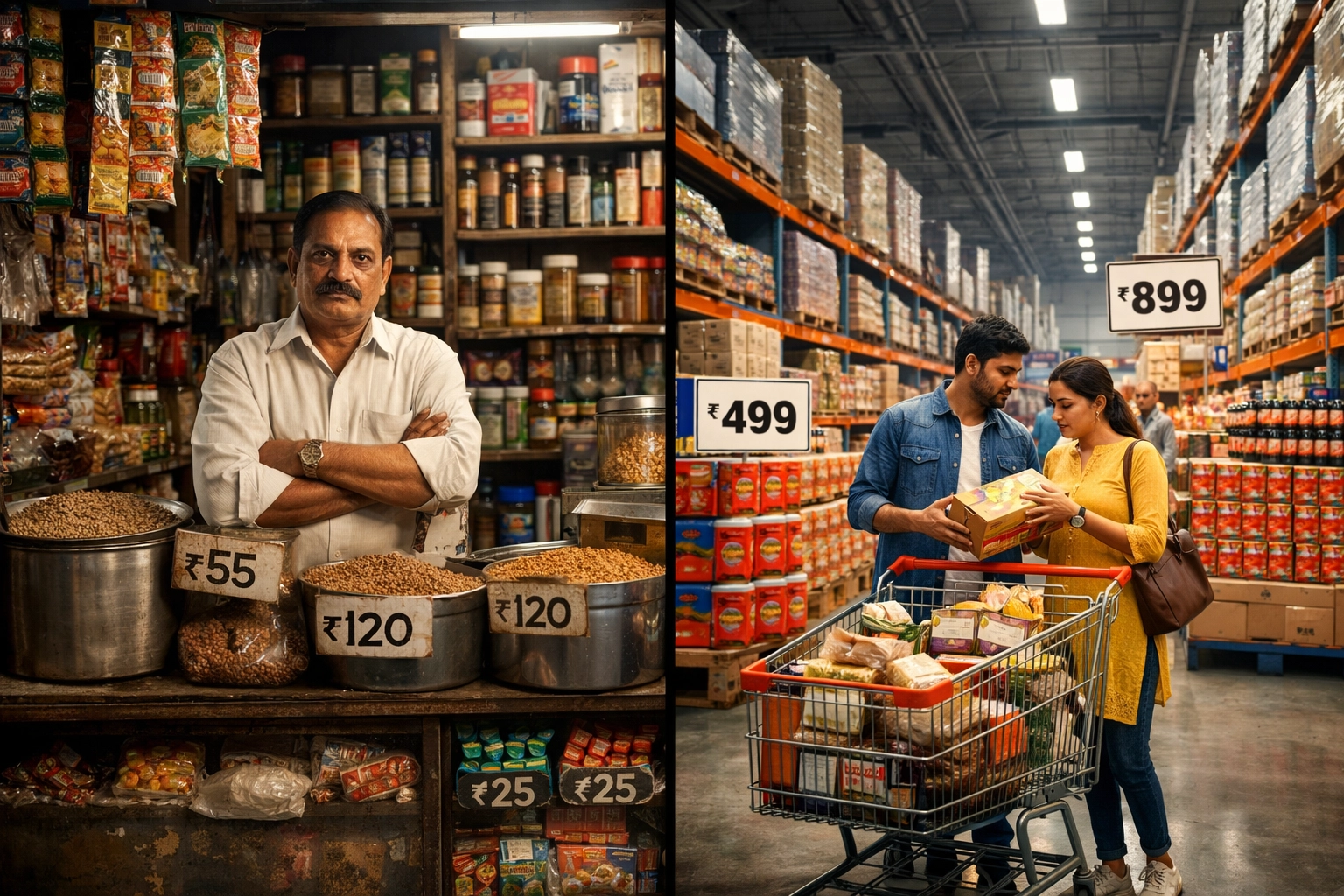

Startup news india is increasingly being shaped by a quieter but far more consequential battle: the pricing war between independent retailers and warehouse-scale supermarket chains. At the center of this debate is Alap Vora, whose experience has come to symbolize how modern bulk-pricing structures can reward scale while punishing entrepreneurial grit. His struggle is not merely a personal business challenge; it reflects a structural imbalance in how supply chains, discounting logic, and consumer expectations are evolving across the retail economy.
For many observers tracking indian business updates, Vora’s story offers a precise case study in market concentration. Small grocery operators often enter the market with localized trust, curated inventory, and neighborhood familiarity. Yet they are forced to compete against giant formats such as Costco-style warehouse retailers and other large chains that can negotiate lower procurement costs, spread logistics over massive volumes, and use headline discounts as a catalyst for change in customer behavior. The result is a marketplace where the "everyday low price" model becomes difficult for independent stores to match without sacrificing margin, cash flow, or long-term viability.
1. Why Startup News India Is Watching the Retail Pricing Battle
The current retail environment demonstrates that price is no longer just a consumer incentive; it has become a strategic weapon. Alap Vora’s challenge illustrates how smaller operators can be revitalized by innovation, yet simultaneously squeezed by structural disadvantages built into procurement systems. Large chains derive exponential growth from scale, data-driven insights, and supply contracts that serve a legitimate purpose within competition law, but the downstream effect is often severe for small businesses.
According to reporting and analysis from global retail trackers such as Reuters and market data frequently cited by Bloomberg, bulk retailers thrive because they can price select categories aggressively, even when margins are compressed, knowing profitability can be recovered elsewhere through volume, memberships, or ancillary sales. That model is difficult for an independent grocer to replicate. At Business Tantra, this trend aligns with broader coverage on how Indian enterprises are navigating consolidation, cost pressure, and competitive disruption across sectors.
Vora’s situation has therefore resonated beyond one store or one city. It has become part of the broader startup news india conversation because it shows what happens when entrepreneurship meets an uneven pricing architecture. The mission of a small retailer may be service, trust, and community access, but the value proposition must now survive in a market increasingly defined by warehouse economics.

Alt text: startup news india
2. The Pricing Structures That Hurt Small Businesses
The central issue is not simply that big-box chains are bigger. It is that their pricing structures are designed to democratize purchasing power for consumers while concentrating pressure on smaller competitors. In practical terms, independent retailers face at least four major disadvantages:
- Procurement Asymmetry: Big-box chains buy in bulk and negotiate lower unit costs directly from manufacturers or primary distributors.
- Logistics Efficiency: Large retailers optimize warehousing, transport routes, and electronic communications network systems to reduce per-unit delivery expense.
- Promotional Flexibility: They can discount staple products deeply as traffic drivers while recovering profitability through private labels or premium inventory.
- Working Capital Strength: Stronger balance sheets allow major chains to absorb short-term pricing pain that would destabilize a small operator.
For entrepreneurs like Alap Vora, this creates a harsh operating reality. A neighborhood store may provide superior convenience and stronger local relationships, but those advantages can erode when customers see visible price gaps on everyday essentials. This is where indian business updates intersect with public policy and competition concerns. The question is not whether large chains are efficient; they clearly are. The question is whether the ecosystem offers enough room for smaller businesses to remain commercially viable.
For readers following Business Tantra’s latest stories, this pattern mirrors a wider theme across the economy: scale-based business models are reshaping traditional sectors faster than many local operators can adapt.
3. Alap Vora’s Struggle as a Symbol of Market Transition
What makes Vora’s story especially compelling is that it captures the transition from abstract industry trends to concrete entrepreneurial stress. On paper, modern retail expansion looks like progress: more consumer choice, better inventory systems, and lower prices. In practice, however, that same progress can become a destabilizing force for independent stores that cannot secure equivalent supplier terms.
This is why startup news india must treat the supermarket pricing war as more than an isolated anecdote. It is a signal that the small-business economy needs sharper operational tools, better access to collective procurement, and more sophisticated digital strategy. If independent grocers are to remain relevant, they may need to specialize in hyperlocal delivery, premium curation, subscription models, or customer loyalty ecosystems rather than competing solely on shelf price.
There is also a legalistic dimension to this debate. Competition itself is legitimate and essential, but persistent procurement inequality raises questions about fair access, contract power, and the practical limits of open-market participation. Analysts following Moneycontrol and wider retail coverage have increasingly highlighted how margin compression is forcing smaller operators to rethink inventory planning, payment cycles, and vendor relationships.
4. What Indian Business Updates Suggest Comes Next
The next phase of this story is likely to be defined by adaptation rather than nostalgia. Small retailers cannot out-Costco Costco. But they can differentiate, collaborate, and modernize. Alap Vora’s challenge may ultimately become a catalyst for change if it pushes more founders and local businesses to pursue cooperative sourcing, digital ordering layers, and customer retention models built on trust and convenience.
For those following indian business updates, the takeaway is clear: the future of retail will not be decided by price alone, but by who can combine operational efficiency with customer intimacy. That is where small businesses still have an opening. They understand local demand in ways large chains often do not. They can respond faster to neighborhood preferences, tailor product mix more precisely, and deliver a more human retail experience.
Readers looking for more context on evolving business models can also explore our About Us page to understand how Business Tantra tracks transformational shifts across India’s commercial landscape.
Conclusion
In conclusion, startup news india is increasingly defined by competitive pressure at the ground level, and Alap Vora’s struggle against big-box pricing power captures that reality with unusual clarity. The David vs Goliath supermarket pricing war is not just about one entrepreneur versus one class of retailer. It is about whether small businesses can remain relevant in an economy being reshaped by scale, discounting power, and supply-chain leverage.
The central thesis is definitive: large-format retail may deliver consumer value, but unless smaller businesses are revitalized through smarter strategy, cooperative models, and technology-led adaptation, the market risks losing the diversity and resilience that independent operators provide. For founders, investors, and policymakers tracking indian business updates, this is not a side story. It is one of the most important business shifts unfolding in real time.