
























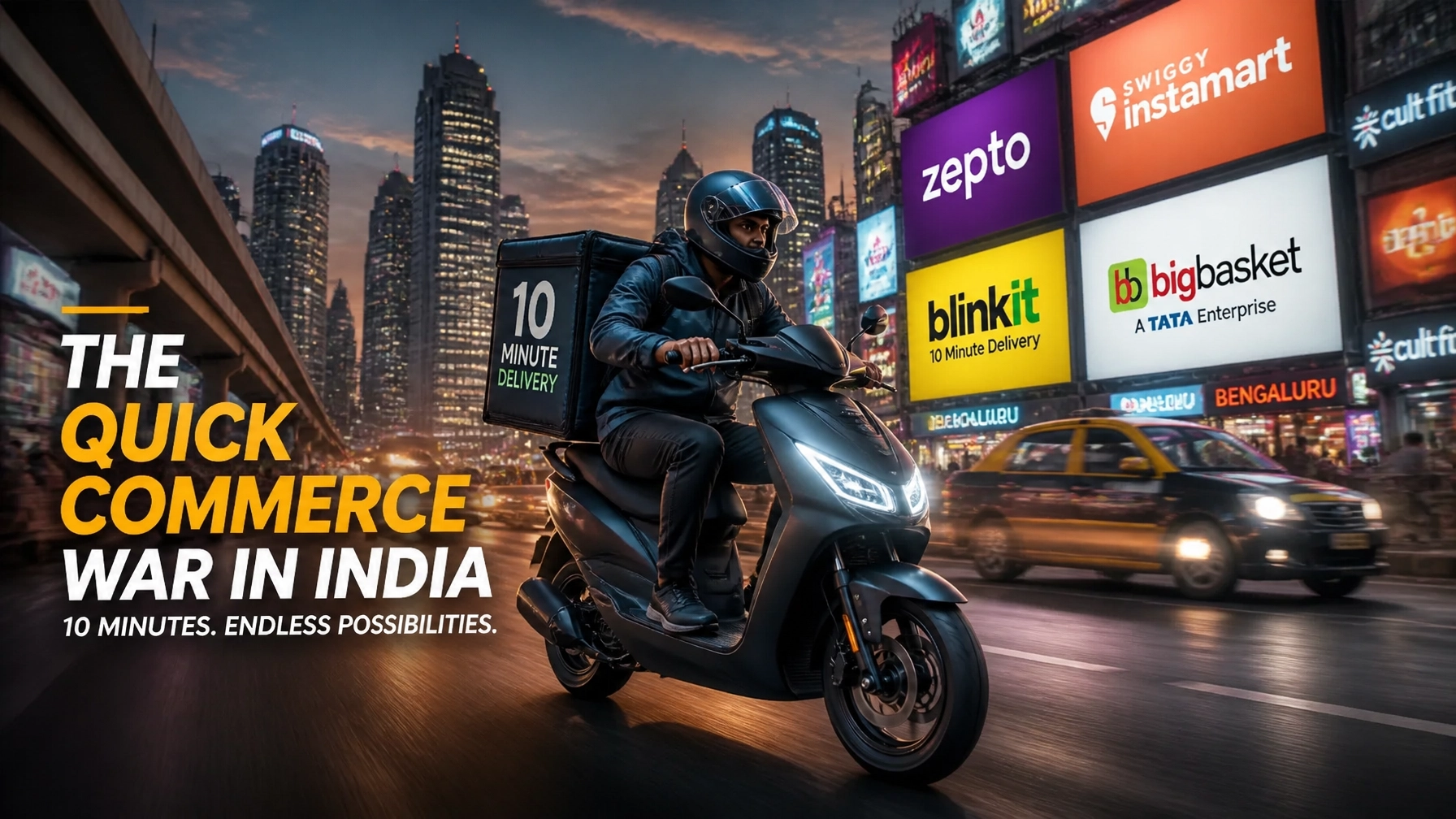

The retail landscape in India is undergoing a seismic shift that transcends the mere convenience of grocery delivery. What began as a bold experiment in "10-minute delivery" has evolved into a sophisticated geopolitical battle for consumer psychology. This is no longer just a "grocery war"; it is a strategic maneuver to control the daily habits of the modern Indian consumer. As we witness the exponential growth of quick commerce india, the industry is pivoting from selling mere speed to selling a fundamental change in lifestyle.
1. The Titan Clash: Who Controls the Doorstep?
The competitive intensity of the Indian quick commerce sector is currently at an all-time high. The market is defined by a handful of well-capitalized incumbents and aggressive new entrants, each vying for a dominant share of the urban wallet.
- Blinkit: Currently the market leader, Blinkit operates in approximately 200 cities with a massive network of over 2,000 dark stores. Its strategy has transitioned from hyper-growth to category expansion, now including electronics, home appliances, and premium gifting.
- Swiggy Instamart: Leveraging its deep integration with Swiggy’s food delivery ecosystem, Instamart maintains a strong presence across 131 cities. Its primary "value proposition" lies in cross-selling to a pre-existing, high-frequency user base.
- Zepto: As the specialized challenger, Zepto has revitalized the sector with its execution-first approach. By focusing on high-density urban clusters, it has demonstrated that operational discipline can be a "catalyst for change" in unit economics.
- Flipkart Minutes: The newest heavyweight entrant, Flipkart Minutes is leveraging Walmart’s supply chain muscle to disrupt the status quo, rapidly expanding its dark store footprint to capture the value-conscious segment.

2. Why India is the Global Quick Commerce Hub
India has emerged as the ultimate laboratory for quick commerce models, far outperforming Western counterparts in adoption and scalability. This phenomenon is not accidental; it is the result of several converging socio-economic factors.
First, the urban density of Indian metros provides the necessary order density required for the "dark store" model to even approach break-even. Unlike the sprawling suburbs of North America, the vertical growth of Indian cities allows a single hub to serve thousands of households within a 2-kilometer radius.
Second, the UPI ecosystem has democratized instant payments, removing the friction from digital transactions. When coupled with cheap data and widespread smartphone adoption, the barrier to entry for a new user is virtually non-existent. These elements have acted as a foundation for the current start-up flood in India, positioning the nation as a global leader in retail tech innovation.
3. The Psychology of Instant Gratification
The true genius of the quick commerce model is its ability to foster consumer dependency. When a consumer realizes that a forgotten ingredient or a late-night craving can be fulfilled in under ten minutes, their internal benchmark for "convenience" is permanently altered. Waiting for a next-day delivery: once considered fast: now feels like an archaic inconvenience.
This shift in psychology is the ultimate goal. By integrating themselves into the daily routine of the consumer, these platforms are no longer just service providers; they are essential utilities. The focus has shifted toward:
- Habit Formation: Moving from emergency purchases to planned weekly restocks.
- Time-Saving Lifestyle: Framing the service as a tool for "buying back time" for busy professionals.
- Instant Gratification: Catering to the "I want it now" mentality of Gen Z and Millennial cohorts.

4. The Profitability Paradox: Can They Survive the Burn?
Despite the staggering GMV (Gross Merchandise Value) growth, the industry faces significant headwinds regarding unit economics. The rapid expansion war necessitates massive operational costs, including real estate for dark stores, delivery personnel incentives, and aggressive marketing spends to acquire "price-elastic" customers.
The industry is currently grappling with a "legitimate purpose" for sustained burn: market share acquisition. However, as investors pivot their focus toward why business management for startups is essential for growth, the pressure to show a clear path to profitability is mounting.
High-frequency, low-ticket orders often result in negative contribution margins when delivery fees are waived to stay competitive. To combat this, platforms are diversifying into higher-margin categories like beauty, personal care, and electronics. This "data-driven insight" allows them to increase the average order value (AOV) while maintaining the same fixed cost of delivery.

5. Scaling Smart: The Next Phase of Evolution
The era of "growth at any cost" is being replaced by a more nuanced strategy: scaling smart. As the market matures, the winners will be those who can optimize their electronic communications network for better routing, reduce inventory wastage through AI, and negotiate superior credit terms with brands.
We are seeing a strategic shift toward:
- Inventory Optimization: Utilizing predictive analytics to stock dark stores based on micro-local demand.
- Private Labels: Launching in-house brands to capture a larger share of the margin.
- Ad-Tech Monetization: Transforming the app into a digital billboard for FMCG brands to reach high-intent shoppers.
This transition mirrors the journey of many Indian startups that have found success by reinventing themselves during periods of market volatility.

6. The Road Ahead: A Permanent Retail Shift
Is the current state of quick commerce india sustainable? While the "irrational competitive intensity" may eventually lead to industry consolidation, the consumer habit is here to stay. We are likely moving toward an oligopoly where two or three dominant players control the vast majority of the "instant delivery" market.
The entry of players like Amazon and Flipkart suggests that quick commerce is no longer a niche segment; it is the future of general e-commerce. The "value proposition" has been proven. Now, the challenge lies in operational excellence and reaching a stage of self-sustaining cash flow.

Conclusion
India's quick commerce war is a fascinating case study in how technology can fundamentally rewire human behavior. It has moved beyond the delivery of milk and eggs to become a high-stakes battle for the digital doorstep. While the operational hurdles are significant and the burn rate is high, the "exponential growth" of the sector underscores a permanent transformation in the Indian retail landscape.
The platforms that will emerge victorious are not necessarily the ones that deliver the fastest today, but the ones that scale the smartest tomorrow: balancing the relentless pursuit of growth with the disciplined pursuit of profitability. As the lines between grocery, electronics, and daily essentials blur, one thing remains certain: the Indian consumer’s expectations have been irrevocably elevated.