



























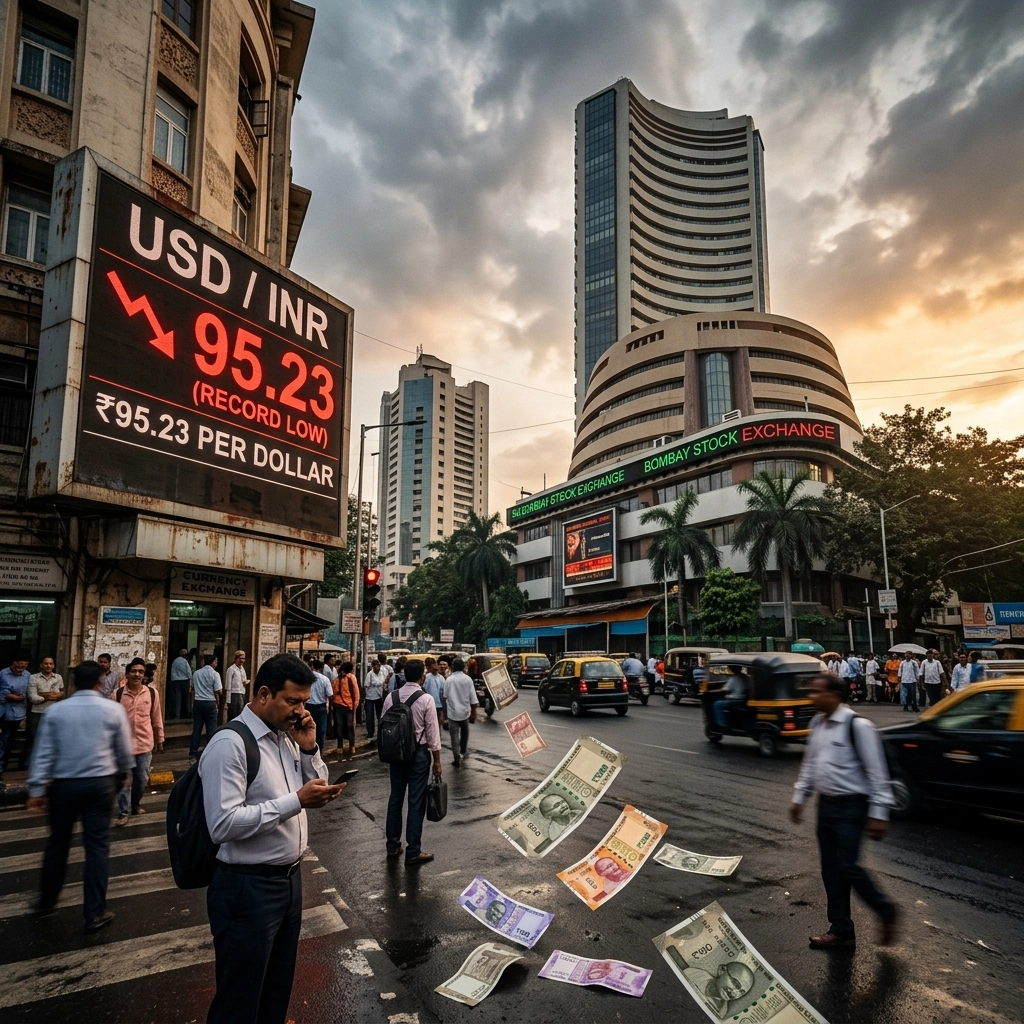
The Rupee Breaches 95: Why the Indian Rupee hit a Record Low of 95.23 Against the Dollar

The headlines on March 30, 2026, sent a collective shiver through the Indian financial markets. For the first time in history, the Indian currency crossed a psychological and economic threshold that many hoped we would never see. With the rupee at 95, specifically touching a record low of 95.23 against the US dollar, the narrative surrounding the Indian economy has shifted from steady growth to high-alert management.
At Business Tantra, we’ve been tracking the currency fluctuations closely, but this move is a "catalyst for change" in how we view our external trade dependencies. While a depreciating rupee isn’t always a sign of a failing economy: often being a byproduct of global macro-dynamics: the speed and scale of this drop are significant.
In this deep dive, we’ll explore the perfect storm of rising oil prices, geopolitical instability, and the relentless strength of the Greenback that pushed the rupee to this historic nadir.
1. The Perfect Storm: Why 95.23 and Why Now?
The journey to 95.23 wasn’t a slow crawl; it was a volatile plunge. Just a few days prior, the market was showing signs of relative stability. However, as of Monday, the intra-day reality hit hard. The rupee opened at 93.62, showing a brief moment of resilience thanks to preemptive RBI intervention. But the optimism was short-lived.
By the afternoon, the currency had plummeted 160 paise from its opening level. To understand why the rupee at 95 became a reality, we have to look at the three-headed monster of current global economics: oil, interest rates, and war.
The Crude Reality of Brent Prices
India imports nearly 85% of its crude oil requirements. When global oil prices spike, our demand for dollars to pay for that oil skyrockets. On the day the rupee hit its record low, Brent crude surged by 2.60%, trading at a staggering $115.50 per barrel.
Supply chain disruptions fueled by heightened geopolitical tensions have made energy security an expensive mission. Every dollar increase in oil prices adds billions to India’s import bill, directly widening the Current Account Deficit (CAD) and putting immense pressure on the domestic currency.

2. The Mighty Dollar Index and "Safe-Haven" Demand
While the internal dynamics of the Indian economy are robust, the rupee is often a passenger on the global stage. Currently, the US Dollar Index: which measures the dollar against a basket of six major currencies: is holding firm above the 100 mark.
In times of global uncertainty, investors flee "riskier" emerging market assets and park their capital in the US dollar, considered the world’s ultimate safe-haven. This "risk-off" sentiment has led to massive capital outflows from the Indian equity and debt markets. When foreign institutional investors (FIIs) sell Indian stocks, they exchange their rupees for dollars, further devaluing our local currency.
3. RBI Intervention: A Brave Battle Against the Tide
The Reserve Bank of India (RBI) hasn't been a silent spectator. In an attempt to curb excessive volatility, the central bank reduced the overnight net open position limit for banks to $100 million. This was a strategic move to prevent speculative trading that could further sink the currency.
Initially, this RBI intervention seemed to work, with the rupee gaining 128 paise in early trade. However, the sheer force of global outflows and the rising oil bill overwhelmed the central bank's defenses.
At Business Tantra, we believe that while the RBI has a "legitimate purpose" in managing volatility, they cannot fight the fundamental global shift indefinitely. The focus now is on ensuring that the slide is orderly, rather than a freefall, to prevent panic in the domestic markets. If you want to keep up with how these policy shifts affect your business, you can follow our latest updates on the Business Tantra Blog.

4. How the Rupee at 95 Affects Your Pocket
A record low of 95.23 isn't just a number on a trading screen; it has real-world consequences for every Indian citizen and business owner.
- Inflationary Pressure: As the rupee weakens, imports become more expensive. Since we import everything from electronic components to edible oils, the "landed cost" of these goods increases. This leads to imported inflation, hitting the common man’s monthly budget.
- Education and Travel: For students heading to universities in the US or Europe, and for families planning international vacations, the cost has effectively jumped by nearly 10% in just a few months.
- The IT Silver Lining: It’s not all bad news. The IT and export sectors, which earn in dollars, see a "revitalized" bottom line when they convert those dollars back into rupees. However, even this benefit is often offset by the rising costs of global operations and the general economic slowdown in the West.
5. Geopolitical Tensions: The Unpredictable Variable
The elephant in the room remains the ongoing geopolitical friction. Whether it's the escalating tensions in Eastern Europe or the supply chain bottlenecks in the South China Sea, the world is in a state of flux.
These tensions don't just affect oil; they impact the "electronic communications network" of global trade. Investors are hesitant, and emerging markets like India are often the first to feel the heat of a "data-driven insights" driven sell-off. The Indian economy is fundamentally strong, with healthy GDP growth projections, but in the short term, it is being buffeted by winds it didn't create.

6. Looking Ahead: Is 100 the New Reality?
The million-dollar question (or rather, the 95-rupee question) is: where is the floor? Some analysts suggest that if oil remains above $110 and the US Fed continues its hawkish stance, we might see the rupee testing the 97-98 levels by the end of the next quarter.
However, the "value proposition" of India as an investment destination remains intact. Our digital infrastructure is democratizing finance at an "exponential growth" rate, and our foreign exchange reserves, while slightly depleted, remain a formidable war chest for the RBI.
For businesses looking to navigate these turbulent waters, now is the time to hedge currency risks and focus on domestic supply chains. If you are looking for tools to help digitize your outreach and save costs during these inflationary times, check out our NFC-enabled Digital Business Cards.
Conclusion
The rupee at 95 is undoubtedly a milestone of concern, representing a record low that challenges the equilibrium of the Indian economy. Driven by a surge in Brent crude to $115.50, a dominant US dollar, and systemic geopolitical risks, the currency is navigating its most difficult period in years.
While the RBI intervention has provided a temporary buffer, the long-term stability of the rupee will depend on the cooling of global tensions and a stabilization of energy prices. At Business Tantra, we remain optimistic about India's long-term resilience, but the current "mission" for every business leader should be one of caution, strategic hedging, and operational efficiency.
Stay tuned to our Post Sitemap for real-time updates as this story develops. If you have questions about how these changes affect your specific industry, don’t hesitate to contact us. We’re all in this together, navigating the new economic reality of 2026.

admin


Related Post