
























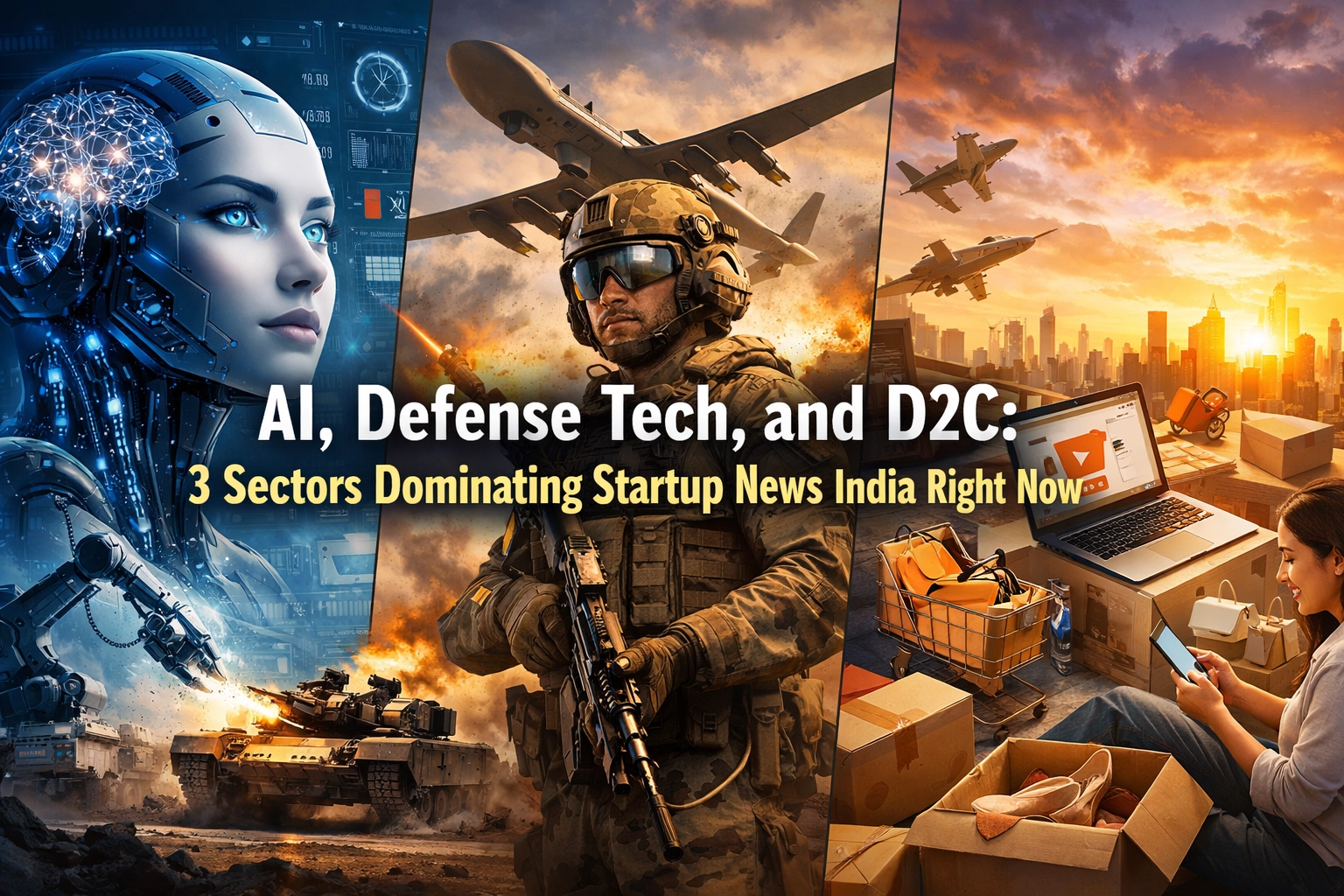

The Indian startup ecosystem in 2026 has undergone a fundamental metamorphosis. Gone are the days of "growth at all costs" fueled by cheap liquidity. Today, the narrative is defined by strategic resilience, technological depth, and sovereign self-reliance. As we navigate the first quarter of 2026, three distinct sectors have emerged not just as market leaders, but as the primary drivers of economic discourse: Defense Technology, Artificial Intelligence (AI), and Direct-to-Consumer (D2C) brands.
This resurgence is characterized by a sophisticated interplay between government policy, private capital, and indigenous innovation. With the total startup funding witnessing a robust rebound: hitting a $1.4 billion milestone in recent months: the focus has shifted from generic consumer internet plays to specialized, high-moat industries. In this analytical deep dive, Business Tantra explores why these three sectors are dominating the headlines and what this means for the broader investment landscape in India.
1. Defense Tech: The Strategic Sovereign Catalyst
Perhaps the most significant shift in the Indian entrepreneurial landscape is the meteoric rise of Defense Technology. Once a sector dominated exclusively by Public Sector Undertakings (PSUs), the defense vertical has been revitalized by a wave of agile, tech-first startups. The numbers tell a compelling story of exponential growth: of the $78 million raised by defense tech startups over the last decade, a staggering $68 million was secured in 2025 alone.
This surge is largely a result of the "Atmanirbhar Bharat" initiative, which has moved from a policy slogan to a legitimate operational framework. The Union Budget for FY 2026-27 has allocated a record ₹7.85 lakh crore ($85.7 billion) to defense, with a strategic reservation of approximately ₹1.39 lakh crore specifically for domestic procurement. This massive capital injection acts as a guaranteed market for startups capable of delivering cutting-edge solutions.

Key Innovation Areas and Market Leaders
Indian defense startups are no longer just manufacturing components; they are pioneering complex systems. We are witnessing breakthroughs in:
- AI-Enabled Autonomous Swarms: Companies like Drexon Industries are developing autonomous systems capable of coordinated reconnaissance and tactical operations.
- Unmanned Aerial Vehicles (UAVs): FTD Innovations has gained significant traction with secure, modular drones designed for high-altitude logistics, solving critical supply chain issues in the Himalayan corridors.
- Quantum Communications: Startups like Ci4 are building autonomous intelligence platforms and quantum-encrypted communication networks, ensuring data integrity in the age of electronic warfare.
The commercial traction is equally impressive. India achieved a record ₹30,000 crore in defense exports in 2026, with indigenous drones and missile components reaching over 100 countries. For those looking to stay updated on these developments, the Business Tantra News Home provides real-time updates on these high-stakes contracts.
2. Artificial Intelligence: Beyond the Hype into Deep-Tech Implementation
While 2023 and 2024 were defined by the global excitement surrounding LLMs, 2026 is the year of specialized, sovereign AI in India. The narrative has shifted from "using AI" to "building AI" that addresses the unique linguistic and structural complexities of the Indian market.
The Indian AI sector is currently bolstered by the "AI for All" mission, which has democratized access to high-compute infrastructure for early-stage ventures. This has led to a surge in startups focusing on "Vertical AI": AI systems designed specifically for sectors like healthcare, vernacular judicial systems, and agriculture.
The Shift to Product-Centricity
India’s traditional strength in IT services is being repurposed to build global AI products. Investment trends show a clear preference for startups that integrate AI at the kernel level rather than just as a wrapper. Key players are focusing on:
- Multilingual LLMs: Bridging the digital divide by creating models that support the 22 scheduled languages of India.
- AI-Driven Satellite Surveillance: Leveraging AI to process terabytes of satellite data for real-time agricultural monitoring and border security.
- Enterprise Automation: SaaS companies are now evolving into "AI Agents" capable of executing complex business processes without human intervention.
The value proposition here is clear: efficiency and scalability. Investors are no longer looking for general-purpose tools but for transformative solutions that offer a quantifiable Return on Investment (ROI) for enterprise clients.

3. D2C 2.0: The Democratization of Consumer Excellence
The Direct-to-Consumer (D2C) sector has entered a "maturity phase." The initial wave of D2C was about digital storefronts; the 2026 wave is about omnichannel dominance and supply chain intelligence. Indian D2C brands are currently dominating startup news due to their aggressive expansion into Tier 2 and Tier 3 cities and their successful integration with "Quick Commerce" platforms.
The catalyst for this change has been the shift in consumer behavior toward premiumization. Indian consumers are increasingly willing to pay a premium for high-quality, purpose-driven brands. This has allowed D2C startups to maintain healthy margins even amidst rising customer acquisition costs (CAC).
The "House of Brands" and Profitability
The current trend sees the consolidation of smaller niche players into larger "House of Brands" entities. This model allows for shared logistics, data-driven insights, and cross-selling opportunities. Unlike the previous era, the focus in 2026 is strictly on EBITDA-positive growth.
Strategic indicators of success in this sector include:
- Hyper-Personalization: Utilizing AI to offer customized products based on local climate, skin type, or dietary preferences.
- Quick Commerce Integration: Brands that can deliver within 10-20 minutes through platforms like Zepto or Blinkit are seeing a 3x growth in daily active users.
- Global Ambitions: Indian D2C brands in the beauty and wellness space are now expanding into the Middle East and Southeast Asian markets, positioning India as a global hub for high-quality consumer goods. To understand how Indian platforms are making waves globally, you might find our analysis on global e-commerce business trends relevant.

Investment Trends: The $1.4 Billion Funding Rebound
The dominance of these three sectors is mirrored in the capital allocation patterns of 2026. After a period of cautious evaluation, Venture Capitalists (VCs) and Private Equity (PE) firms have returned with a "quality over quantity" mindset. The recent funding rebound is characterized by larger ticket sizes for Series B and Series C rounds in companies that demonstrate clear technological moats or path-to-profitability.
Furthermore, the IPO pipeline for 2026 looks exceptionally healthy. Several D2C giants and Defense-tech pioneers are slated to hit the public markets, providing much-needed exits for early-stage investors. This virtuous cycle of investment and exit is essential for the long-term sustainability of the ecosystem.
For founders looking to gain visibility in this competitive landscape, the opportunity to publish your interview can be a strategic move to establish authority and reach potential investors.

The Regulatory and Infrastructure Backbone
No discussion of sector dominance is complete without acknowledging the infrastructure that enables it. The Digital Public Infrastructure (DPI), often referred to as the "India Stack," continues to be the bedrock upon which these startups are built. From UPI for seamless D2C transactions to the ONDC (Open Network for Digital Commerce) democratizing retail, the regulatory environment has become a facilitator rather than a hurdle.
In the Defense sector, the signing of over 289 MoUs across defense industrial corridors has unlocked investments worth over ₹66,000 crore. These corridors provide startups with the physical infrastructure: testing ranges, labs, and manufacturing hubs: necessary to compete on a global stage.
Conclusion
The current state of the Indian startup ecosystem reflects a nation in transition: from a consumer of technology to a primary innovator. AI, Defense Tech, and D2C are leading the news because they represent the three pillars of modern India: technological intelligence, strategic security, and domestic consumption power.
For investors, these sectors offer a blend of high-growth potential and strategic stability. For entrepreneurs, they represent the frontier of what is possible when deep tech meets a massive, evolving market. As we move further into 2026, the success of these sectors will likely define the trajectory of the Indian economy for the next decade. At Business Tantra, we remain committed to tracking these shifts and providing the data-driven insights necessary to navigate this dynamic landscape.
Stay tuned for more updates, and if you are a founder leading the charge in these sectors, consider reaching out to us through our contact page to share your story.