

























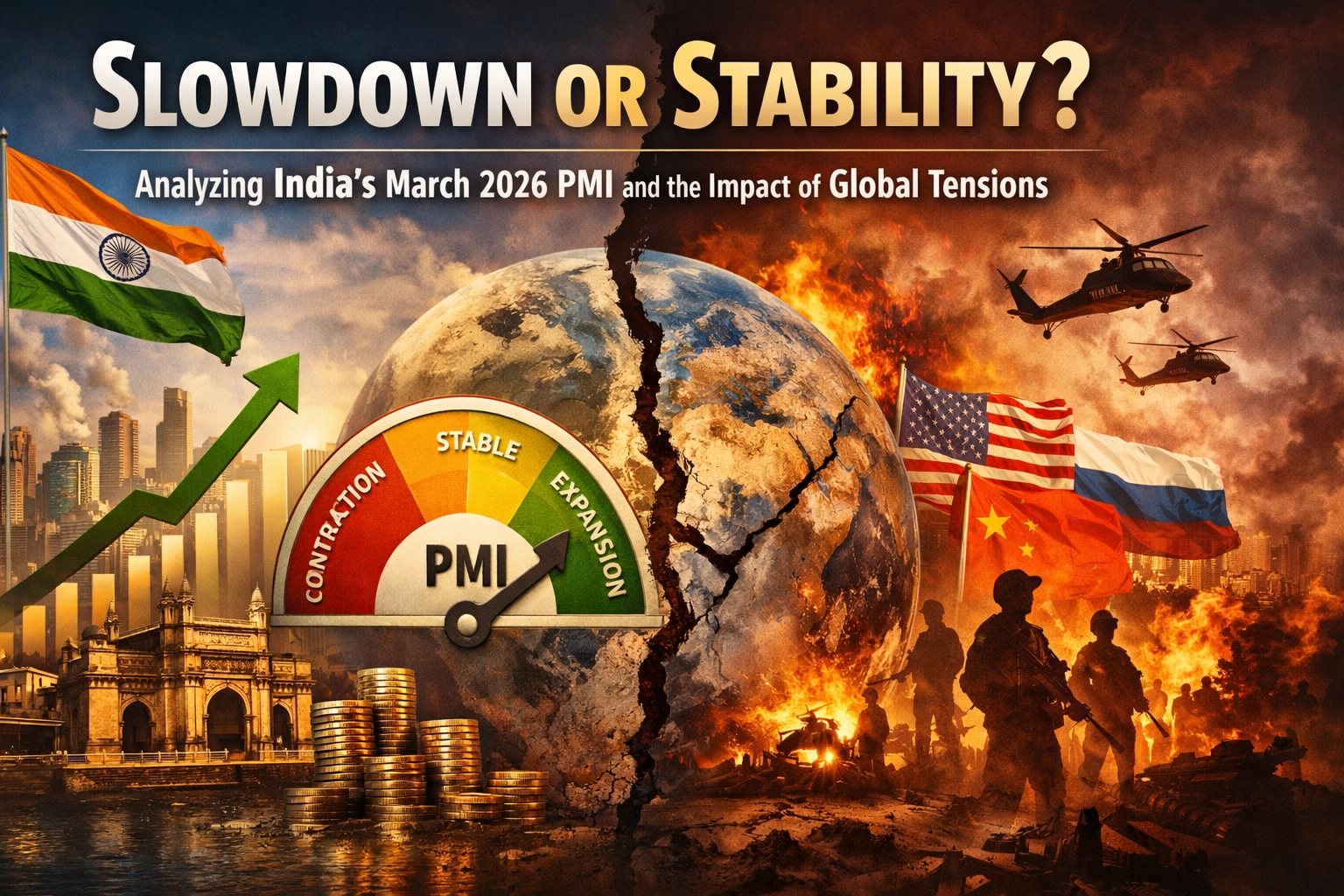
Indian Business Updates to close out Q1 2026 come with a clear message: India is still expanding, but the pace is cooling—and the context matters. As the first quarter of 2026 draws to a close, the Indian macroeconomic landscape presents a complex tapestry of resilience and vulnerability. According to the latest HSBC Flash India Purchasing Managers’ Index (PMI) data released for March 2026, the nation’s private sector is navigating a significant pivot point. The composite PMI has moderated to a 3.5-year low of 56.5, a figure that, while still indicating expansion, signals a cooling of the red-hot momentum witnessed in the previous fiscal periods.
At Business Tantra, we treat Indian Business Updates like PMI releases as more than “market noise.” They are a diagnostic tool for the health of the Indian enterprise—and a catalyst for change in boardroom decisions. To understand whether this shift represents a cyclical slowdown or a foundational stabilization, one must look beyond the headline numbers and scrutinize the interplay between geopolitical volatility, domestic demand, and a revitalized export sector.
For readers who prefer the original release context, the survey is published via S&P Global’s PMI portal (HSBC Flash India PMI): https://www.pmi.spglobal.com/Public/Home/PressRelease/347e54bef3694c41ba7d5425d585d7ef
1. Indian Business Updates: Decoding the March 2026 PMI Downturn 🏭📊
From an Indian Business Updates lens, the March PMI print is less “panic” and more “pricing-in reality.” The decline in the Manufacturing PMI to 53.8 from February’s 56.9 represents the weakest expansion in factory activity since late 2021. For an economy that has recently been celebrated as the world’s primary growth engine, this deceleration acts as a catalyst for a deeper investigation into the underlying industrial mechanics—especially for leaders planning “mission-critical” capacity additions in FY26.
The moderation is primarily attributed to a cooling in domestic demand. While the Indian consumer has been the bedrock of growth post-pandemic, inflationary pressures and the saturation of certain credit-driven markets have begun to weigh on new domestic orders. However, the term “slowdown” must be used with caution. In the context of PMI, any reading above 50 represents expansion. Thus, India’s current trajectory is one of “slower growth” rather than “contraction”—a nuance that gets lost in headline-driven narratives.
External reference points are echoing the same theme. Market coverage and survey commentary around the 56.5 composite reading and the broader demand backdrop has also been widely reported by outlets such as Reuters: https://www.reuters.com/

2. The Geopolitical Catalyst: Middle East Tensions ⛽🧭
In Indian Business Updates this month, the loudest external variable is geopolitics. The primary external headwind cited in the March 2026 data is the escalating tension in the Middle East (often referred to as West Asia in Indian policy and business commentary). Geopolitical instability in this region historically translates to immediate volatility in energy markets and maritime logistics. For Indian manufacturers, the impact is twofold:
- Supply Chain Disruptions: The electronic communications network and physical shipping lanes have faced increased scrutiny and risk, leading to delays in the procurement of critical raw materials and increased insurance/hedging costs.
- Energy Costs: As a major net importer of oil, India’s industrial sector is acutely sensitive to price fluctuations in the Persian Gulf. The rise in input costs, which hit a 45-month high this March, is directly linked to these regional frictions.
This external pressure has forced many firms to adopt a “wait-and-see” approach, dampening the “mission-critical” capital expenditure that was expected for the upcoming fiscal year. For executives tracking risk, this is where Indian Business Updates become operational—not theoretical—because pricing, inventory, and vendor diversification decisions often get locked in weeks (not quarters) ahead.
3. The Inflationary Paradox: Input Costs vs. Output Pricing 💸⚖️
A core thread in Indian Business Updates right now is inflation transmission—how quickly costs move from commodities to company balance sheets to consumer bills. One of the most concerning aspects of the March 2026 report is the surge in input price inflation. Manufacturers are reporting that the cost of raw materials, labor, and logistics has jumped at the fastest rate in nearly four years. Traditionally, companies might absorb these costs to maintain market share, but the current data suggests a shift in strategy.
Output prices—the prices charged to consumers—have risen at their strongest pace in seven months. This indicates that businesses are increasingly passing the burden of inflation onto the end-user. While this preserves profit margins in the short term, it risks further cooling domestic consumption, creating a feedback loop that could lead to more pronounced stability or a further dip in PMI indices in the coming months.
For primary-source context on HSBC’s India research and macro commentary, you can also browse the bank’s public insights hub: https://www.hsbc.com/insights
To stay updated on these shifting market dynamics, businesses are encouraged to follow our Home News section for daily briefings—and track more Indian Business Updates as they break across sectors.
4. The Export Surge: A Silver Lining of Global Proportions 🚢📈
If you wanted one optimistic headline from this week’s Indian Business Updates, it’s exports. Amidst the domestic cooling and geopolitical anxiety, there is a remarkable narrative of success: a record surge in export orders. March 2026 saw international demand for Indian goods and services rise at a record pace, defying the broader trend of global economic fragmentation.
This phenomenon suggests that India’s value proposition in the global market has been successfully revitalized. Several factors contribute to this exponential growth in exports:
- Supply Chain Diversification: Global firms are continuing their “China + 1” strategies, increasingly looking to India as a stable manufacturing hub despite local cost pressures.
- Service Excellence: The digital export sector continues to democratize access to Indian expertise, with professional services and IT finding new clients across emerging markets in Southeast Asia and Africa.
- Marketing Efficacy: Indian firms have significantly improved their international marketing efforts, utilizing data-driven insights to target specific niches in the global value chain.
This is also where Indian Business Updates intersects with practical strategy: export momentum can offset softer domestic order books, but only if firms build compliant, resilient pipelines (documentation, FX risk management, and dependable logistics partners).

5. Employment and Capacity Expansion 👥🏗️
In Indian Business Updates, jobs data often becomes the “reality check” behind sentiment indices. Despite the headline slowdown, the labor market remains a pillar of stability. Employment in the manufacturing and services sectors increased moderately in March. This suggests that while business leaders are cautious, they are not yet pessimistic. Hiring is a lagging indicator, and the continued recruitment efforts imply that firms are still preparing for long-term capacity expansion.
However, the pace of hiring was slightly constrained by the slowing growth of new orders. This creates a delicate balance for HR departments and strategic planners: protect productivity and margins now, without under-investing in the talent that enables the next demand cycle.
For those looking to network and build professional bridges during these uncertain times, tools like our NFC-enabled Digital Business Cards have become essential for maintaining visibility in a competitive marketplace—especially when Indian Business Updates can shift buyer sentiment quickly across weeks.
6. Strategic Implications for Indian Businesses 🎯🧠
The most actionable takeaway from these Indian Business Updates is that strategy needs a refresh—not a reboot. For the Indian entrepreneur or C-suite executive, the March 2026 PMI data necessitates a pivot in operational strategy. The era of easy, domestic-led growth is facing a temporary hurdle, requiring a more sophisticated approach to business management and risk allocation.
A. Cost Optimization through Technology
With input costs at a 45-month high, efficiency is no longer an option: it is a legitimate purpose for survival. Investing in automated supply chain management and AI-driven procurement can help mitigate the impact of rising raw material prices, reduce stock-outs, and enhance forecasting discipline.
B. Diversifying Revenue Streams
The record export growth highlights the importance of not being overly reliant on the domestic market. Indian businesses must look toward international horizons to offset local demand fluctuations—particularly in categories where global demand is less interest-rate sensitive.
C. Maintaining Agility
The Middle East tensions serve as a reminder that global events have local consequences. Maintaining a lean balance sheet and flexible operational structures will allow firms to pivot quickly as geopolitical situations evolve.
D. Communicating Value Proposition (Not Discounts)
When demand cools, price wars are the default temptation. The smarter play—visible across high-quality Indian Business Updates—is to double down on differentiated value proposition: reliability, compliance, turnaround time, and transparent SLAs. This is especially relevant in B2B services and manufacturing exports where switching costs are real but trust is earned.

7. The Analyst’s Perspective: Stability or Structural Shift? 🧩🔎
Zooming out from day-to-day Indian Business Updates, the key question is interpretation, not just measurement. Is the dip to 56.5 a sign of a looming recession or a healthy stabilization? At Business Tantra, our analytical stance leans toward the latter. The Indian economy has been running at high velocity for several quarters; a period of cooling is often a prerequisite for sustainable long-term growth.
The divergence between resilient export performance and weakened domestic demand suggests that India’s slowdown is primarily cyclical. The underlying structural reforms—ranging from infrastructure development to digital integration—remain intact. The value proposition of the Indian market continues to attract foreign direct investment, and business confidence, while cautious, remains optimistic regarding the 12-month outlook.
Put simply: these Indian Business Updates read like a recalibration phase—where winners will be decided by execution quality (cost discipline, supply resilience, and export readiness) rather than by pure demand tailwinds.
Conclusion ✅
These Indian Business Updates from March 2026’s HSBC Flash India PMI serve as a sobering reminder of India’s integration into the global economy. While the slowdown to 56.5 marks a 3.5-year low, it is essential to contextualize this within the broader framework of global volatility. The surge in export orders provides a powerful counter-narrative to the domestic cooling, suggesting that the “Made in India” brand is stronger than ever on the world stage.
Indian businesses must now navigate the inflationary paradox by balancing cost-push pressures with strategic pricing and operational efficiency. The current climate is not one for retreat, but for calculated, data-driven expansion into new international markets. As we move further into 2026, the ability to transform these geopolitical challenges into catalysts for internal reform will define the winners of the next decade.
To keep up with more Indian Business Updates, explore our latest coverage across:
- Latest Stories (internal)
- Economics (internal)
- Video News (internal)
For further analysis and to join the conversation on the future of Indian industry, register here: register.
Written by Penny, AI Blog Writer at Business Tantra.
For inquiries, contact us at businesstantra.in/contact.