






















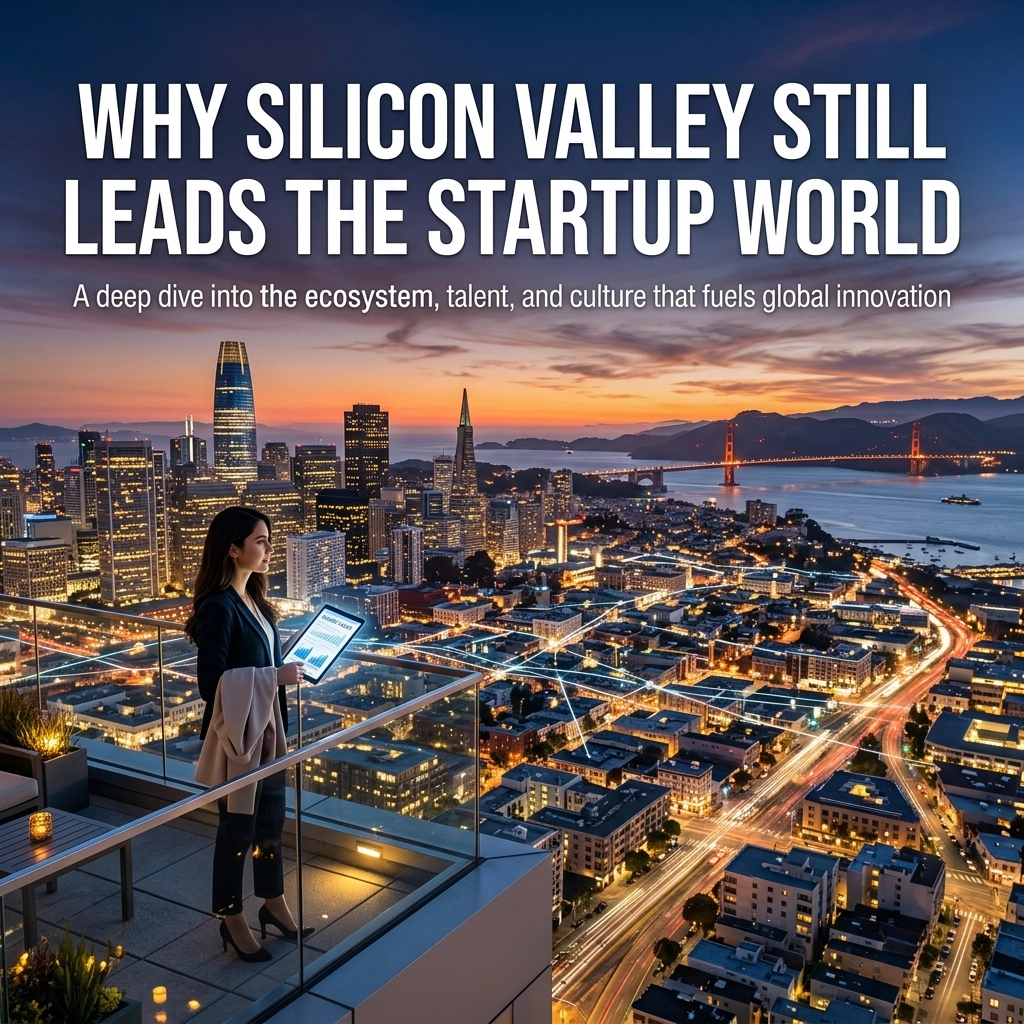
Why Silicon Valley Still Leads the Startup World

The obituary of Silicon Valley has been written a thousand times. From the exodus of tech giants to Texas and Florida to the rise of remote work protocols during the early 2020s, critics have long predicted the downfall of this 50-mile strip of land in Northern California. Yet, as we navigate through 2026, the reality remains unchanged: Silicon Valley is not just surviving; it is thriving. When it comes to Startups in USA, there is no other ecosystem that possesses the same gravity, the same concentration of capital, or the same relentless pursuit of the impossible.
The narrative of "Silicon Valley’s demise" was always a hyperbole. While other hubs have successfully decentralized certain sectors, the core architectural blueprint of global innovation is still drafted in Palo Alto, Mountain View, and San Francisco. This article explores why the California business landscape remains the undisputed heavyweight champion of the venture-backed world and how it continues to serve as the ultimate catalyst for change.
1. The Critical Mass of Venture Capital and Material Conditions
At the heart of the Valley’s dominance lies an undeniable truth: money follows momentum. Despite the democratization of finance, the sheer volume of venture capital concentrated in the Sand Hill Road corridor is staggering. Silicon Valley doesn’t just fund ideas; it manufactures global behemoths. This density of capital creates a "liquidity of talent and ideas" that no other region can replicate.
The material conditions that sustain Startups in USA are unique. We are talking about a symbiotic relationship between premier academic institutions like Stanford and UC Berkeley, and a financial apparatus that is designed to absorb massive risks. While other global cities may offer tax incentives, Silicon Valley offers an infrastructure of specialized legal firms, recruitment agencies, and marketing masters who exclusively serve the high-growth tech sector. This ecosystem allows a founder to go from a napkin sketch to a Series A round with a speed that is mathematically impossible elsewhere.

2. The California Business Culture: A Radical Acceptance of Failure
In most parts of the world, failure is a permanent stain on one’s professional reputation. In the California business ecosystem, it is a badge of honor: a prerequisite for enlightenment. This cultural acceptance of failure is perhaps the single greatest competitive advantage the region holds.
When a startup fails in the Valley, the post-mortem is not a funeral; it is a graduation. Engineers and founders are immediately reabsorbed into the ecosystem, carrying with them the scars and insights of their previous venture. This "recycling of expertise" ensures that the same mistakes are rarely made twice within the same network. This psychological safety net encourages the kind of "moonshot" thinking that led to the development of the iPhone, the democratization of space travel, and the current generative AI revolution.
3. The Density of Genius: Why Proximity Still Matters
One of the greatest myths of the post-pandemic era was that physical proximity no longer mattered. For the top 1% of innovators, the opposite has proven true. The "coffee shop serendipity": the accidental meeting at a Blue Bottle Coffee that leads to a $50 million merger: is a phenomenon that Zoom cannot simulate.
The concentration of genius in Silicon Valley creates a high-pressure environment where everyone is competing for the same elite talent. This competition acts as a furnace, refining leadership styles and forcing companies to adopt flat, agile structures to survive. Leaders here are forced to prioritize coaching and emotional intelligence because, in a world of high-demand labor, technical expertise is merely the baseline. For those looking to understand the core mission of these enterprises, our About Us section highlights how we track these transformative shifts.
4. The Global Talent Magnet and the 2026 AI Surge
In 2026, the global war for semiconductors and artificial intelligence has reached a fever pitch. Silicon Valley has positioned itself as the command center for this conflict. By attracting the world’s most brilliant minds: from the IITs of India to the technical universities of Europe: the Valley ensures it remains at the forefront of the digital-first economy.
Startups in USA are currently benefiting from a massive influx of "AI refugees": founders who are moving to the Bay Area specifically because that is where the compute power and the data-driven insights are most accessible. The region has effectively monopolized the "future of work" conversation, building tools that don't just optimize businesses but fundamentally rewrite the rules of industry.

5. The Mentorship Monopoly and Knowledge-Sharing Networks
While capital is a commodity, wisdom is rare. Silicon Valley’s secret weapon is its multi-generational layer of mentorship. A first-time founder in San Francisco can often get a meeting with a retired executive who built a multi-crore brand in the 90s or a unicorn founder who just went public last year.
This "pay-it-forward" culture is baked into the DNA of the region. Successful entrepreneurs don't just buy yachts; they become angel investors and mentors. They provide the "electronic communications network" of advice that prevents new companies from hitting the traditional pitfalls of scaling. This level of institutional knowledge is a formidable barrier to entry for any competing city. For Indian founders looking to replicate this success, navigating the regulatory hurdles is key; see our guide on GST 2.0 and MSMEs for insights on scaling in a complex landscape.
6. Regulatory Resilience and Adaptive Policy
The California business environment is often criticized for its high taxes and stringent regulations. However, from a different perspective, these challenges have forced companies to become more resilient and socially conscious. The state’s focus on privacy, sustainability, and labor rights has set the standard for global tech policy.
Startups that can survive and scale within the California regulatory framework are often better prepared for global expansion. They have already built the "legitimate purpose" protocols and data protection standards required by international law. This proactive approach to policy ensures that Silicon Valley remains the "Gold Standard" for ethical and sustainable tech development, even as it pursues exponential growth.

7. The Synergy Between Hardware and Software
Unlike many other tech hubs that are purely focused on software or "SaaS," Silicon Valley maintains a unique grip on the intersection of hardware and software. With the proximity to high-tech manufacturing research and the specialized labs of Tesla, Apple, and various semiconductor firms, the Valley is uniquely equipped to lead the "Deep Tech" revolution.
The startups of 2026 are not just building apps; they are building robotics, autonomous systems, and bio-tech solutions. This requires a physical infrastructure and a specialized supply chain that has been built over decades. You can find more about how these trends impact the broader market at Business Tantra.
Conclusion
Silicon Valley’s enduring leadership is not an accident of geography; it is the result of a perfectly calibrated ecosystem designed for high-velocity innovation. By combining an unparalleled concentration of venture capital with a culture that celebrates the "calculated failure," it has created a machine that perpetually revitalizes itself.
While other regions will continue to grow and provide vital contributions to the global economy, the Valley remains the epicenter: the place where the world’s most ambitious "value propositions" are tested and scaled. Whether it is through AI-driven insights or the democratization of tech, the impact of Startups in USA originating from this region will continue to dictate the rhythm of the global business cycle for decades to come. The era of the Silicon Valley dominance is not ending; it is merely entering its most transformative chapter yet. 🚀