


























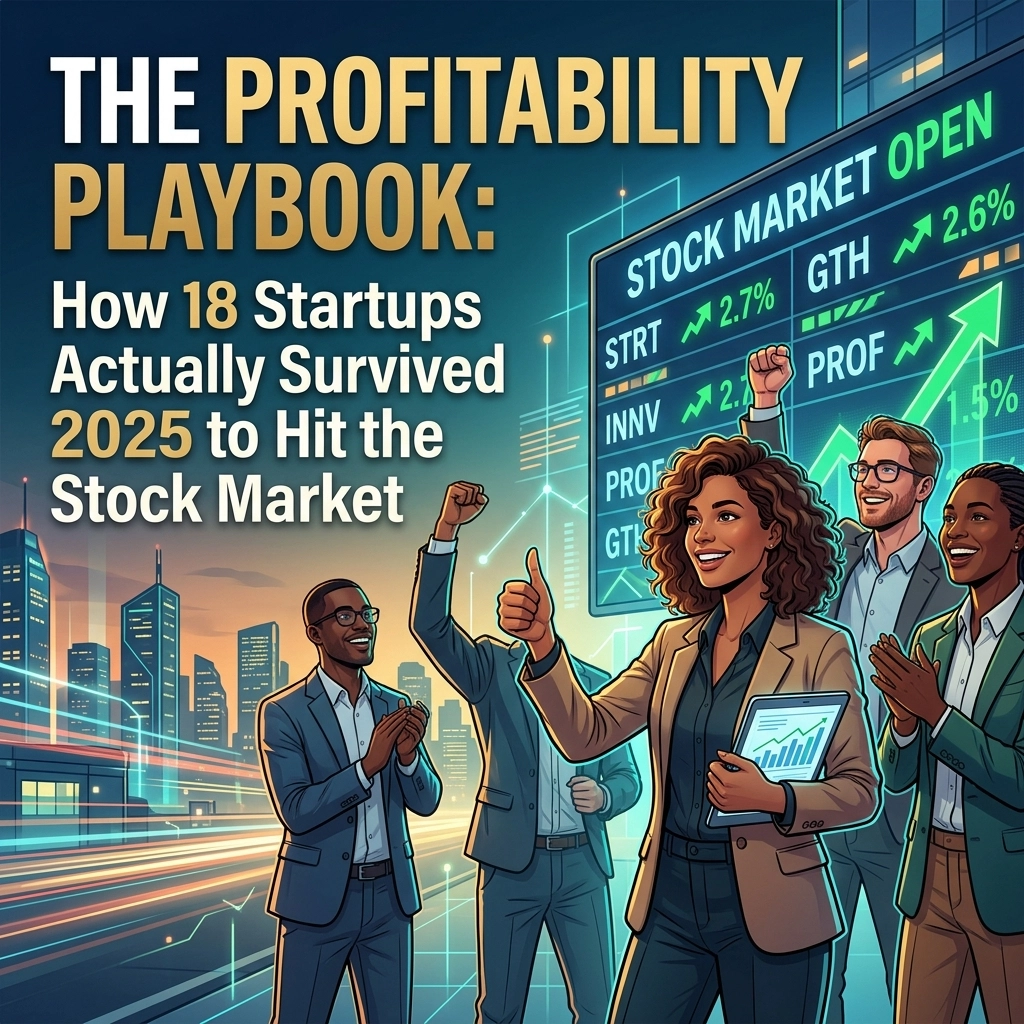
The Profitability Playbook: How 18 Startups Actually Survived 2025 to Hit the Stock Market.

The year 2025 will be remembered in the Indian corporate annals as the "Great Pivot." After years of venture-backed exuberance followed by a sobering "funding winter," the ecosystem finally matured. The most tangible evidence of this evolution was the successful listing of 18 major startups on the public markets. These companies did not just survive; they thrived by rewriting the rules of engagement. This Profitability Playbook serves as a post-mortem and a roadmap, detailing how these organizations transitioned from cash-burning entities to dividend-promising public corporations.
At Business Tantra, we have closely monitored this transition. For those looking for the latest updates on market shifts, our home-news section provides real-time analysis of the evolving fiscal landscape.
1. The End of "Growth at Any Cost"
The primary catalyst for change in 2025 was a fundamental shift in investor sentiment. The era of "blitzscaling": prioritizing market share over margins: came to an abrupt halt. The 18 startups that successfully hit the stock market in 2025 were those that embraced startup profitability as their North Star at least 24 months prior to their IPO filing.
These companies realized that the public markets, unlike private equity, demand predictability. The playbook involved a ruthless audit of customer acquisition costs (CAC). By shifting focus from broad-based marketing to high-intent organic growth, these firms reduced their burn rates by an average of 40% year-on-year. The strategy was no longer about how many users were on the platform, but how many of those users were contributing to a positive contribution margin.

2. Masterclass in Unit Economics
To understand the Profitability Playbook, one must look at the granular level of unit economics. The 2025 IPO class shared a common trait: they achieved "Contribution Margin Three" (CM3) positivity. This meant that after accounting for marketing, variable costs, and fixed overheads allocated per order, the companies were generating actual cash.
Key survival tactics included:
- Dynamic Pricing Models: Utilizing AI-driven data-driven insights to adjust pricing in real-time, ensuring that every transaction contributed to the bottom line.
- Supply Chain Localization: Startups in the D2C and e-commerce sectors revitalized their logistics by sourcing closer to the point of consumption, mitigating the impact of global fuel price volatility.
- Vertical Integration: By bringing essential services in-house: such as proprietary payment gateways or last-mile delivery fleets: startups eliminated the "middleman tax" that had previously eroded their margins.
3. Regulatory Reforms: The Flexible ESOP Catalyst
A significant, yet often overlooked, driver of the 2025 IPO boom was the introduction of flexible Employee Stock Option Plan (ESOP) rules by the Securities and Exchange Board of India (SEBI). These regulatory reforms allowed startups to democratize wealth creation while maintaining lean balance sheets.
The new rules permitted companies to offer "cashless exercise" and extended the exercise period post-resignation, which became a vital tool for talent retention during the 2024-2025 lean periods. Instead of offering astronomical base salaries that depleted cash reserves, startups utilized these revitalized ESOP structures to align employee interests with long-term profitability. This fiscal discipline was a cornerstone of the Profitability Playbook, allowing companies to keep their "OpEx" (Operating Expenses) manageable while preparing for the public eye.

4. The "Pruning" Strategy: Cutting Non-Core Verticals
Survival in 2025 required a level of corporate humility. Many of the 18 startups that went public had previously over-extended themselves into unrelated verticals. The playbook for 2025 involved a "Return to Core."
For instance, several fintech giants that had ventured into gaming or "ed-tech" segments chose to divest or shut down those divisions. This strategic divestment allowed them to focus resources on their high-margin lending and insurance businesses. This clarity of mission was highly rewarded by institutional investors during the IPO roadshows. By presenting a streamlined, high-performance business model, these startups established a legitimate purpose for their capital raises, primarily focused on scaling what already worked rather than experimenting with what might not.
5. Governance and Transparency as a Value Proposition
Public markets require a level of scrutiny that many private companies find stifling. However, the 2025 cohort viewed governance not as a hurdle, but as a value proposition. They moved away from "founder-led" chaos to "board-governed" stability.
The incorporation of independent directors with deep experience in traditional sectors helped these startups navigate the complexities of the Ministry of Corporate Affairs guidelines. This shift toward institutionalization was a catalyst for change, bridging the trust gap between "disruptive tech" and "conservative retail investors."
6. Macroeconomic Growth and the Indian Context
The success of these listings cannot be viewed in isolation from the broader Indian macroeconomic story. With India’s GDP growth consistently outpacing other major economies in 2025, the domestic appetite for equity was at an all-time high. The 18 startups tapped into a "Retail Revolution" where individual investors, empowered by low-cost brokerage apps, sought to participate in the nation’s exponential growth.
Furthermore, the integration of the Unified Payments Interface (UPI) into almost every facet of the digital economy provided the electronic communications network necessary for these startups to scale without the friction points seen in other emerging markets.

7. Lessons for the Next Generation of Founders
The Profitability Playbook of 2025 offers several definitive takeaways for current founders:
- Profitability is not an exit strategy; it is a survival skill. Waiting for an IPO to become profitable is no longer a viable path.
- Cash is King, but Cash Flow is Queen. Managing the timing of receivables and payables can be the difference between a successful listing and a quiet shutdown.
- Governance is a Shield. Building a robust legal and compliance framework early on prevents "due diligence" nightmares during the IPO process.
For those interested in how Business Tantra supports the ecosystem through detailed reporting and analysis, you can learn more on our about-us page or reach out via our contact-us portal for collaborative inquiries.
Conclusion
The listing of 18 startups in 2025 was not merely a financial milestone; it was a psychological turning point for the entire industry. It proved that the "Indian Startup" could mature into a "Blue Chip" corporate entity. By adhering to a rigorous Profitability Playbook, focusing on unit economics, leveraging regulatory reforms, and prioritizing governance, these companies demonstrated that sustainable growth is the only true path to the stock market.
As we look toward the remainder of 2026, the legacy of the 2025 cohort remains clear: the market will always reward companies that solve real problems with fiscal precision and operational excellence. The era of the "unicorn" is being replaced by the era of the "profitable powerhouse," and the business landscape is all the better for it.

admin


Related Post