

























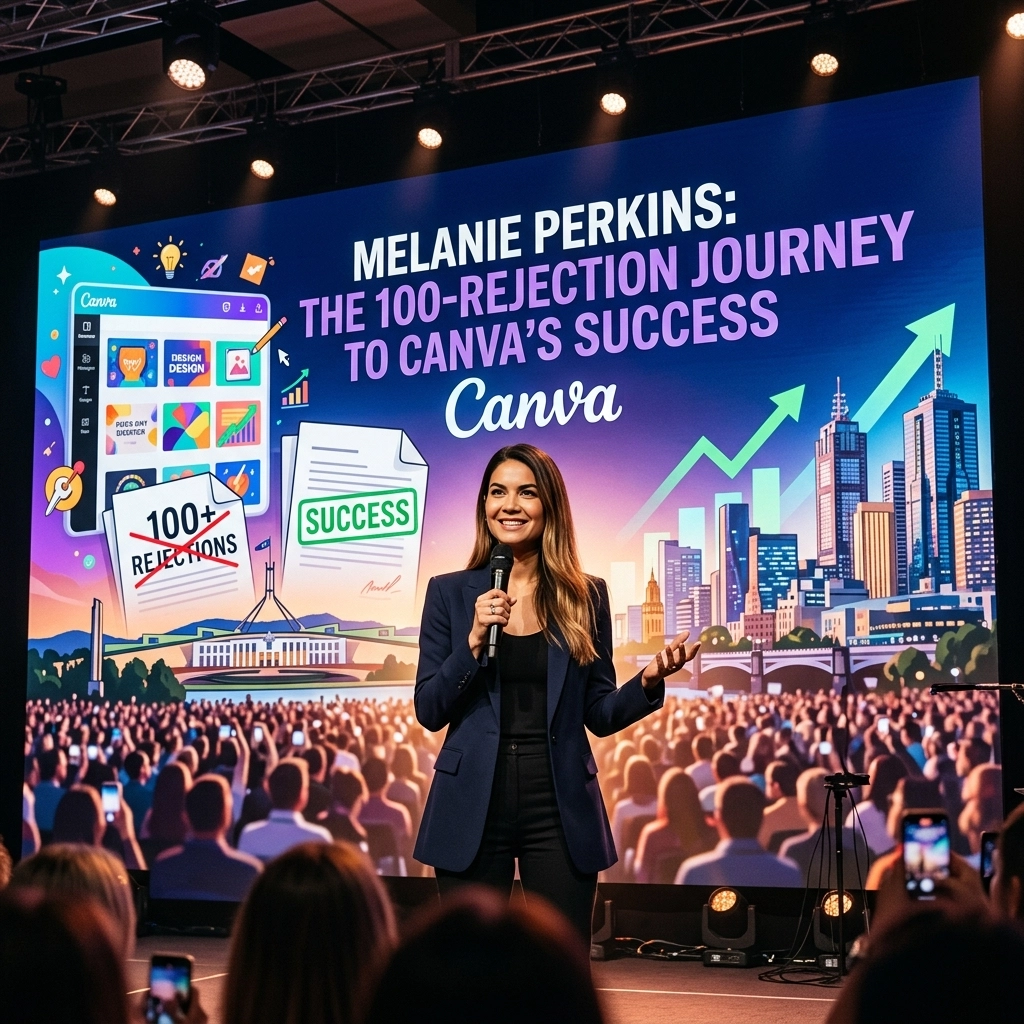
Melanie Perkins: The 100-Rejection Journey to Canva’s Success

How Melanie Perkins Turned 100 Rejections into a Design Revolution.
She was 19 when she started. Silicon Valley VCs wouldn't even take her calls. Today, her platform is used by 100 million people. This is not just a story of a successful startup; it is a testament to the fact that persistence is the ultimate "superpower" in the volatile world of global business.
As we look at the landscape of 2026, where Canva stands as a titan valued at over $42 billion, it is easy to forget that this empire was built on a foundation of "No." For Melanie Perkins, the journey to Melanie Perkins Canva success was paved with more than 100 investor rejections and a decade of relentless refinement. At Business Tantra, we analyze the catalysts for change that define our era, and Perkins’ story is a masterclass in turning systemic resistance into exponential growth.
1. The Genesis: Tutoring Design Software and the "Pain Point"
Every design revolution begins with a problem. In 2007, while a university student in Perth, Australia, Melanie Perkins was tutoring other students on how to use mainstream design software like Adobe Photoshop and InDesign. She noticed a recurring theme: the software was prohibitively expensive, unnecessarily complex, and had a learning curve so steep it discouraged the average person from even trying.
The "value proposition" she conceptualized was simple yet radical: design should be collaborative, online, and accessible to everyone, regardless of their technical background. She envisioned a future where the "gatekeepers" of design: those with expensive degrees and even more expensive software: were no longer the only ones capable of creating professional-level visuals.

Perkins didn't just want to build a tool; she wanted to democratize the entire design industry. However, having a vision and having the capital to build it are two very different things. To bridge this gap, she and her co-founder (and now husband) Cliff Obrecht started small, testing their hypothesis in a niche market.
2. The Turning Point: The 'Yearbook' Success (Fusion Books)
Before Canva became a household name, there was Fusion Books. Understanding that launching a massive design platform required a "proof of concept," Perkins and Obrecht targeted a specific, underserved market: high school yearbooks.
They built a simple drag-and-drop interface that allowed students to design their own yearbooks online. This was the MVP (Minimum Viable Product) that would eventually evolve into the Canva we know today. Working out of her mother’s living room, Perkins grew Fusion Books into the largest school yearbook publisher in Australia, eventually expanding to France and New Zealand.
While Fusion Books was a legitimate success, Perkins knew it was only a stepping stone. She had a grander mission. To achieve it, she needed the kind of "data-driven insights" and capital that only Silicon Valley could provide. You can learn more about how we cover these early-stage pivots on our About Us page.
3. The Struggle: The 100 'No's in Silicon Valley
The leap from a profitable niche business to a global tech platform is where most entrepreneurs falter. For Perkins, this transition was a grueling three-year marathon of rejection. When she first arrived in San Francisco, she was an outsider: both geographically and demographically.
The statistics were against her. In an industry where venture capital overwhelmingly flows to male-led teams, Perkins faced an uphill battle. She pitched to over 100 investors, and for three long years, the answer was always the same: "Not yet," or worse, total silence.

Perkins didn't just sit and wait. She took up kitesurfing: not as a hobby, but as a strategic move to network with Silicon Valley’s elite "Mai Tai" tech crowd. She refined her pitch deck constantly, using every rejection as a feedback loop to address the concerns of the next skeptical VC. This period of her life was defined by what we at Business Tantra call "strategic resilience." She understood that a "No" was often just a request for more information or a different angle.
4. Breaking Through: The Global Growth of Melanie Perkins’ Canva Success
The breakthrough finally came when she met Bill Tai and later, Lars Rasmussen (co-founder of Google Maps). They saw the potential in her "simplified design" philosophy. With their backing, and the recruitment of tech lead Cameron Adams, Canva was officially launched in 2013.
The growth was nothing short of revitalized innovation. Within the first year, Canva had over 600,000 users. By focusing on a "freemium" model, Perkins ensured that the platform could spread organically through schools, small businesses, and non-profits. The company didn't just provide a tool; it provided a solution to the "blank page syndrome" by offering thousands of templates.

By 2026, Canva has reached a level of global dominance that few could have predicted. It has integrated advanced AI features: often referred to as "Magic Studio": to stay ahead of legacy competitors. This technological evolution has secured Canva’s place not just as a design tool, but as a comprehensive productivity suite used by 240 million monthly active users worldwide.
5. Lessons for Modern Entrepreneurs: Persistence is a Superpower
The story of Melanie Perkins offers several critical takeaways for the modern business leader. As we navigate the competitive environment ahead of the 2026 IPO wave, these lessons remain more relevant than ever.
I. Simplify the Complex
Perkins’ greatest achievement wasn't adding features; it was removing friction. In a world of complex "electronic communications networks" and data-heavy software, the company that makes life easier for the end-user will always win.
II. The Power of "Small Wins"
By starting with Fusion Books, Perkins proved the technology worked before trying to conquer the world. This lowered the risk for early investors and gave the team the confidence to scale.
III. Persistence is a "Legitimate Purpose"
One hundred rejections would break most people. Perkins viewed them as a necessary part of the process. She maintained a "mission-first" mindset, focusing on the value her platform would bring to millions of users rather than the personal sting of rejection.

6. The 2026 Impact: A Billion-Dollar Market Trajectory
Today, Canva is more than just a startup; it is a "unicorn" that has redefined the "market moves" of the SaaS industry. With annual revenues exceeding $3 billion and a commitment to social impact: Perkins and Obrecht have pledged to give away the vast majority of their wealth: the company serves as a model for "conscious capitalism."
The Melanie Perkins Canva success story is frequently cited in boardrooms across Mumbai and Silicon Valley alike. It serves as a reminder that the most transformative solutions often come from those who were initially told "it’s impossible."
For more insights into the strategies of global market movers, visit our Home Blog.
Conclusion
Melanie Perkins’ journey from a 19-year-old university student to the CEO of a $42 billion design powerhouse is a narrative of grit, vision, and the courage to simplify. By turning 100 rejections into a catalyst for a design revolution, she did more than just build a software platform; she empowered 100 million people to tell their own stories through professional-grade visuals.
The central thesis of her journey is clear: if you solve a real problem with unwavering persistence, the world will eventually stop saying "No" and start hitting "Export." As the business world continues to evolve toward more intuitive, AI-driven solutions, the lessons from Canva’s rise will remain the ultimate blueprint for any entrepreneur daring enough to challenge the status quo.
Whether you are a startup founder or a seasoned executive, the message is the same: stay the course, simplify the complex, and remember that the next "Yes" might be just one more "No" away.

admin


Related Post