























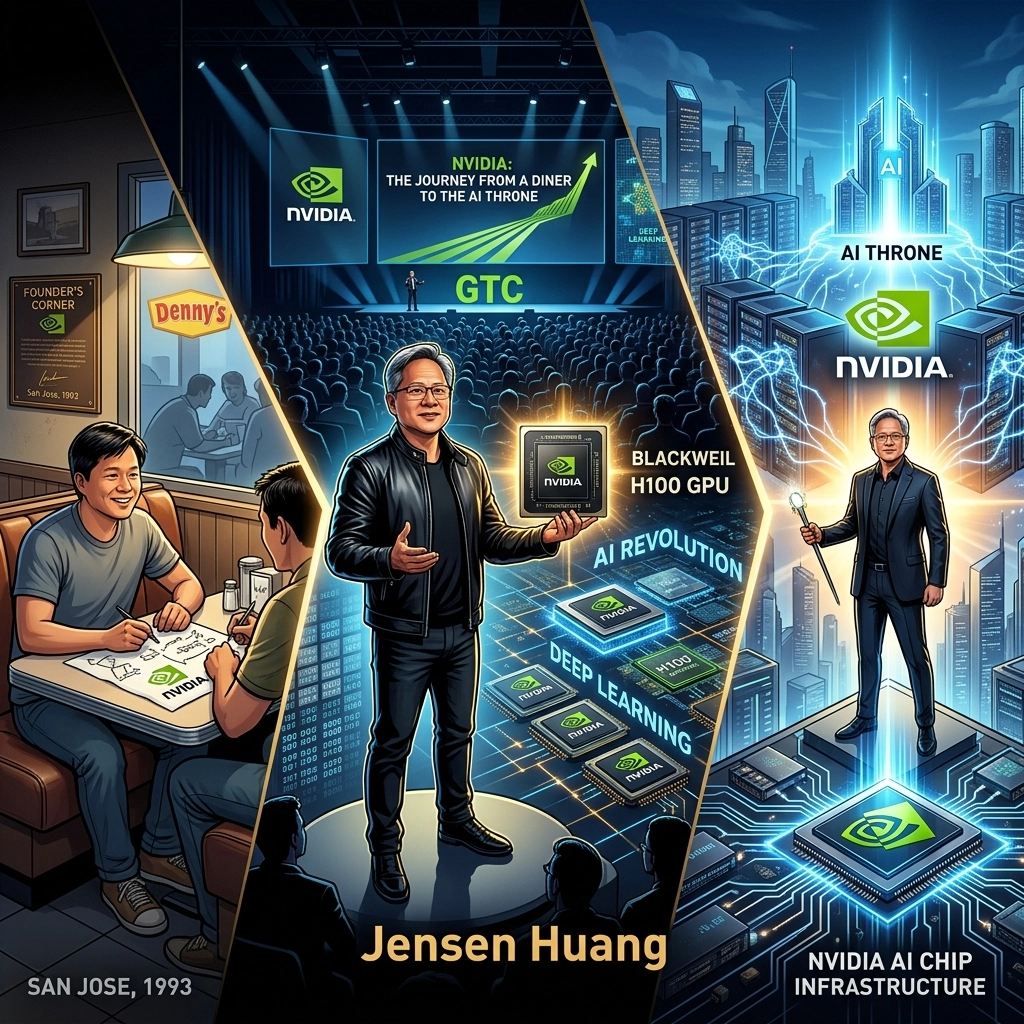
Jensen Huang: NVIDIA’s Journey from a Diner to the AI Throne

The Denny’s Meeting That Started the AI Revolution
He started in a booth at a diner. He was told the market for graphics cards was too small. Now, his chips power the entire future of intelligence.
In the early 1990s, three engineers sat in a booth at a Denny’s in East San Jose. They weren't there for the Grand Slam breakfast; they were there to figure out how to revolutionize a market that didn’t even exist yet. At the center of this trio was Jensen Huang, a man who would go on to lead NVIDIA’s journey from a scrappy startup to a multi-trillion dollar powerhouse that effectively owns the hardware layer of the modern world.
Today, NVIDIA is the backbone of the generative AI boom, but the road to the "AI Throne" was paved with near-bankruptcy, high-stakes gambling on unproven tech, and a level of long-term vision that is rare in the quarterly-profit-obsessed world of Silicon Valley.
Background: Engineering at AMD and the Vision for 3D
Before the leather jackets and the keynote stages, Jensen Huang was a young engineer honing his craft at some of the most influential firms of the 1980s. After graduating from Oregon State and Stanford, he spent time at LSI Logic and, most notably, Advanced Micro Devices (AMD). It was during this period that Huang realized the potential for specialized processing.
In 1993, at age 30, Huang co-founded NVIDIA with Chris Malachowsky and Curtis Priem. Their initial capital was a modest $40,000. At the time, the computing world was dominated by the CPU: the central processing unit. The general consensus was that the CPU would eventually handle everything. But Huang and his co-founders had a different theory: the future of computing would be accelerated. They believed that 3D graphics for video games would be the catalyst for change that would drive the demand for specialized hardware.

Visual Suggestion: A 1993-style Denny's diner booth with a napkin sketch of a computer chip.
Despite the skepticism of many in the industry who viewed the gaming market as a niche hobby for children, Huang saw it as a massive compute problem waiting for a solution. This belief in "accelerated computing" became the foundational pillar of the company’s mission.
The Struggle: Near Bankruptcy in the 90s
NVIDIA’s journey was almost cut short before it truly began. The company’s first product, the NV1, was a technical marvel but a commercial disaster. It attempted to use "quadrilateral" rendering at a time when the rest of the industry, led by Microsoft’s DirectX, was moving toward "triangle-based" rendering.
By the mid-90s, NVIDIA was on the brink of collapse. They were down to their last month of payroll. In a move that sounds like something out of a thriller, Huang had to negotiate for the company’s life. He had a contract with Sega to develop the chip for the Sega Saturn’s successor, but he knew NVIDIA’s tech was going in the wrong direction.
In an act of radical transparency, Huang told the CEO of Sega that NVIDIA’s architecture was the wrong path and that Sega should look elsewhere. However, he also admitted that if Sega didn’t pay NVIDIA for the work already done, the company would go bankrupt. In a legendary show of faith, Sega’s leadership agreed to pay the $5 million, giving NVIDIA just enough runway to pivot.
That pivot resulted in the RIVA 128, a chip that finally embraced the industry standards. It was a hit, selling one million units in its first few months and saving the company. It was the first of many times Huang would bet the entire company on a single, make-or-break vision.
Turning Point: The 'CUDA' Bet
If saving the company in the 90s was about survival, the 2006 launch of CUDA was about dominance. This is the most critical chapter in NVIDIA’s journey to the AI throne.
At the time, GPUs (Graphics Processing Units) were strictly for gaming. Huang, however, realized that the massive parallel processing power required to render pixels could also be used for complex mathematical simulations: science, weather forecasting, and, eventually, neural networks.
He introduced CUDA (Compute Unified Device Architecture), a programming model that allowed developers to use NVIDIA GPUs for general-purpose computing. For years, Wall Street hated the move. It cost billions in R&D and added significant cost to every chip they sold, with very little immediate ROI. Analysts called it a "bridge to nowhere."
But Huang stayed the course. He democratized supercomputing, putting the power of a data center into the hands of any researcher with a $500 graphics card.
When researchers like Alex Krizhevsky used NVIDIA GPUs to win the ImageNet competition in 2012, the world of Artificial Intelligence changed forever. It was the "Big Bang" of AI. The bet on CUDA had paid off, positioning NVIDIA as the only hardware provider capable of training the massive models that would eventually lead to ChatGPT and beyond.
Growth: Leading the AI Era
Today, NVIDIA isn't just a chip company; it's an infrastructure titan. From the H100 to the recently announced Blackwell architecture, NVIDIA's hardware has become the "new oil" of the global economy. Every major tech giant: from Microsoft to Meta: is in a frantic race to acquire as many NVIDIA chips as possible.
The company's market capitalization, which once struggled to stay relevant against giants like Intel, has skyrocketed. This exponential growth is a testament to what happens when technical precision meets long-term strategic foresight. At Business Tantra, we often track how these market shifts impact global trade, and NVIDIA’s rise is perhaps the most significant economic story of the decade.

The demand for AI compute has revitalized the semiconductor industry and sparked a global geopolitical race for hardware sovereignty. As countries compete to build their own AI data centers, Jensen Huang stands at the center of it all, still wearing his signature leather jacket, still pushing the boundaries of what is computationally possible.
Lessons: Bet on the Future and Long-Term Vision
What can entrepreneurs learn from Jensen Huang and NVIDIA’s journey? There are several key takeaways that we at Business Tantra believe are essential for any leader:
- Seek the "Zero Billion Dollar Market": Huang often talks about looking for markets that don't exist yet. If a market is already $10 billion, it's already crowded. NVIDIA succeeds by creating markets through sheer technical will.
- Intellectual Honesty: When the NV1 failed, Huang didn't double down out of ego. He admitted the failure, asked for help, and pivoted.
- The Courage to Over-Invest: CUDA was a massive financial drain for a decade. Most CEOs would have cut the project to appease shareholders. Huang’s long-term vision allowed him to see the "AI Promised Land" before anyone else.
- Hardware is the Foundation: Software might be eating the world, but hardware provides the teeth. In a world of digital abstractions, NVIDIA’s focus on physical, tangible compute power has made them indispensable.
For those looking to scale their own ventures, keeping up with these trends is vital. You can find more deep dives into successful business models on our blog page.

Conclusion: An Emotional Closing
Jensen Huang’s story is a quintessential immigrant success story: he arrived in the U.S. as a child, worked as a dishwasher at Denny's, and eventually built a company that defines the future of human intelligence.
He often tells his employees to "run, don't walk" because in the tech world, if you aren't chasing the future, the future is chasing you. NVIDIA’s journey reminds us that greatness isn't born in a pristine lab or a mahogany boardroom. It’s born in a sticky booth at a 24-hour diner, fueled by coffee and the audacity to believe that the world's most difficult problems can be solved if you just have enough compute power.
The AI revolution didn't start with a line of code in 2023. It started in 1993, with three guys and a dream of 3D graphics. Jensen Huang didn't just build a company; he built the engine that will power the next century of human progress.
To stay updated on the latest in business and technology, visit Business Tantra or contact us for inquiries on how AI is reshaping your industry.

admin


Related Post