























The Manufacturing Sector in California: Leading the Way in Innovation

California’s status as the world’s fifth-largest economy is often attributed to the digital gold mines of Silicon Valley and the cinematic exports of Hollywood. However, beneath the surface of the software-driven narrative lies a formidable industrial foundation. As of May 2026, California remains the undisputed manufacturing leader of the United States, serving as a catalyst for change in how goods are conceived, designed, and produced. For startups in California, the state offers an unparalleled ecosystem where manufacturing is not merely an assembly line process but a high-tech discipline integrated with artificial intelligence, sustainability, and advanced robotics.
With over 35,000 manufacturing firms and a workforce of 1.2 million skilled professionals, the Golden State’s industrial output is a vital component of its economic resilience. Manufacturing accounts for approximately 12% of the state’s total economic output, generating $155 billion in annual exports. This sector's evolution is a testament to the "Cali Entrepreneur" spirit: a drive to blend traditional craftsmanship with disruptive technological advancements.
1. The Economic Scale of the Golden State’s Industrial Base
The sheer scale of California’s manufacturing sector is staggering. If the state were a sovereign nation, its manufacturing sector alone would rival the total GDP of many developed countries. This dominance is driven by a diverse portfolio that ranges from massive aerospace hangars to boutique biotech laboratories. The state’s infrastructure supports a seamless transition from prototype to mass production, a feature that attracts thousands of startups in California looking to disrupt traditional industries.
Investment in the sector has been revitalized through strategic public-private partnerships. By early 2026, the state government had doubled down on its commitment to industrial growth, recognizing that a strong manufacturing base is essential for long-term economic stability. For businesses looking to understand these macro trends, exploring our About Us page reveals how Business Tantra tracks these pivotal shifts in the global market.

2. Aerospace: Reaching New Heights of Innovation
California has long been the heart of the American aerospace industry, but the sector has undergone a radical transformation. While legacy giants like Boeing and Northrop Grumman maintain a significant presence, the new era is defined by private space exploration and satellite technology. Companies like SpaceX and Relativity Space have redefined the "Cali Entrepreneur" archetype, moving away from slow-moving government contracts toward agile, vertically integrated manufacturing models.
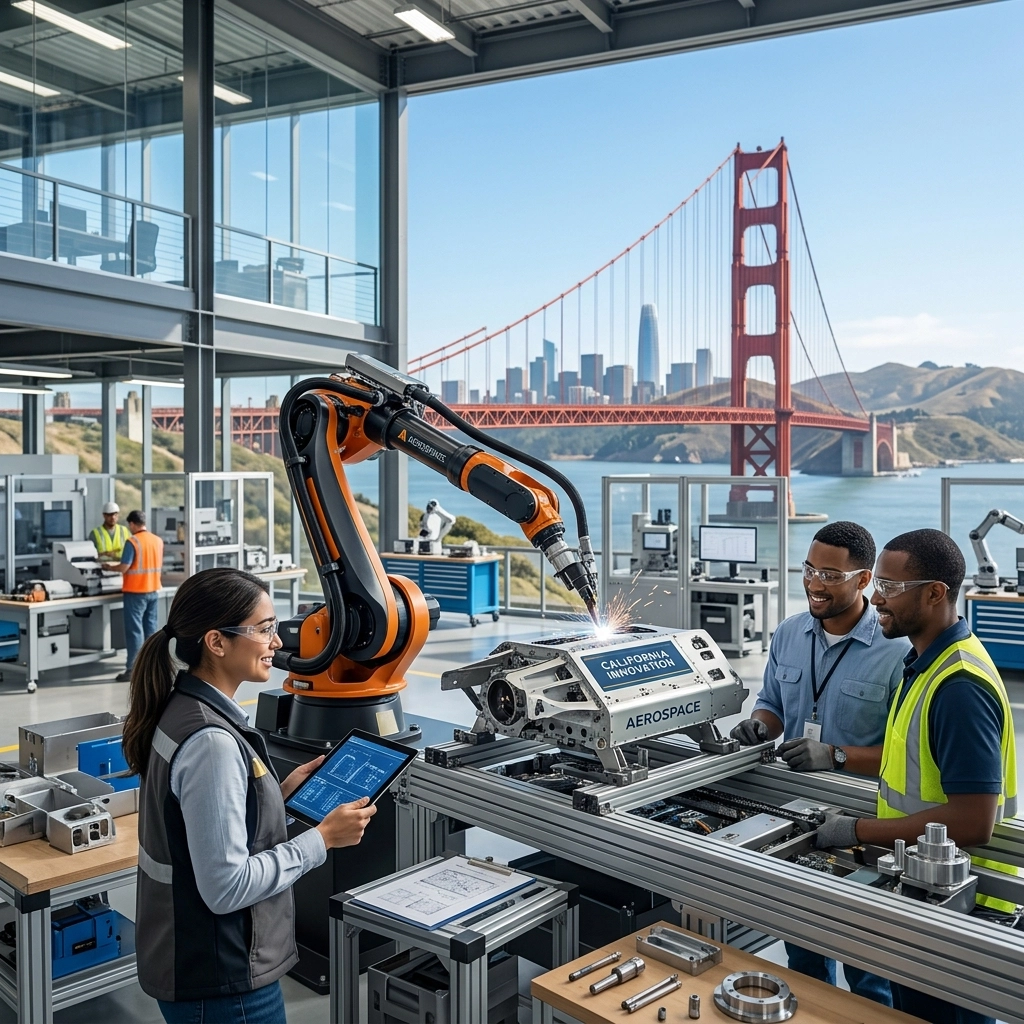
The aerospace manufacturing sector in California is no longer just about building aircraft; it is about the exponential growth of the orbital economy. The integration of 3D printing (additive manufacturing) at scale has allowed aerospace startups to reduce part counts from thousands to dozens, significantly lowering the cost of access to space. This technological leap has created a massive ripple effect, benefiting sub-tier suppliers specializing in advanced alloys and sensor technologies.
3. High-Tech Manufacturing and the Semiconductor Renaissance
While much of the world’s high-volume consumer electronics assembly moved overseas decades ago, California has retained its edge in high-value, high-complexity tech manufacturing. The state is currently a global hub for semiconductor design and specialized fabrication. In a world where supply chain security is a "legitimate purpose" for national concern, California’s tech manufacturers are leading the charge in re-shoring critical components.
The Focus on Silicon and Hardware
Modern startups in California are increasingly focused on hardware that supports the AI revolution. From specialized GPUs to autonomous vehicle sensors, the manufacturing requirements are incredibly precise. This necessitates a workforce that is not just labor-intensive but knowledge-intensive. The synergy between research universities and factory floors ensures that the latest breakthroughs in material science are immediately applied to production lines.

Caption: Advanced semiconductor manufacturing facility in California, showcasing the precision of high-tech industrial automation.
4. Food Production: The Agri-Business Titan
California’s Central Valley is often called the "breadbasket of the world," but its contribution to the manufacturing sector through food processing is frequently undervalued. Food production is a cornerstone of the state’s industrial identity, blending agricultural prowess with sophisticated logistics and processing technology.
From the world’s largest nut processing plants to innovative plant-based protein factories, California is the laboratory for the future of food. The Cali Entrepreneur in this space is focusing on sustainability: reducing water usage in processing and utilizing data-driven insights to minimize waste. This sector provides a stable bedrock for the economy, ensuring that even during tech market fluctuations, the state’s industrial engine continues to hum.
5. Strategic Government Support: Roadmap 4 Innovation (R4I)
In January 2026, the launch of Roadmap 4 Innovation (R4I) marked a new chapter for California's industrial policy. R4I was established as a nonprofit entity to provide technical and business assistance to manufacturers, effectively replacing older federal models with a more agile, state-centric approach.
Key pillars of this support include:
- Tax Credits: Governor Newsom’s administration recently awarded $120 million in tax credits to eight innovative companies, a move projected to create over 2,100 high-paying jobs.
- Workforce Training: Through the Employment Training Panel, R4I has facilitated $40 million in funding to upskill workers for the era of Industry 4.0.
- Sustainability Subsidies: Incentives for manufacturers who adopt green energy and carbon-neutral production processes.
For those interested in how these policies compare to global trends, such as manufacturing shifts in Asia, our blog layout offers deep dives into international business news.
6. The "Cali Entrepreneur" and the Startup Ecosystem
What sets a Cali Entrepreneur apart is the proximity to a unique "innovation infrastructure." Nowhere else in the world is the distance between a venture capital office and a high-tech fabrication lab so short. This allows for a "fail fast" mentality even in hardware, a sector traditionally known for high barriers to entry.
Startups in California benefit from a market of nearly 40 million consumers within the state borders, providing a massive testing ground for new products before they hit the global stage. Whether it is a new medical device or a sustainable fashion brand, the ability to manufacture locally and scale globally is a distinct Californian advantage.

7. Opportunity for Global Synergy: California and India
As we analyze the manufacturing landscape, it is impossible to ignore the growing synergy between California and India. Both regions are currently experiencing a manufacturing boom driven by government incentives and a surge in entrepreneurial talent. While India is positioning itself as the "next big manufacturing hub" for high-volume production, California remains the leader in high-complexity, R&D-heavy manufacturing.
The cross-pollination of ideas and capital between these two regions is a major trend for 2026. Indian entrepreneurs are increasingly looking to California for technological partnerships, while California-based startups are leveraging India’s massive scaling capabilities. To stay updated on these cross-border opportunities, you can contact us for tailored business insights.
8. Navigating Challenges: Costs and Regulations
It would be remiss to discuss California manufacturing without acknowledging the challenges. High energy costs, stringent environmental regulations, and a high cost of living present significant hurdles. However, the state’s "value proposition" lies in its efficiency and innovation. By utilizing data-driven insights and automation, California manufacturers are able to offset higher labor costs through increased productivity and higher-quality output.
The regulatory environment also serves as a "catalyst for change," forcing companies to innovate in ways that make them more competitive in a global market that is increasingly demanding sustainable and ethical production practices.

Caption: A modern robotic assembly line in a California EV factory, demonstrating how automation overcomes high labor costs.
9. Future Outlook: The Smart Factories of 2027 and Beyond
Looking ahead, the "smart factory" will become the standard across California. The integration of 5G-enabled electronic communications networks within factory floors will allow for real-time monitoring and predictive maintenance. This will further democratize manufacturing, allowing smaller startups to compete with established giants by utilizing shared "maker spaces" and high-end industrial facilities on a per-use basis.
The evolution of the "Cali Entrepreneur" will continue to blur the lines between software and hardware. As AI becomes more integrated into the physical world, the ability to manufacture the "bodies" for these AI "brains" will be the next frontier of the industrial race.

Conclusion
The manufacturing sector in California is not a relic of the past but a vibrant, high-tech blueprint for the future. By focusing on high-value sectors like aerospace, semiconductor fabrication, and advanced food production, the state has secured its position as a global leader in innovation. For startups in California, the state provides an unmatched environment of capital, talent, and government support through initiatives like R4I.
As the industrial world undergoes a digital transformation, the Cali Entrepreneur remains at the forefront, proving that with the right mix of technology and vision, manufacturing can thrive even in the most competitive environments. California doesn't just build things; it builds the future. For more insights into how these trends affect your business, visit Business Tantra to explore our latest reports and market movers.

admin


Related Post