






















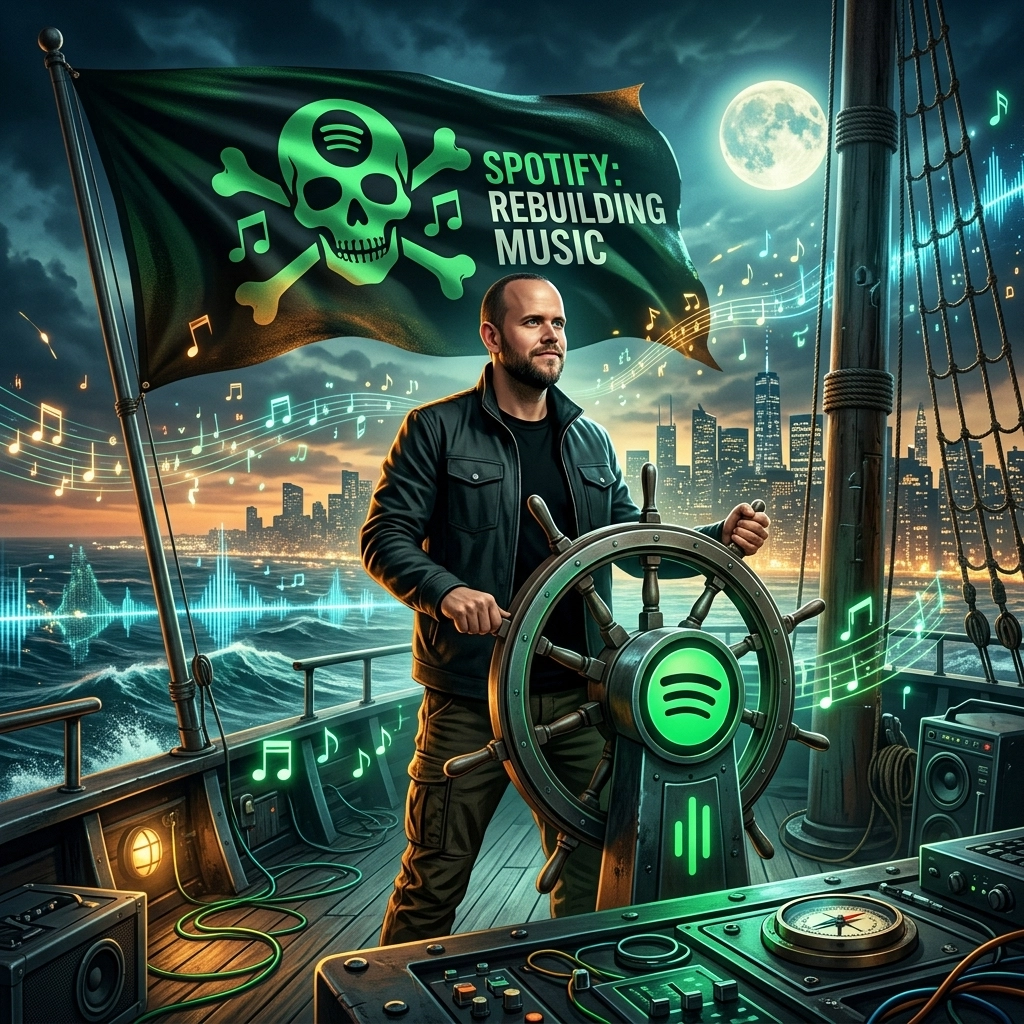
Daniel Ek: The Pirate Who Rebuilt Music with Spotify

How Daniel Ek Saved the Music Industry from Itself
Piracy was killing music. Artists weren't getting paid. He built a 'legal' way to listen for free, and the industry called him crazy.
In the early 2000s, the music industry was in a freefall. The era of the physical CD was crumbling, and in its place stood a digital Wild West. Platforms like Napster, Kazaa, and LimeWire had "democratized" access to music, but at a devastating cost: nobody was paying for it. For the average consumer, the choice was between paying $18 for a plastic disc with two good songs or downloading the entire discography for free in minutes.
The industry’s response was litigious. Record labels began suing their own customers, trying to "legislate away" a technological shift. It was a failing strategy. Amidst this chaos, a young Swedish tech prodigy named Daniel Ek saw a different path. He didn't want to fight the pirates; he wanted to out-compete them. Daniel Ek's Spotify journey is not just a story of a successful startup; it is a masterclass in how a "pirate" mindset, when channeled through a legitimate purpose, can revitalize an entire global economy.
1. Background: The Tech Prodigy in Sweden
Daniel Ek was never a traditional student. Born in 1983 in Ragsved, a suburb of Stockholm, he was a child of the internet age. By the age of 14, he was already running a business from his bedroom, creating websites for local companies and managing web hosting services. At an age when most teenagers were worried about high school exams, Ek was earning more than his parents.
His trajectory was always towards the "bleeding edge" of technology. He briefly attended the KTH Royal Institute of Technology but dropped out after just eight weeks, realizing that the academic world couldn't keep pace with the exponential growth of the digital sector.
Ek’s early career was a whirlwind of entrepreneurial success. He founded Advertigo, an online marketing firm, which he sold to Tradedoubler in 2006. This sale made him a multi-millionaire at 23. He tried the "retired life": buying a Ferrari and frequenting high-end clubs: but quickly found it hollow. He realized that his true passion wasn't just wealth; it was solving complex, systemic problems.
Crucially, Ek spent a brief period as the CEO of μTorrent, the world’s most popular BitTorrent client. This gave him a front-row seat to the mechanics of piracy. He understood why people used it: it wasn't just because it was free; it was because it was easy. It had every song in the world in one place. If he wanted to build a legal alternative, it had to be better than piracy. It had to be faster, more intuitive, and just as comprehensive.

2. The Struggle: Negotiating with the Labels
In 2006, Ek co-founded Spotify with Martin Lorentzon. The vision was simple: a "celestial jukebox" that gave users instant access to all the world's music. But the execution was a nightmare. To make Spotify a reality, Ek needed the "Big Three" record labels: Universal, Sony, and Warner: to agree to license their entire catalogs.
The negotiations were brutal. The music industry executives viewed tech entrepreneurs with extreme suspicion. They saw Spotify’s "freemium" model: where users could listen for free with ads: as a direct threat to their remaining CD and iTunes revenue. They called Ek crazy. Why would anyone pay for music if they could get it for free on the same app?
For two long years, Spotify existed as a product without a launch. Ek and his team spent millions of dollars of their own money just to keep the lights on while they begged for meetings. Ek’s secret weapon was the product itself. When he finally got executives into a room, he would show them the interface. The speed was the "catalyst for change." In an era of slow downloads, Spotify played music instantly. It felt like the music was already on your hard drive.
Eventually, by offering the labels equity in the company and promising a steady stream of "micro-payments" from every single play, Ek secured the deals. Spotify launched in Sweden and parts of Europe in 2008. But the biggest challenge: the United States: was still ahead.

3. Turning Point: The US Launch and the Sean Parker Effect
The 2011 US launch was the make-or-break moment for Daniel Ek's Spotify journey. The American market was the graveyard of many European tech firms. To succeed, Ek needed an ally who understood the "pirate" DNA. He found it in Sean Parker, the co-founder of Napster and the first president of Facebook.
Parker had been an early fan of Spotify, even emailing Ek to tell him that he had built the product Parker had dreamed of since Napster. Parker’s involvement provided Spotify with the Silicon Valley "street cred" and the strategic connections needed to navigate the American landscape.
The US launch changed everything. It wasn't just a music player; it was a social network. Integration with Facebook allowed users to see what their friends were listening to in real-time. Suddenly, music was no longer a solitary file on an iPod; it was a living, breathing social experience. The growth was explosive. Within months, Spotify went from a European curiosity to a global powerhouse, proving that consumers were willing to pay for convenience and curation even when "free" was an option elsewhere.
4. Growth: Personalization, Data-Driven Decisions, and Podcasts
As the company scaled, Ek realized that having every song wasn't enough. In a world of infinite choice, the most valuable commodity is curation. This led to the development of "Discover Weekly," an AI-driven recommendation engine that used data-driven insights to predict what a user wanted to hear before they knew it themselves.
This pivot to personalization turned Spotify from a utility into a daily habit. But Ek wasn't finished. He observed that the "music" industry was actually the "audio" industry. In 2019, he led Spotify on a massive spending spree, acquiring podcast networks like Gimlet and The Ringer, and signing exclusive deals with figures like Joe Rogan.
His goal was to "democratize" audio. By bringing podcasts into the same interface as music, Spotify increased user engagement and diversified its revenue streams, making it less dependent on the high-royalty payments demanded by record labels. This move solidified Spotify’s position as the dominant platform for the "earshare" of the global population.

5. Lessons: Innovation through Legality and Resilience
The story of Daniel Ek provides several critical lessons for modern entrepreneurs and business leaders:
- Innovation through Legality: You don't have to break the law to disrupt an industry. Ek took the core value proposition of piracy (access and speed) and wrapped it in a "legitimate purpose" that benefited stakeholders.
- User Experience as a Moat: Spotify’s greatest defense against competitors like Apple and Google wasn't just its library; it was its friction-less interface. In business, speed is often a feature in itself.
- Data-Driven Decisions: Ek moved the music industry from "gut-feeling" A&R decisions to data-backed streaming metrics. This shift allowed for more efficient marketing and a better understanding of consumer behavior.
- The Pivot is Essential: Ek’s transition from a music-only platform to an all-audio platform (podcasts, audiobooks) was a masterstroke in future-proofing the business.
For those looking to build their own legacy, whether through tech or traditional commerce, understanding these principles is vital. If you are looking to start your own professional journey, having the right tools, like a Digital Business Card, can be your first step in building a modern network.
Conclusion: The New Rhythm of the Industry
Daniel Ek did the impossible: he convinced the world to pay for something they had grown accustomed to getting for free. In doing so, he didn't just build a company; he saved an entire industry from its own obsolescence. Today, streaming accounts for over 80% of recorded music revenue, and the industry is more profitable than it has been in decades.
On September 30, 2025, Ek announced he would step down as CEO to become Executive Chairman, a move that signals his transition from an operational leader to a long-term strategist. His journey from a "pirate" teenager in Sweden to the executive of a $60+ billion company is a testament to the power of resilience and the belief that technology can be a force for both disruption and restoration.
At Business Tantra, we follow these stories of entrepreneurial excellence closely to provide you with the insights needed to navigate the modern market. Daniel Ek’s legacy is a reminder that the best way to predict the future is to build a legal, better version of it.

Want to stay updated on more business success stories and industry news? About Us | Contact Us

admin

Related Post
- By admin
- 06 Views