


























The 'Mail Order' Mistake That Created the King of Streaming
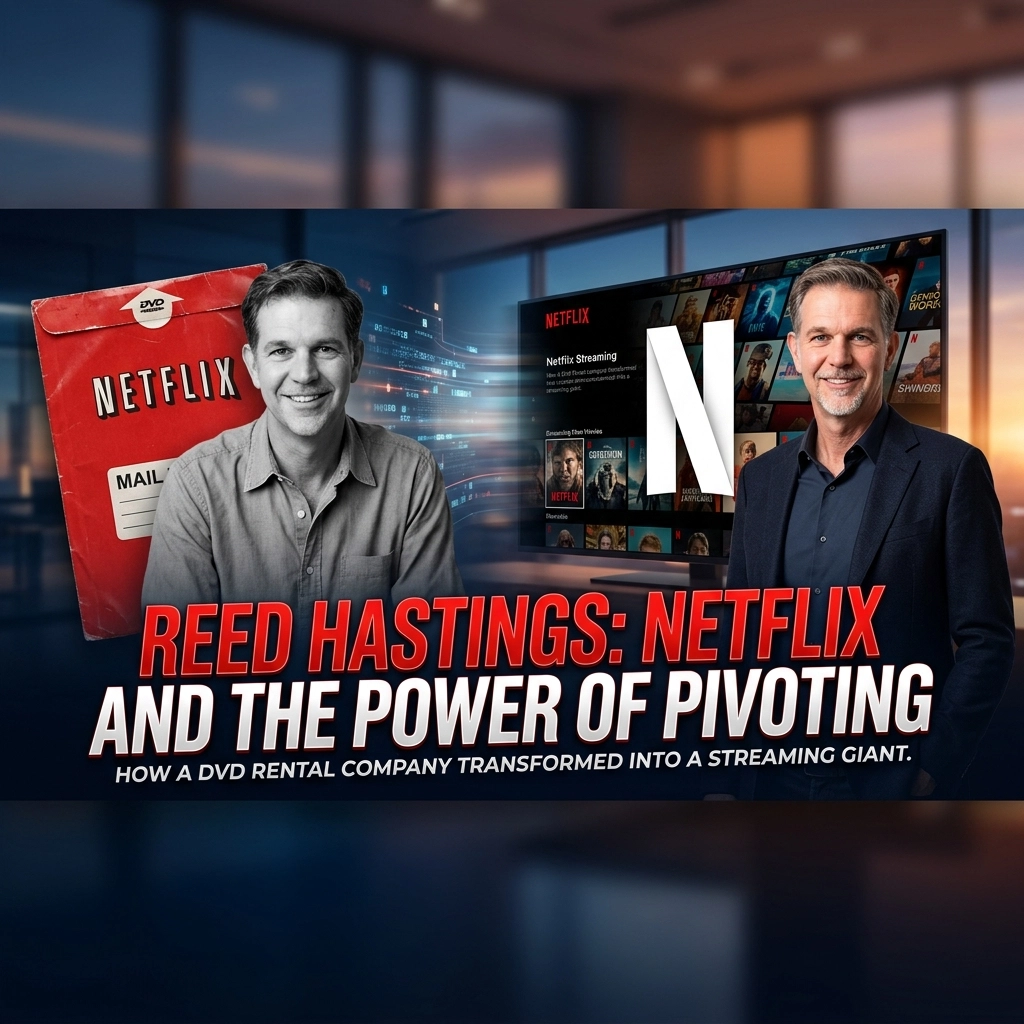
He was charged a $40 late fee for a VHS tape. Most people would just pay it, grumble about the injustice of corporate greed, and move on with their lives. Reed Hastings decided to build a company to kill late fees forever.
In the fast-paced world of digital disruption, few stories resonate as powerfully as the evolution of Netflix. Today, as we look back from April 2026, the company stands as a titan of global entertainment, but its path was far from a straight line. The story of Netflix and the Power of Pivoting is a masterclass in how a "mission-driven" approach can turn a minor annoyance into a multi-billion dollar empire that fundamentally changed how the world consumes stories.
Background: The Pure Software Foundation
Long before the red envelopes or the "Tudum" sound, Reed Hastings was a mathematician and a software engineer. After a stint in the Peace Corps teaching math in Swaziland, he founded Pure Software in 1991. The company created tools for developers to troubleshoot code: a far cry from Hollywood glamour.
Pure Software was a success by any standard, eventually merging with Atria Software and being acquired for $750 million. However, the experience left Hastings with a profound realization. As the company grew, it became burdened by bureaucracy and "process-oriented" thinking that stifled creativity. He realized that to build a truly great company, he needed a culture that could scale without losing its soul.
When Hastings "lost" a copy of Apollo 13 and faced that infamous $40 late fee at Blockbuster, he didn’t just see a problem; he saw a market opportunity to democratize movie access. He realized that the gym membership model: a flat monthly fee for unlimited access: could be applied to home entertainment. Along with co-founder Marc Randolph, he launched Netflix in 1997 as a DVD-by-mail service. It was a "mail order" mistake that Blockbuster never saw coming.

The Struggle: When Blockbuster Laughed
Every great entrepreneurial saga has a moment of profound rejection. For Netflix, that moment came in 2000. The dot-com bubble had burst, and Netflix was burning cash at an unsustainable rate. Hastings and Randolph flew to Dallas to meet with the executives of Blockbuster, the undisputed king of the video rental world with thousands of stores across the globe.
Hastings offered to sell Netflix to Blockbuster for $50 million. The proposal was simple: Netflix would run Blockbuster’s online brand, and Blockbuster would promote Netflix in its stores. The Blockbuster executives reportedly "laughed them out of the room." To the incumbents, Netflix was a niche service for "nerds" who didn't mind waiting two days for a movie.
This rejection was the ultimate catalyst for change. It forced Hastings to double down on his vision. It wasn’t just about being a better rental store; it was about leveraging technology to create a superior user experience. At Business Tantra, we often see this pattern: the arrogance of the incumbent becomes the fuel for the disruptor. You can read more about similar market shifts in our home-news section.
Turning Point: The Shift to Streaming
The first major pivot in the history of Netflix and the Power of Pivoting occurred in 2007. Despite the DVD business finally becoming profitable, Hastings saw the writing on the wall. Bandwidth speeds were increasing, and YouTube was proving that people were willing to watch grainy videos on their computers.
Hastings famously split his management team. He realized that if the people running the DVD business were also in charge of streaming, they would naturally protect their existing revenue stream and stifle the new technology. He relegated the DVD executives to their own meetings, focusing the core of the company's intellectual capital on the "Watch Now" button.
This was a high-stakes gamble. At the time, the streaming library was tiny and the quality was subpar compared to a physical disc. But Hastings understood that the "value proposition" wasn't the disc: it was the convenience. By 2011, the company faced its biggest PR disaster with the "Qwikster" announcement: an attempt to split the DVD and streaming services into two separate brands. While the execution was flawed, the underlying logic was sound: the future was digital, and the company had to be willing to cannibalize its own successful business to survive.
Growth: The Original Content Revolution
By 2013, Netflix faced a new existential threat. The major studios and cable networks realized that Netflix was no longer a helpful "after-market" for their old shows; it was a competitor. They began hiking licensing fees and withholding their best content.
Hastings’ response was the second major pivot: becoming a studio. "The goal is to become HBO faster than HBO can become us," he famously stated. This wasn't just a shift in strategy; it was a shift in the company's DNA. Netflix moved from being a tech aggregator to a creative powerhouse.
The launch of House of Cards was a data-driven insight put into practice. Netflix didn't just guess that a political drama starring Kevin Spacey and directed by David Fincher would work; they knew from their viewing data that their audience loved all three components. This move allowed Netflix to achieve exponential growth, moving from 33 million subscribers in 2013 to over 200 million by the early 2020s.

Lessons: Adapt or Die, Culture is Product
The enduring legacy of Reed Hastings isn't just a streaming app; it’s the "Netflix Culture Memo." Hastings believes that a company’s culture is its most important product. He implemented a "Freedom and Responsibility" framework that includes:
- The Keeper Test: Managers ask themselves, "If this employee wanted to leave for a similar job at a peer company, would I fight to keep them?" If not, they are given a generous severance package.
- Radical Candor: Employees are encouraged to give direct feedback to anyone, including the CEO.
- No Rules Policy: From vacation time to travel expenses, Netflix trusts its employees to act in the company’s best interest.
For any entrepreneur reading this on Business Tantra, the lesson is clear: Adapt or die. Netflix’s ability to pivot was only possible because they had a high-performance culture that embraced change rather than fearing it. They viewed every technological shift not as a threat, but as a "legitimate purpose" to reinvent their service.
Netflix and the Power of Pivoting in 2026
As of April 2026, the streaming landscape has reached a point of saturation. Yet, Netflix continues to thrive by pivoting yet again: this time into gaming, live sports, and ad-supported tiers. Reed Hastings, now in his role as Executive Chairman, has successfully passed the torch to Ted Sarandos and Greg Peters.
The company has revitalized its business model to include diversified revenue streams while remaining focused on "member joy." Their journey from a $40 late fee to a global cultural phenomenon serves as a blueprint for any business navigating the "electronic communications network" of the modern era.

Conclusion
The story of Reed Hastings and Netflix proves that your initial business model is rarely your final one. The power of pivoting lies in the ability to stay wedded to your vision while remaining flexible with your tactics. Whether it was fighting Blockbuster’s late fees, betting the house on streaming, or spending billions on original content, Netflix has consistently shown that the greatest risk is standing still.
At Business Tantra, we believe that understanding these "market movers" is essential for any modern professional. Success isn't just about a great idea; it's about the relentless pursuit of improvement and the courage to change direction when the world shifts beneath your feet.
Are you ready to pivot your business toward success? Stay updated with the latest in business news and strategy right here.
To learn more about our mission to empower entrepreneurs, visit our About Us page or Contact Us for collaborations.