


























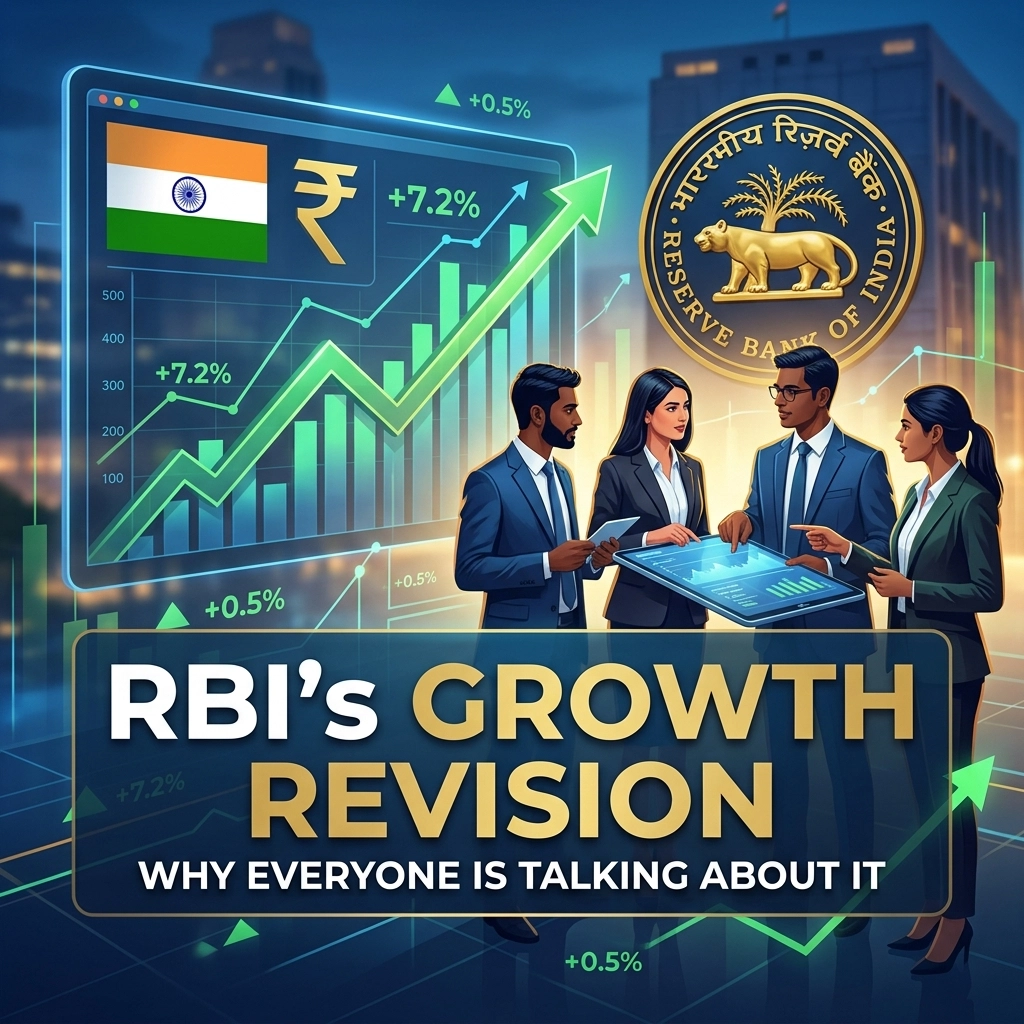

In the high-stakes world of macroeconomics, a decimal point can be the difference between cautious optimism and a full-blown market rally. This is precisely why the RBI’s growth revision in the February 2026 Monetary Policy Committee (MPC) meeting has become the focal point of every boardroom discussion from Mumbai to Silicon Valley.
When Governor Das announced that the Reserve Bank of India was upgrading its GDP growth forecast for FY26 from 7.3% to 7.4%, it wasn't just a statistical adjustment. It was a loud, clear signal that India is currently navigating a "Goldilocks" phase, an economy that is neither overheating with runaway inflation nor cooling into a recessionary slump. For entrepreneurs, investors, and the average taxpayer, this revision is a catalyst for change that deserves a deep dive.
1. The Power of 0.1%: Understanding the RBI’s Growth Revision
To the uninitiated, a shift from 7.3% to 7.4% might seem like academic hair-splitting. However, in an economy as massive as India's, that 0.1% represent billions of dollars in additional economic output. The RBI’s growth revision is a direct response to the resilience of domestic demand, which has remained stubbornly strong despite the "Operation Epic Fury" conflict in the Middle East and the subsequent volatility in global oil prices.
The central bank’s confidence stems from a "Structural Recovery." We are no longer looking at a post-pandemic bounce-back; we are witnessing a fundamental shift in India's industrial and digital infrastructure. This 7.4% projection positions India as the fastest-growing major economy globally, a title it has defended with remarkable consistency. At Business Tantra, we believe this revision serves as a "Green Light" for long-term capital expenditure (CapEx) planning.

2. The Repo Rate Hold: Why 5.25% is the Sweet Spot
While the growth revision stole the headlines, the decision to maintain the Repo Rate at 5.25% provides the necessary stability to fuel that growth. By keeping rates steady, the RBI is balancing the need to support consumption while keeping a watchful eye on the 2.1% projected inflation rate.
For the business community, this "steady hand" approach means:
- Loan Predictability: Businesses looking to scale can rely on stable interest costs for their working capital and expansion loans.
- Investment Security: Fixed-income investors can enjoy decent yields without the immediate fear of a rate-cut cycle devaluing their returns.
- Consumer Confidence: As long as home loan and auto loan EMIs remain stable, private consumption, the biggest driver of our GDP, is likely to stay robust.
This policy consistency is a cornerstone of the Business Tantra mission to provide clarity in an often-confusing financial landscape.
3. The "Goldilocks Phase" and the Neutral Stance
One of the most significant takeaways from the February meet was the shift to a "Neutral" stance. Previously, the RBI was focused on the "withdrawal of accommodation," a technical way of saying they were sucking liquidity out of the system to fight inflation. By moving to neutral, the RBI is essentially saying: "We’ve reached the destination. Now, we watch and wait."
This neutral stance is the hallmark of a Goldilocks economy. It suggests that the current monetary conditions are "just right."
- Manufacturing is reviving: Supply chains are localizing under the "Make in India" initiative.
- Services are surging: Digital exports and domestic SaaS demand are at record highs.
- Agriculture is a tailwind: With healthy reservoir levels and a strong rabi sowing season, the rural economy is finally catching up with its urban counterpart.

4. Big Wins for MSMEs: Democratizing Credit
The RBI’s growth revision wasn't the only gift for the business sector. The central bank has doubled down on its commitment to democratizing credit for Micro, Small, and Medium Enterprises (MSMEs). A new framework for collateral-free loans, supported by AI-driven credit scoring, is set to revitalize the heart of Indian industry.
For years, the "credit gap" has been a primary hurdle for small manufacturers. The latest policy measures aim to bridge this gap by utilizing the "Account Aggregator" framework, allowing MSMEs to leverage their cash-flow data rather than physical assets to secure funding. If you are an entrepreneur looking to capitalize on this, staying updated with our latest news is essential.
5. Real Estate and the REITs Revolution
The stability in interest rates has also provided a significant boost to the Real Estate sector. With the repo rate held at 5.25%, Real Estate Investment Trusts (REITs) are becoming an increasingly attractive vehicle for retail investors. The RBI's optimistic growth revision suggests that commercial real estate demand, driven by the IT and manufacturing boom, will continue to rise.
This creates a virtuous cycle:
- Stable Rates lead to affordable project financing.
- Growth Revisions attract foreign institutional investors (FIIs).
- Increased Liquidity allows developers to complete projects on time, boosting buyer sentiment.

6. Navigating Global Headwinds: The Structural Shield
It is impossible to discuss the RBI’s growth revision without mentioning the global context. As we sit in April 2026, the world is grappling with fragmented trade blocks and geopolitical friction. However, India's "Structural Recovery" acts as a shield.
The RBI pointed out that while net external demand might be a drag due to global slowdowns, the sheer volume of internal consumption is enough to carry the 7.4% weight. This "de-coupling" is what makes the Indian story so compelling to global investors right now. We are no longer just a "back-office" to the world; we are a primary market.
7. What This Means for Your Investment Strategy
With a 7.4% growth forecast and a neutral RBI stance, the investment thesis for 2026 becomes clearer:
- Equity Markets: Sectors like Banking, Infrastructure, and Defense are likely to see exponential growth as they are the primary beneficiaries of a CapEx-led recovery.
- Debt Markets: With inflation under control at 2.1%, the real rate of return is currently very attractive for debt fund investors.
- Startups: For those looking at the California vs. India startup landscape, the RBI's move makes the Indian market look significantly more "de-risked" compared to high-interest-rate environments in the West.
Conclusion: A Definitive Vote of Confidence
The RBI’s growth revision to 7.4% is far more than a routine update; it is a definitive vote of confidence in the Indian economic engine. By maintaining a repo rate of 5.25% and adopting a neutral stance, the central bank has provided the perfect environment for "exponential growth" across sectors.
Whether you are an MSME owner looking for collateral-free credit or a retail investor eyeing the REITs market, the message is clear: India is in a structural uptrend. The "Goldilocks" phase is here, and those who align their business strategies with this momentum are likely to reap significant rewards.
Stay tuned to Business Tantra as we continue to track these shifts and provide you with the data-driven insights you need to navigate the 2026 economy. If you haven't already, register today to get these updates delivered straight to your inbox.
Disclaimer: This article is for informational purposes only and does not constitute financial advice. Please consult with a certified financial advisor before making investment decisions.