


























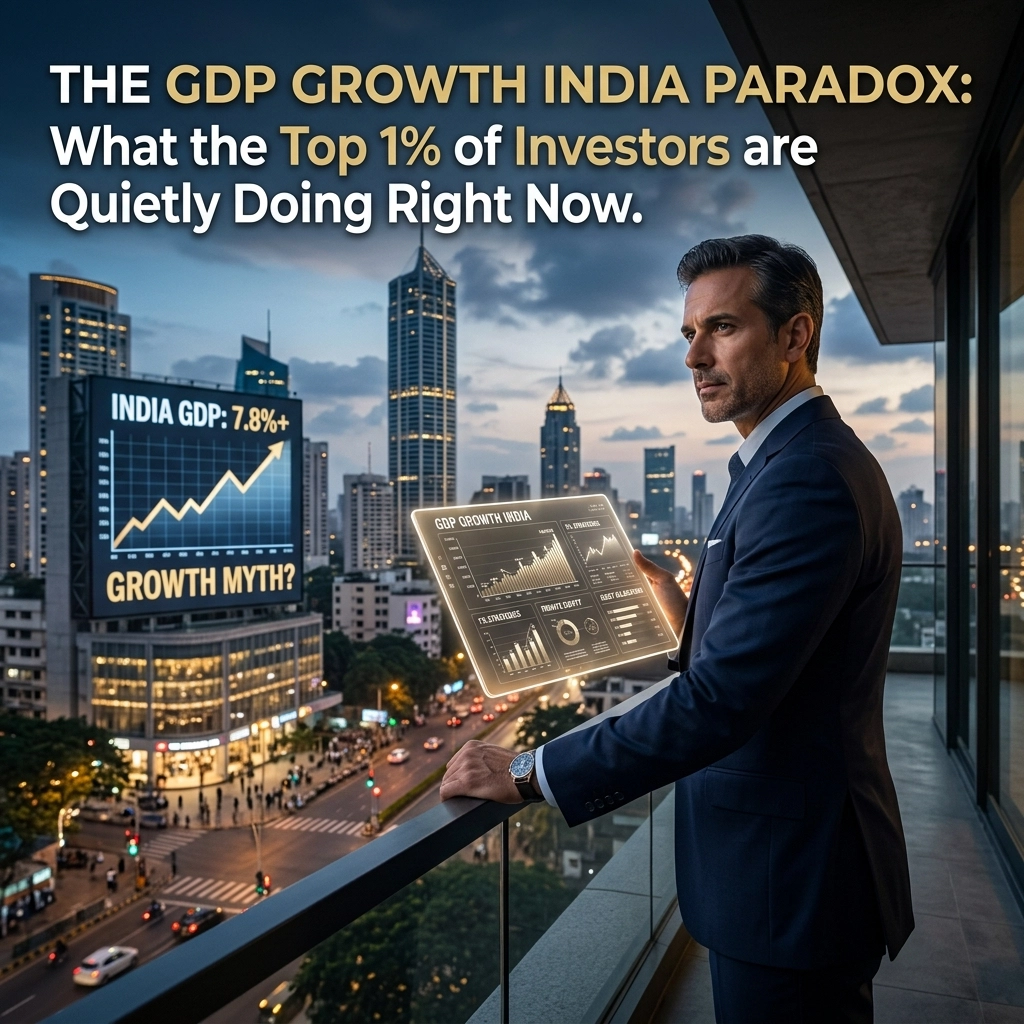

The mainstream media is feeding you a sedative, and most of you are swallowing it whole. While the headlines scream about a "global miracle" and a "roaring tiger," the cold, hard data suggests a far more predatory reality. In the boardroom shadows of Mumbai and the elite social clubs of Delhi, the conversation isn’t about how high the tide is rising: it’s about who is going to be left naked when it recedes.
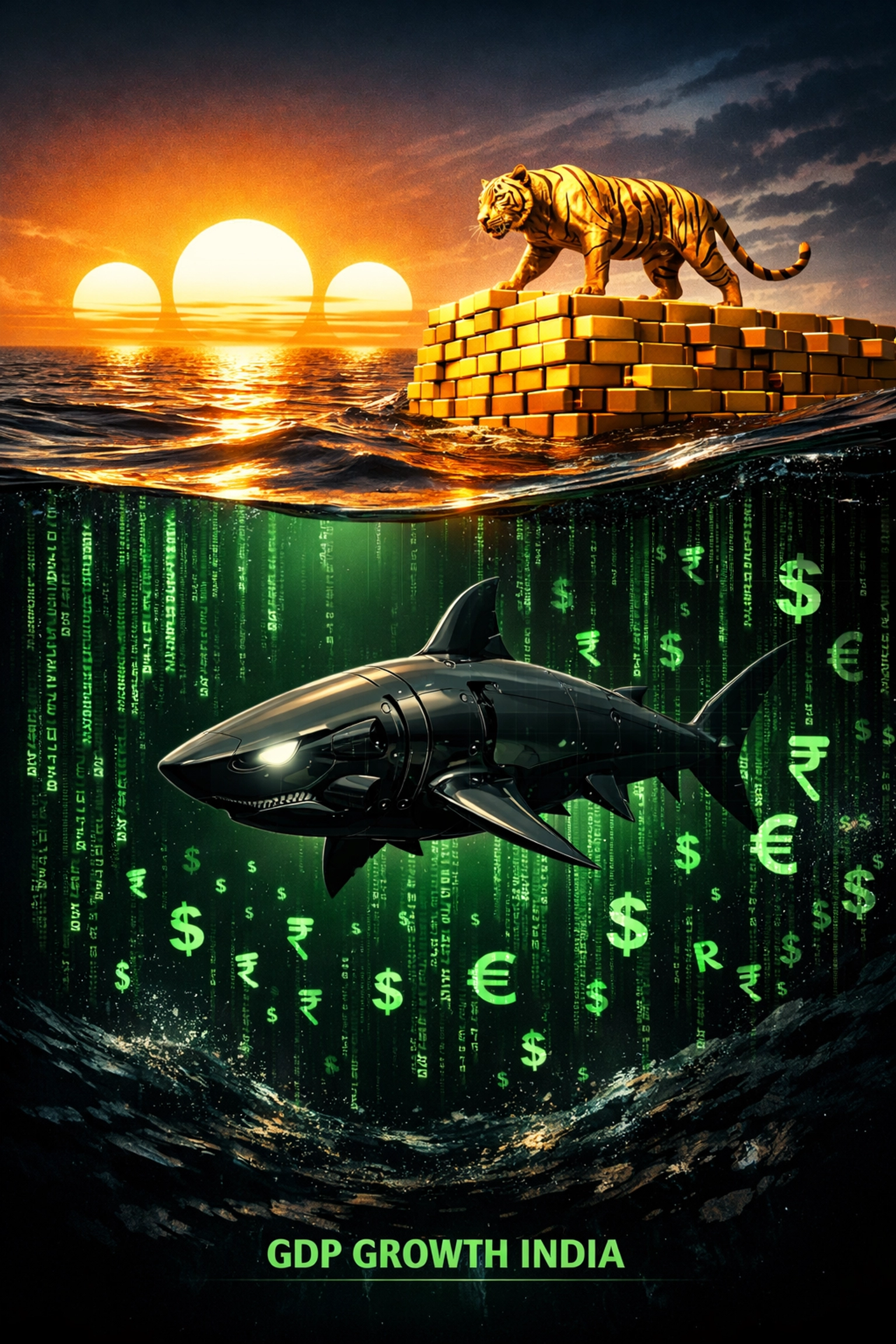
The official GDP Growth India narrative is currently standing at a staggering 8.2% real growth for Q2 FY26. On paper, this is a triumph. In reality, it is a statistical anomaly that masks a hollowed-out core. The top 1% of investors: the sharks who move before the blood hits the water: are not buying the hype. They are quietly, aggressively, and surgically reallocating their capital. If you are still trading based on the evening news, you aren't an investor; you are the exit liquidity for the elite. 🦈
The Illusion of 8.2%: Why GDP Growth India is a Double-Edged Sword ⚔️
To understand the paradox, you must look beneath the "Real GDP" mask. While the headline GDP Growth India figure is pegged at 8.2%, the core GDP growth: the actual muscle of the economy: has plummeted to a measly 4.1%. This is a nine-quarter low. The disconnect is not just a rounding error; it is a systemic credibility gap.
Why the discrepancy? The "Real" growth figure is being artificially inflated by low inflation or even localized deflation in certain sectors, which makes the "Real" numbers look better than the "Nominal" ones. In a healthy, surging economy, nominal growth should be significantly higher than real growth. Currently, nominal growth is struggling at 8.7%. This is a "catalyst for change" that most retail investors are ignoring at their own peril. When nominal growth is this weak, corporate earnings fail to materialize. You cannot pay dividends or expand factories with "Real" GDP percentages; you need actual, nominal cash flow.
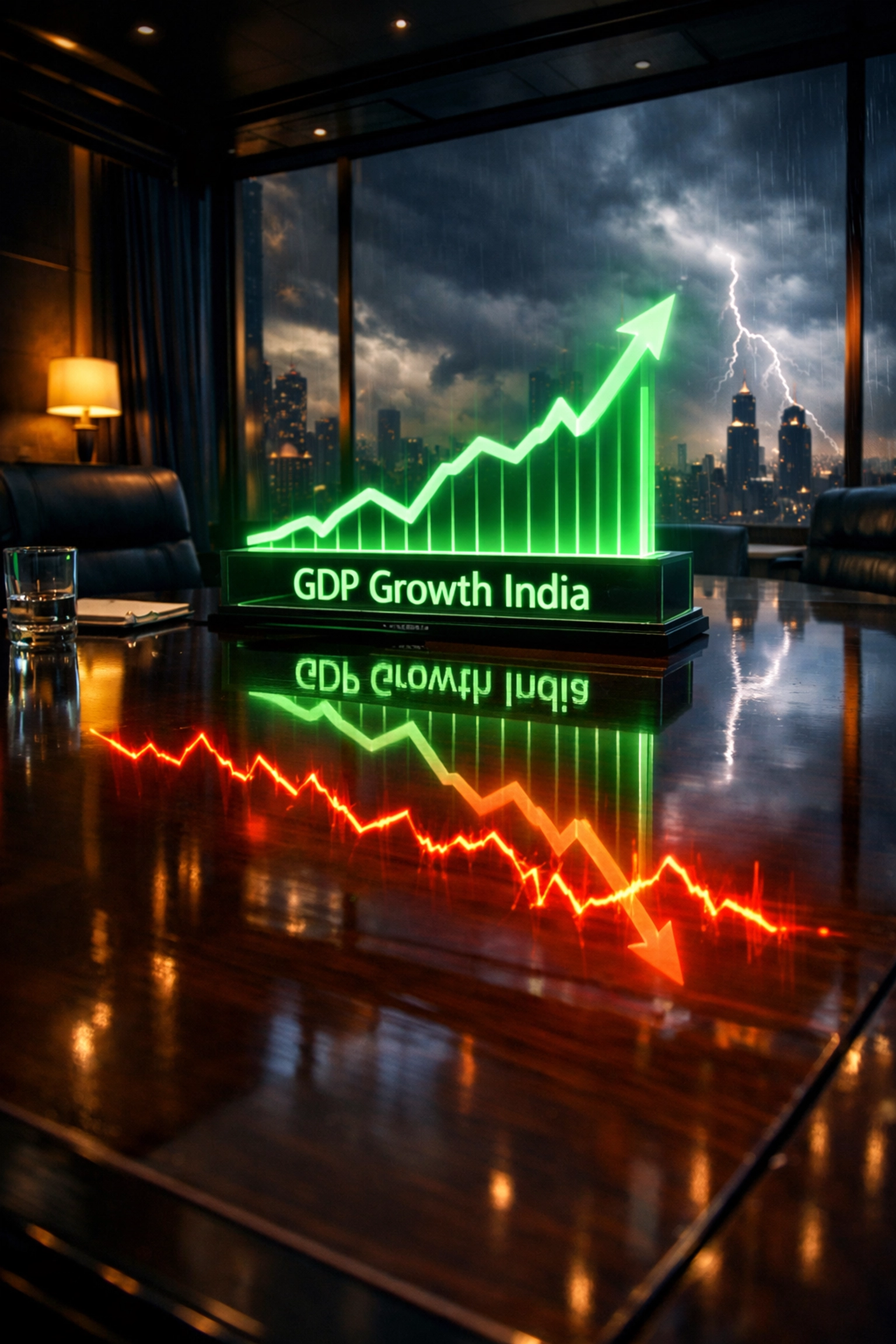
Sophisticated capital is already reacting to this. According to data from the Reserve Bank of India, the gap between manufacturing output and service sector demand is widening. While the government pushes for a $35 trillion vision, the immediate ground reality is one of uneven consumption.
The Silent Erosion: Decoupling Ground Reality from the Excel Sheets 📊
If the GDP Growth India story was as robust as the government claims, why are the high-frequency indicators flashing crimson? 🚨
- GST Collections: Growth has decelerated to low single digits, a clear sign that transaction volumes are hitting a ceiling.
- Electricity Demand: Industrial demand for power actually turned negative in the October-November period.
- Petroleum Consumption: Fuel usage: the lifeblood of logistics: remains erratic and weak.
The top 1% are looking at these "data-driven insights" and realizing that the consumer is exhausted. The middle class is being squeezed by high interest rates, while the elite are moving into assets that are decoupled from local consumption. This is why we are seeing a surge in high-value transactions even as mass-market sales slump. We've seen a similar pattern in the US, as discussed in our analysis of whether the AI bubble is finally popping in LA.
The Exodus of the Elite: What the Top 1% Know That You Don’t
Foreign Institutional Investors (FIIs) are not waiting around for a "revitalized" second half of the year. They are voting with their feet. Staring at anemic earnings growth and valuations that can only be described as "hallucinogenic," they have begun a massive liquidation of Indian equities.
The paradox of GDP Growth India is that while the economy looks "fast," the stocks are "expensive." When you pay 25x earnings for a company growing its bottom line at 5%, you are not investing; you are donating. The elite 1% are pivoting away from the public markets and into "legitimate purpose" private equity and MSME growth plays where they can exert more control over the outcome.
Strategic Pivot: Reallocating Capital into the 'New India' Sectors 🚀
The smart money isn't leaving India entirely: it’s just leaving the old India. They are moving into sectors that are being aggressively deregulated. The Jan Vishwas 2.0 legislation is a massive "catalyst for change," decriminalizing business compliance and making it easier for agile companies to scale without the fear of predatory litigation.

Top-tier investors are doubling down on:
- NFC-Enabled Business Tech: Digitizing the very fabric of networking. Check out how NFC-enabled digital business cards are becoming the standard for the elite.
- MSME Scaling: While large-caps struggle with bloated valuations, MSMEs are finding new ways to triple their revenue.
- High-Value Real Estate: We are seeing $25 million home sales becoming a "new normal" in Mumbai and Alibaug. This is a classic "wealth parking" strategy during periods of headline volatility.
Navigating the GDP Growth India Narrative as a Professional Investor
To survive this paradox, you must adopt a journalistic, third-person perspective on your own portfolio. Stop falling in love with the "Growth Story." Start looking at the cash. The GDP Growth India metric is a useful tool for politicians, but for a "Business Tantra" professional, it is a distraction.
The mission now is to identify the "value proposition" in sectors that have been overlooked. The stock market may be overpriced, but the "electronic communications network" of India’s digital economy is still in its infancy. There is exponential growth to be found in the infrastructure that supports the $100 billion startup gold rush, provided you know where to look.
The Billion-Dollar Exit: Exploiting the Credibility Gap
The gap between the 8.2% "Real" growth and the 4.1% "Core" growth is where the profit lies. This is the "credibility gap." While the masses pile into index funds based on the 8.2% figure, the 1% are shorting overextended sectors and buying into the "Core." They are looking for businesses that thrive regardless of what the GDP Growth India headlines say: businesses with "data-driven insights" and resilient "value propositions."
Conclusion: The Verdict on the 2026 Economic Mirage 🏁
The GDP Growth India paradox is a masterclass in economic theater. We are witnessing a monumental shift where headline numbers no longer reflect the ground reality of the average business. The top 1% of investors are not being "pessimistic": they are being "precise." They are trimming the fat, exiting the hype cycles, and positioning themselves in deregulated, high-moat sectors that will survive the inevitable valuation correction.
The 2026 economic landscape is one of "exponential growth" for those who can see through the fog and "systemic risk" for those who cannot. Don't be a spectator to your own financial demise. Decouple your strategy from the headlines, focus on nominal earnings, and follow the quiet move of the elite. The tiger is still roaring, but the sharks are the ones truly feeding.
For more deep dives into the evolving Indian economy and to stay ahead of the curve, visit our About Us page or explore our post sitemap for the latest industrial insights. 📈