
























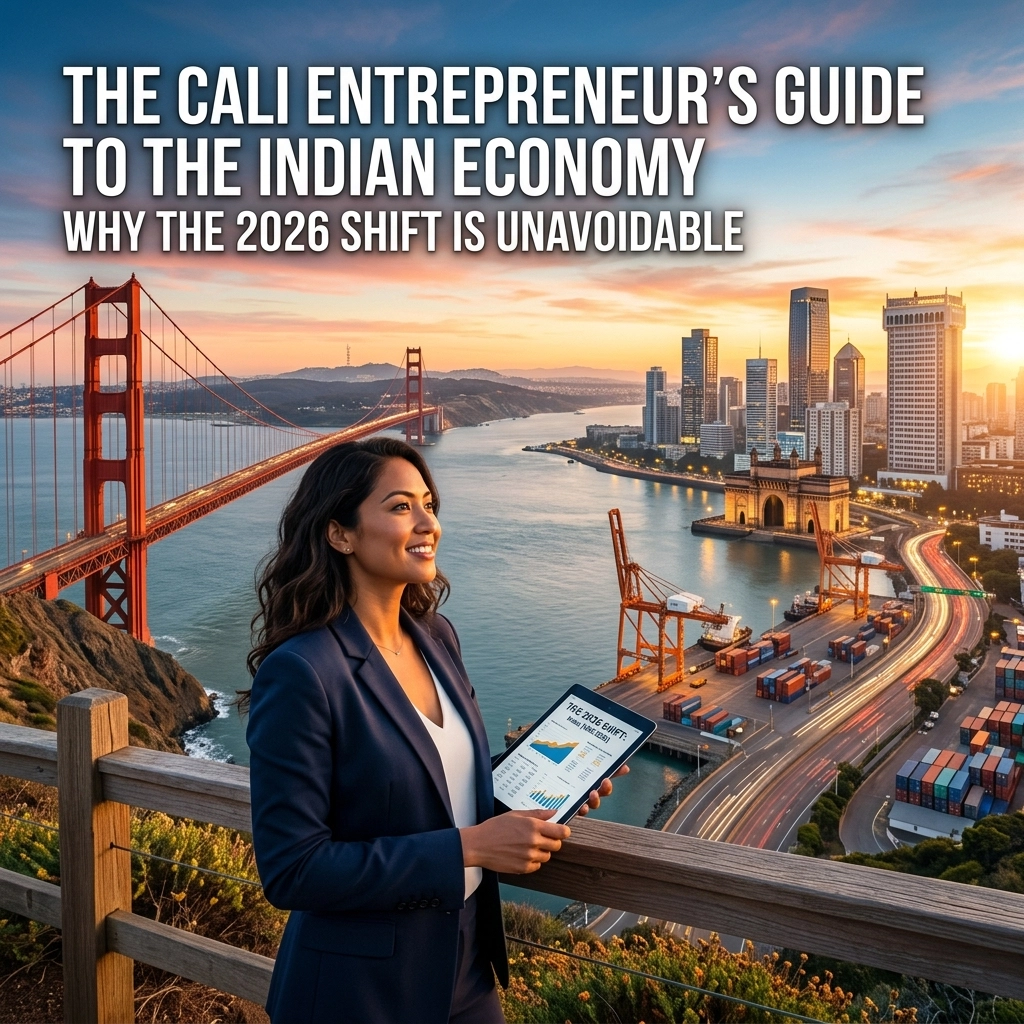
The Cali Entrepreneur’s Guide to the Indian Economy: Why the 2026 Shift is Unavoidable.

Listen up, Silicon Valley. If you’re still staring at the cooling embers of the Palo Alto AI hype cycle, you’re missing the largest wealth migration in human history. The "California Dream" is currently being rewritten in the high-rises of Mumbai and the tech parks of Bengaluru. As of April 2026, the global financial compass has permanently pivoted. 🧭
The Economy of India is no longer just an "emerging market" or a "outsourcing hub" to be considered during a quarterly review. It is the mandatory theater of operations for any entrepreneur who plans to exist in five years. If you are a California-based founder, investor, or C-suite executive ignoring the seismic shifts of 2026, you aren't being cautious: you’re being obsolete. 📉
1. The Death of the California Bubble and the Rise of Real-World Utility
For years, the LA and SF tech scenes have been bloated on venture debt and speculative AI valuations that lacked a bottom line. We’ve already seen signs that the AI bubble in LA is finally popping, leaving thousands of founders scrambling for a "Plan B."
Meanwhile, the Economy of India has been building something far more resilient. While California chased "vibes," India chased infrastructure. The 2026 Union Budget has poured fuel on this fire, specifically targeting MSMEs and green businesses with a ferocity that makes US federal incentives look like pocket change. For a Cali entrepreneur, the shift isn't just about moving capital; it’s about moving into a market that actually demands solutions for the next billion users.

2. Navigating the 2026 Tectonic Shift in the Economy of India
What makes 2026 different? It’s the year the regulatory "Jan Vishwas 2.0" movement fully matured. The Indian government has effectively decriminalized hundreds of minor business compliance issues, turning a once-notorious bureaucracy into a streamlined machine designed for rapid scaling. 🚀
When we analyze the Economy of India today, we see a landscape where the "Ease of Doing Business" isn't just a political slogan: it’s a operational reality. For a California entrepreneur used to the crushing weight of CA state regulations and astronomical tax burdens, India’s current fiscal environment is a revitalized sanctuary.
- Green Energy Mandates: Massive subsidies for any tech tackling carbon sequestration.
- MSME Integration: Local manufacturing is being democratized through advanced digital stacks.
- Fintech Dominance: With the $1.5B valuation of players like KreditBee, the financial plumbing is ready for your entry.
3. Why the Economy of India is the Unavoidable Catalyst for Change
You cannot hide from a $5 trillion GDP trajectory. The Economy of India is currently the third-largest in the world by PPP, and by the end of 2026, the gap between the U.S. and India in terms of real growth will be a chasm. According to data from the World Bank, India’s resilience against global inflationary pressures has made it the "Lender of Last Resort" for growth-hungry investors.

If you are building a SaaS product, a hardware solution, or a biotech venture, your "Total Addressable Market" (TAM) is no longer the United States. The purchasing power of the Indian middle class has hit a tipping point. As we discussed in our analysis of India's startup gold rush, the capital flowing into the subcontinent is now outstripping Silicon Valley's seed-stage velocity.
4. The "Cali-India" Playbook: Strategic Operational Tools
If you're ready to stop mourning the 2021 bull run in California and start profiting from the 2026 shift, you need a data-driven approach to the Economy of India. This isn't about "opening a branch office." It's about a fundamental integration of your value proposition into the Indian growth story.
- Leverage Digital Public Infrastructure (DPI): Use the India Stack to automate identity verification and payments. This is lightyears ahead of anything currently available in the US.
- Focus on "Frugal Innovation": California's "burn-at-all-costs" model doesn't work here. The Economy of India rewards unit economics and lean operations. 🧠
- Cross-Border Synergy: Utilize the tech talent in Bengaluru not just as "labor," but as co-founders. The 2026 shift is led by Indian entrepreneurs who are now returning from the US with "reverse brain drain" expertise.

5. Risk Assessment: The Aggressive Reality of the Economy of India
Don't mistake this for a playground. The Economy of India is a combat zone of hyper-efficiency. If you enter with a patronizing "West knows best" attitude, you will be liquidated by local competitors who move twice as fast with half the capital. The regulatory environment, while improved, requires precision. You need to stay updated with Corporate News India to navigate the tightening grip on digital communications and data sovereignty. ⚖️
The shift is unavoidable because the capital has already moved. Look at the $25M high-value real estate trends and the massive institutional investment tips surfacing daily. The money is voting for India.
Conclusion: Adapt or Evaporate
The 2026 shift is the final wake-up call for the Western entrepreneur. The Economy of India has evolved from a back-office utility into the world’s primary engine of exponential growth. For a California entrepreneur, the choice is binary: you can either stay in a market characterized by stagnation, regulatory overreach, and "bubble-bursting" cycles, or you can pivot to the most revitalized economy on the planet. 🌍
This is not a suggestion. It is a mathematical certainty. The Economy of India will define the winners and losers of the next decade. If you haven’t started your India strategy by the time you finish reading this, you are already behind.
Stay aggressive. Stay informed. Check our latest business news to ensure you don't get left in the dust of 2026. 💼🔥
For more deep dives into the shifting global markets, explore our About Us page or connect with our analysts at Business Tantra.

admin

Related Post