


























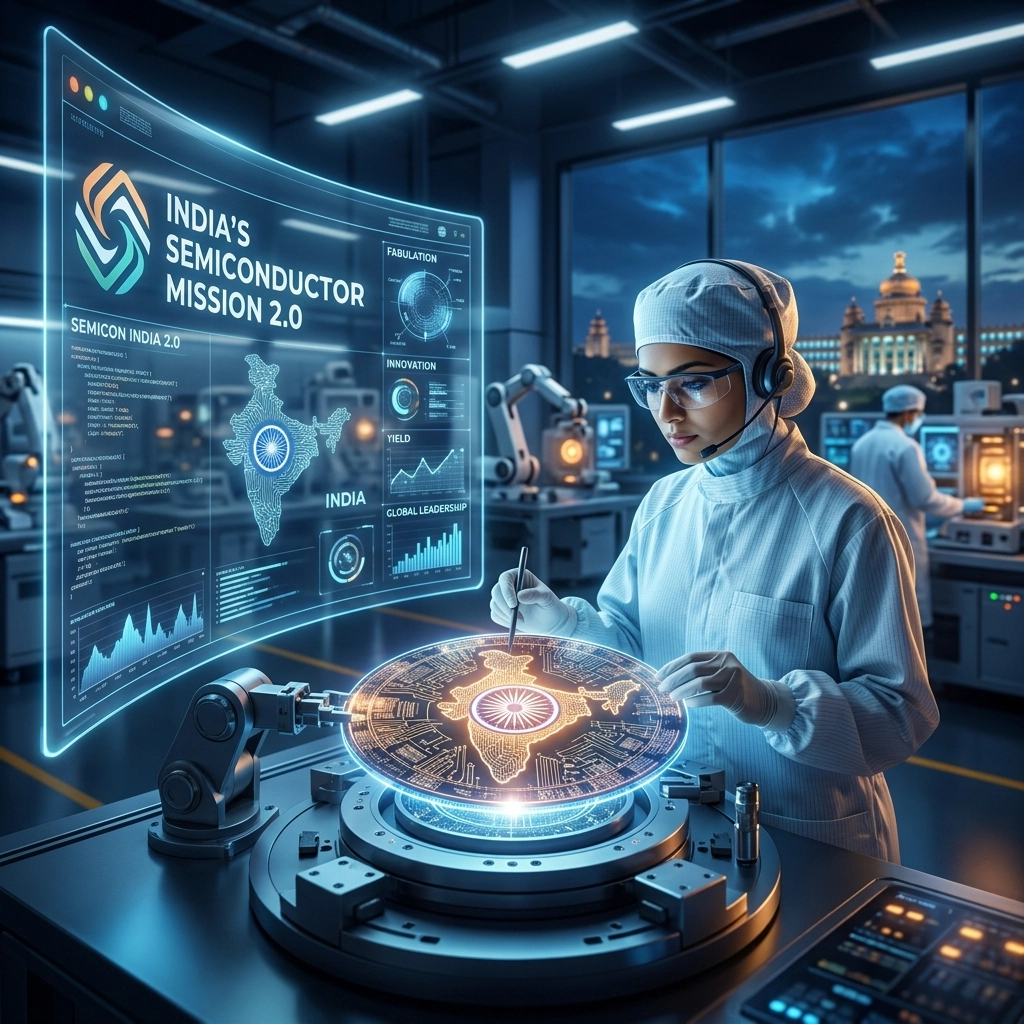

The global race for silicon dominance has reached a fever pitch, and as of April 2026, the narrative surrounding India’s role in this theater is shifting dramatically. While the mainstream media remains fixated on high-profile factory inaugurations, the real story lies beneath the surface. India’s Semiconductor Mission 2.0 is not merely an incremental update to its predecessor; it is a fundamental reimagining of how a nation-state can secure its digital future.
For years, the conversation was dominated by the "fab-first" mentality: the idea that building massive fabrication plants was the only way to join the elite semiconductor club. However, the "secrets" being discussed in high-level policy circles reveal a more nuanced and aggressive strategy. This new phase, revitalized by the Union Budget 2026-27, pivots toward a "full-stack" semiconductor ecosystem that prioritizes deep tech sovereignty over mere assembly.
1. The Strategic Pivot: Moving Beyond the "Fab-First" Obsession
When India launched the first iteration of the India Semiconductor Mission (ISM) with an outlay of ₹76,000 crore, the objective was clear: attract global giants like Micron and Foxconn to set up shop. While successful in planting the seeds, ISM 1.0 faced the harsh reality of global supply chain complexities. India’s Semiconductor Mission 2.0 marks a departure from this singular focus.
Instead of just chasing the glitz of multi-billion dollar fabs, experts are now focusing on the "unseen" parts of the value chain. This includes the production of semiconductor-grade chemicals, ultra-pure gases, and specialized manufacturing equipment. By localizing these inputs, India is insulating its nascent industry from the volatility of international logistics. This "full-stack" approach is the catalyst for change that will transform India from a consumer of chips into a critical node in the global electronics network.

2. The Geopolitical Chessboard: Decoupling and Strategic Autonomy
The geopolitical angle of India’s Semiconductor Mission 2.0 cannot be overstated. In an era where silicon is the new oil, the ability to manufacture chips domestically is synonymous with national security. The ongoing tensions between the US and China have created a vacuum that India is uniquely positioned to fill.
The "secret" that industry insiders are closely guarding is the extent of India’s "China + 1" strategy. While publicly advocating for global cooperation, the mission is designed to ensure strategic autonomy. By developing domestic capabilities in Radio Frequency (RF), compute, and power management systems, India is reducing its reliance on foreign intellectual property that could be weaponized in a future conflict. This is not just a business move; it is a high-stakes play for tech sovereignty on the global stage. For more updates on how these shifts affect the economy, visit our Home News section.
3. The 28nm "Gold Mine": Why Mature Nodes Matter
There is a common misconception that if you aren't producing 3nm or 5nm chips: the kind found in the latest smartphones: you aren't a serious player. Experts, however, point to a different reality. Approximately 70% of the global chip demand by volume is for "mature nodes" (28nm to 90nm).
These are the workhorse chips used in automobiles, industrial machinery, medical devices, and home appliances. India’s Semiconductor Mission 2.0 leans heavily into this segment. By mastering the 28nm-90nm range, India is targeting the massive volume of the Internet of Things (IoT) market. This pragmatic approach allows the country to build expertise and scale without the astronomical R&D costs associated with sub-7nm processes, effectively democratizing high-tech manufacturing for the Indian MSME sector.

4. Designing the Future: Sovereign IP and the Role of C-DAC
Perhaps the most guarded "secret" of ISM 2.0 is the aggressive push for domestic Intellectual Property (IP). Manufacturing is a low-margin game compared to design. To address this, the government has designated the Centre for Development of Advanced Computing (C-DAC) as a sovereign repository for semiconductor design IP.
This initiative aims to create a library of Indian-owned designs that can be licensed to startups and established firms alike. By owning the "blueprints," India ensures that the value created within its borders stays within its borders. This focus on deep tech design is expected to lead to exponential growth in the number of Indian "fabless" semiconductor companies, many of which are already seeking registration to tap into government incentives.
5. Government Incentives: A Data-Driven Approach to Funding
Under India’s Semiconductor Mission 2.0, the incentive structure has been revitalized to be more performance-linked and data-driven. While the initial provision in the FY 2026-27 budget stands at ₹1,000 crore, this is widely viewed as a "feeder fund" for a much larger, multi-year allocation.
The new incentives are not just for those building the fabs, but for the entire "electronic communications network" of suppliers. This includes:
- Design-Linked Incentives (DLI): Financial support for startups creating innovative chip architectures.
- Modernization Grants: Funding for existing SCL (Semi-Conductor Laboratory) facilities to upgrade to 28nm capabilities.
- Talent Development: Massive investments in specialized engineering programs to create a "semiconductor-ready" workforce of over 100,000 professionals by 2030.

6. Addressing the "Hidden" Challenges: Infrastructure and Power
While the mission's value proposition is strong, experts are quietly concerned about the "legitimate purpose" of infrastructure readiness. A semiconductor fab requires an uninterrupted supply of ultra-pure water and massive amounts of electricity. Even a micro-second flicker in power can ruin a multi-million dollar batch of wafers.
ISM 2.0 addresses this by creating "Semiconductor Hubs" in states like Gujarat and Karnataka, where dedicated power grids and water recycling plants are being built. These hubs are designed to be "plug-and-play" environments for global investors. The level of state-central coordination currently underway is unprecedented in Indian industrial history, aiming to eliminate the bureaucratic friction that often hampers large-scale projects.
7. The Deep Tech Secret: India’s Role in AI Hardware
The explosion of Generative AI has created an insatiable demand for specialized AI hardware. While NVIDIA currently dominates this space, India’s Semiconductor Mission 2.0 is carving out a niche in AI edge computing.
Instead of competing with giant data center GPUs, Indian designers are focusing on low-power AI chips that can process data on the device itself: essential for drones, autonomous vehicles, and smart cities. This focus on "AI at the Edge" is a strategic move to capture the next wave of computing innovation before the market becomes saturated by Western incumbents.

Conclusion
The evolution of India’s Semiconductor Mission 2.0 represents a sophisticated maturation of India’s economic and technological ambitions. By moving beyond the simplistic goal of just "building a factory," the government is architecting a comprehensive ecosystem that values design IP, supply chain resilience, and mature node dominance.
The "secrets" revealed by this deep tech pivot suggest that India is no longer content being a peripheral player. Through strategic domestic manufacturing, targeted government incentives, and a keen eye on the geopolitical chessboard, the nation is positioning itself as an indispensable pillar of the global semiconductor industry. As this mission unfolds, the ripple effects will be felt across every sector of the economy, from consumer electronics to national defense, marking a new era of technological empowerment for the country.
To stay informed about how these developments impact your business and investments, explore our latest insights on Business Tantra. Our about us page details our commitment to bringing you the most analytical and precise business news in the industry.