

























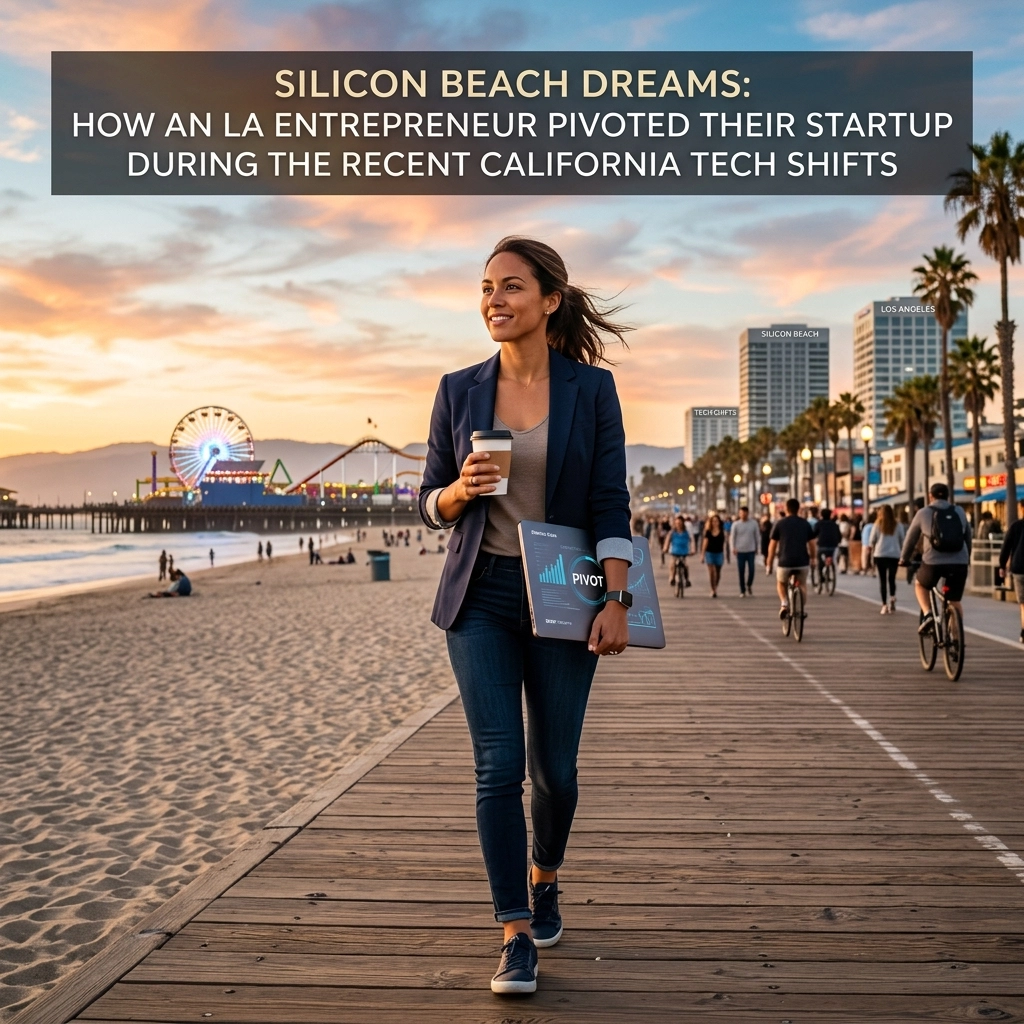

The salt air of Santa Monica used to smell like pure opportunity. For any LA Entrepreneur, the stretch of coastline known as Silicon Beach wasn’t just a location; it was a promise. But as we navigate the landscape of April 2026, that promise has undergone a radical transformation. The "growth at all costs" mantra that defined the early 2020s has been replaced by a gritty, data-driven pragmatism.
In this era of shifting venture capital and geopolitical fluctuations, the story of Marcus Thorne and his startup, VibeMetric, serves as a masterclass in survival. It is a narrative that highlights the resilience required to maintain a successful California business when the economic winds shift overnight.
The Sunset of the Hype Era
In early 2024, Marcus Thorne was the quintessential Silicon Beach success story. His platform, VibeMetric, used hyper-local data to help luxury brands partner with influencers for exclusive pop-up events in West Hollywood and Malibu. On paper, he was winning. He had a sleek office in Venice, a growing team, and the kind of "burn rate" that venture capitalists used to applaud.
However, the Startups in USA ecosystem hit a massive roadblock. As our recent coverage at Business Tantra has highlighted, venture capital funding in Greater Los Angeles saw a staggering 73% drop from its 2021 peaks. The "AI bubble" began to show signs of tension, and the late-stage funding that many LA companies relied on to scale simply evaporated.
Marcus found himself at a crossroads. "We were selling 'vibe' in a market that suddenly only cared about 'value'," Marcus told us during a recent sit-down. "The shift wasn't gradual; it was a wall. If we didn't pivot, we were going to be just another statistic in the Silicon Beach graveyard."
https://cdn.marblism.com/gbFZ3SDWXFB.webp
Identifying the Catalyst for Change
The pivot didn't happen in a vacuum. It required a deep dive into the "New California" economy. While the consumer luxury market was cooling, the demand for sophisticated, AI-driven logistics was skyrocketing. Marcus realized that the core technology his team had built: originally designed to track influencer movements and event heatmaps: could be "revitalized" to solve a much larger problem: urban supply chain optimization.
This transition from a marketing tool to a logistics powerhouse is what we call a "mission-critical pivot." It wasn’t just about changing the logo; it was about democratizing complex data for small-to-medium enterprises struggling with California’s increasingly complex delivery regulations and environmental mandates.
By late 2025, VibeMetric had become GridFlow AI. The focus shifted from "Who is at the party?" to "How do we get the goods to the customer in the most carbon-efficient way possible?"
The Anatomy of a Successful Pivot in 2026
For any LA Entrepreneur looking to replicate this success, Marcus points to three "legitimate purpose" pillars that guided his transition:
- Unit Economics over Vanity Metrics: If a feature doesn't contribute directly to the bottom line within 18 months, it’s discarded.
- Resource Allocation: Moving talent from creative design to backend data engineering and electronic communications network security.
- Local Expertise: Leveraging California’s unique regulatory environment as a moat rather than a hurdle.

Navigating the California Business Climate
Operating a California business in 2026 requires a different playbook than operating in the Silicon Valley of old. While San Francisco remains the titan of generative AI, Los Angeles has carved out a niche in "Applied Tech": the intersection of entertainment, aerospace, and logistics.
However, the challenges remain significant. The brain drain to emerging markets: including the burgeoning tech hubs in India: has forced many US founders to rethink their global strategy. At Business Tantra, we often compare the startup environments of California and India to help our readers understand where to deploy capital. The 2026 reality is that an LA Entrepreneur must be as comfortable discussing Bengaluru’s GDP growth as they are discussing the latest tech layoffs in Culver City.
https://cdn.marblism.com/9VgC7-8W08X.webp
The decline in late-stage funding (which fell to approximately $4.2 billion by 2023 and has only recently begun to stabilize in early 2026) means that startups must achieve "exponential growth" through lean operations. Marcus Thorne did this by slashing his Venice Beach office space and adopting a hybrid model that utilizes talent across multiple time zones.
The "New India" Influence on Silicon Beach
It is impossible to discuss Startups in USA today without acknowledging the cross-pollination with the Indian market. Many LA founders are looking at how Indian unicorns have managed to scale in high-friction environments.
Marcus’s pivot to GridFlow AI actually drew inspiration from logistics startups in Mumbai. "The way they handle 'last-mile' delivery in high-density areas is a work of art," Marcus noted. By integrating similar data-driven insights into his California-based operations, he was able to offer a value proposition that his domestic competitors, still stuck in the "luxury marketing" mindset, could not match.
For those interested in how these global shifts impact local strategy, you might want to contact us for a more personalized analysis of market entry strategies.
https://cdn.marblism.com/QYqaWG87ouc.webp
Key Lessons for the Modern LA Entrepreneur
The journey of Marcus Thorne is a testament to the fact that the "Silicon Beach Dream" isn't dead: it's just evolved. To thrive in the current 2026 ecosystem, founders must be willing to:
- Embrace the Pivot Early: Don't wait for the bank account to hit zero. If the market signals a shift, move before the competition does.
- Focus on Applied AI: Don't just build another LLM. Build a tool that solves a specific, boring, and expensive problem.
- Prioritize Sustainability: In California, green tech isn't a "nice to have": it’s a regulatory necessity that can become a competitive advantage.
The current geopolitical shocks and interest rate fluctuations have served as a "catalyst for change," weeding out the fragile models and leaving behind a more robust class of entrepreneurs. Marcus Thorne didn't just survive the tech shifts; he used them as a springboard to build a company that is now more profitable than his original "vibe-based" startup ever was.
Conclusion
The evolution of the Silicon Beach landscape from a playground for social apps to a hub for critical infrastructure and applied AI marks a new chapter for the LA Entrepreneur. The success of Marcus Thorne and GridFlow AI proves that while the California tech shifts of 2024-2026 were painful, they were also necessary.
By shifting focus from growth-at-all-costs to data-driven insights and operational excellence, Startups in USA are becoming more resilient and globally competitive. As we look forward to the remainder of 2026, the message is clear: the dream is still alive, but it requires a new level of professional discipline and a willingness to pivot when the horizon changes.
For more deep dives into the stories shaping the global economy, stay tuned to Business Tantra. Whether you are scaling a California business or exploring new frontiers in the "New India" economy, we provide the insights you need to lead with confidence.