

























NIFTY50, SENSEX Today: Wall Street Cues, FII Activity, Key Things to Know Before Markets Open on June 25

The Indian stock market today finds itself at a pivotal juncture as market participants navigate a complex landscape of global macroeconomic shifts and domestic institutional dynamics. Following a period of consolidation, the indices have showcased a revitalized momentum, with the benchmark SENSEX and NIFTY50 opening on a robust note this Thursday, June 25, 2026.
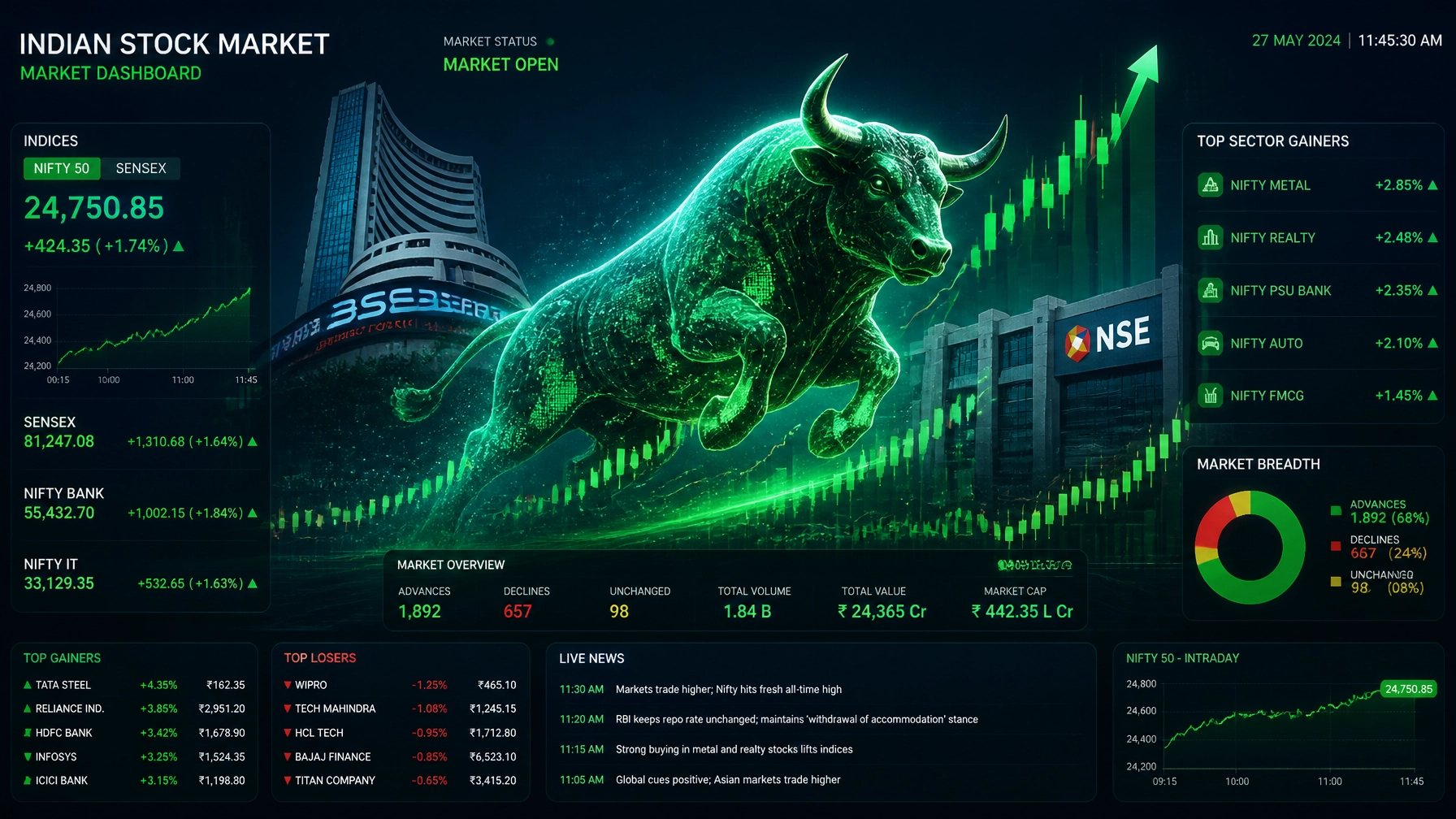
As the opening bell rang, the SENSEX surged approximately 440 points to settle near the 77,436 mark, while the NIFTY50 mirrored this optimism, climbing 138 points to reach 24,148. This bullish opening serves as a significant catalyst for change, potentially setting the tone for the remainder of the trading week, particularly given the upcoming market closure on Friday in observance of Muharram. Investors are closely monitoring whether this upward trajectory can be sustained amidst a backdrop of mixed signals from Wall Street and persistent selling pressure from Foreign Institutional Investors (FIIs).
Global Cues: Navigating the Wall Street Divergence
The performance of the stock market today is inextricably linked to the electronic communications network of global finance, specifically the cues emanating from the United States. Overnight, Wall Street presented a fragmented picture that has left analysts weighing the implications for emerging markets like India.
The Dow Jones Industrial Average managed a modest gain of 0.35%, reflecting resilience in traditional industrial sectors. Conversely, the S&P 500 and the Nasdaq Composite experienced slight declines of 0.10% and 0.43%, respectively. This divergence is largely attributed to a rotation out of high-growth technology stocks, which have seen exponential growth over the past year, and into value-oriented segments. For Indian investors, the Gift Nifty is currently hovering around the 24,100 level, signaling a relatively flattish start that suggests a degree of caution despite the positive domestic opening.

The "democratize" of data-driven insights has allowed retail investors to better understand these international correlations. While the Nasdaq’s weakness often weighs on Indian IT stocks, the strength in the Dow often provides a cushion for banking and industrial majors. This interplay is a critical component of the professional trading desk’s daily calculus.
Macro Catalyst: Brent Crude and Inflation Mitigation
One of the most potent drivers for the stock market today is the significant slide in Brent crude prices, which have dipped below the $73 per barrel threshold. For an oil-importing giant like India, this downward trend in energy costs is a vital stabilizer for the national economy. Lower oil prices act as a primary mechanism to ease inflation concerns, providing the Reserve Bank of India (RBI) with greater maneuverability in its monetary policy.
The reduction in input costs for logistics, manufacturing, and aviation serves as a legitimate purpose for renewed investor confidence. When energy costs retreat, the corporate profit margins across various sectors are effectively revitalized, leading to more optimistic valuation models. This macroeconomic tailwind is particularly beneficial for the Indian Business and Economics landscape, where fiscal health is closely tied to global commodity cycles.
Institutional Headwinds: Decoding FII and FPI Activity
Despite the optimistic opening of the SENSEX and NIFTY50, a shadow continues to loom in the form of sustained institutional selling. Data from the prior trading session indicates that Foreign Institutional Investors (FIIs) offloaded equities worth ₹1,843.4 crore. More strikingly, Foreign Portfolio Investors (FPIs) have sold a staggering ₹64,761 crore in the first half of June alone.

This persistent exit by foreign entities is being largely counterbalanced by robust Domestic Institutional Investor (DII) participation and a growing base of retail traders. The "exponential growth" of the domestic investor base has provided a much-needed liquidity cushion, preventing a more drastic drawdown in the face of global capital flight. However, the sheer volume of FPI selling remains a metric that requires careful observation, as it dictates the long-term sustainability of the current rally. According to reports from Bloomberg and the NSE India, these flows are often influenced by rising US Treasury yields and shifting global risk appetites.
Sectoral Momentum: Auto, Banking, and FMCG Lead the Charge
The strength in the stock market today is not merely a superficial index movement but is backed by solid sectoral performance. Key industries such as Automotive, Banking, and Fast-Moving Consumer Goods (FMCG) have emerged as the primary leaders in today's session.
- Banking & Financials: The "backbone of the economy" has seen renewed interest as credit growth remains healthy.
- Automotive: Driven by strong rural demand and a shift toward electric vehicles, the auto sector continues to outperform.
- FMCG: With cooling inflation, consumer discretionary spending is expected to rise, benefiting large-cap FMCG players.

The leadership transition seen in the Indian tech space, such as the recent appointment of Kunal Shah, further underscores the evolving nature of the Indian corporate hierarchy. These high-profile moves often signal a maturing ecosystem where strategic leadership becomes a differentiator for market performance.
Technical Analysis: Support and Resistance Levels for NIFTY50
From a technical perspective, the NIFTY50 is currently navigating a well-defined trading range. Market analysts have identified the 24,000 mark as a crucial psychological and technical support zone. As long as the index sustains above this level, the short-term bias remains cautiously optimistic. On the upside, the immediate resistance is pegged at 24,500.

The India VIX, a measure of market volatility, currently stands at 13.39. This relatively low level suggests that while there is underlying selling pressure from FIIs, there is no immediate panic in the domestic market. Traders are advised to utilize "data-driven insights" to execute buy-on-dip strategies near support levels while maintaining tight stop-losses to hedge against potential intraday volatility. The lack of a major directional cue from the BSE India indicates that we may see a period of time-wise consolidation before the next major breakout.
Conclusion
In summary, the stock market today is characterized by a tug-of-war between positive domestic sentiment and global institutional caution. The strong opening of the SENSEX and NIFTY50 is supported by cooling oil prices and resilient sectoral performance in banking and auto. However, the massive FII sell-off remains a significant headwind that investors cannot afford to ignore.
As we approach the long weekend following the Muharram holiday on Friday, market participants are likely to focus on capital preservation and selective stock picking. The primary mission for any prudent investor in this environment is to remain anchored in fundamental analysis while remaining agile enough to respond to rapid global shifts. Whether the current rally acts as a definitive "catalyst for change" or merely a temporary respite will depend heavily on the institutional flow trajectory in the coming weeks.