


























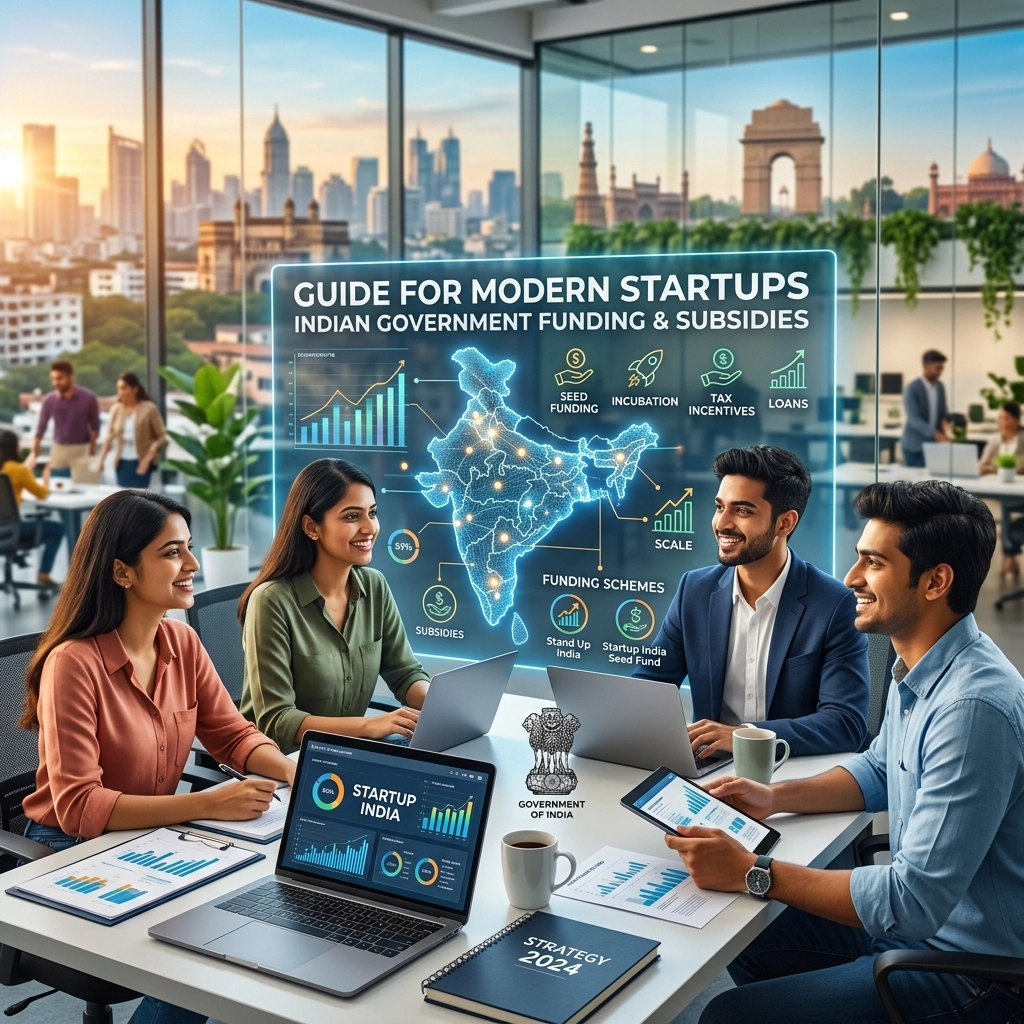

The landscape of the Indian economy has undergone a seismic shift over the last decade, transitioning from a traditional service-oriented market to a global powerhouse of innovation. As we look at the latest startup news india, it is evident that the central government has positioned itself not just as a regulator, but as a primary architect of entrepreneurial growth. For modern founders, navigating the complex web of Indian Government Funding and Subsidies is no longer an optional task: it is a strategic necessity for sustainable scaling.
With the recent fiscal directives outlined in the budget 2026 india, the emphasis on "Atmanirbhar Bharat" (Self-Reliant India) has intensified. The government has allocated unprecedented capital toward fostering a "startup flood," creating a multi-tiered support system that spans from ideation to international commercialization. This guide provides a comprehensive analysis of the schemes, incentives, and financial instruments currently available to the modern Indian entrepreneur.
1. The Startup India Initiative: Building the Foundation
Launched in 2016, the Startup India Initiative remains the flagship program designed to democratize entrepreneurship across the nation. By providing a "Single Window Clearance" system, the initiative has successfully reduced the bureaucratic friction that previously stifled innovation. Under this umbrella, recognized startups gain access to significant tax holidays under Section 80-IAC and exemptions on capital gains, which are crucial for maintaining liquidity in the early stages.
The momentum generated by these policies has led to what many industry observers call a start-up flood in India. This "wave" is characterized by a surge in deep-tech, fintech, and agritech ventures that leverage government-backed infrastructure to reach markets that were previously inaccessible.
2. Startup India Seed Fund Scheme (SISFS): Bridging the Valley of Death
One of the most critical challenges for any founder is the "capital gap" during the proof-of-concept stage. The Startup India Seed Fund Scheme (SISFS), with an initial outlay of ₹945 crores, was specifically designed to address this. This scheme provides financial assistance to startups for proof of concept, prototype development, product trials, market entry, and commercialization.
The funding structure is meticulously organized:
- Grants of up to ₹20 Lakhs: For validation of Proof of Concept, or prototype development, or product trials.
- Investments of up to ₹50 Lakhs: Through convertible debentures or debt-linked instruments for market entry, commercialization, or scaling.
By empowering incubators across the country to distribute these funds, the government ensures that the capital reaches grassroots innovators who may not yet be ready for traditional venture capital.

3. Production Linked Incentive (PLI) Schemes: A New Era for Manufacturing
If the SISFS targets the early stage, the Production Linked Incentive (PLI) schemes are the engines for massive industrial scaling. These schemes are a cornerstone of financial news india, representing a paradigm shift in how the government incentivizes domestic manufacturing.
The PLI scheme offers a percentage-based incentive on incremental sales of goods manufactured in India. Currently, the scheme covers 14 strategic sectors, including:
- Electronics and IT Hardware: Aiming to make India a global hub for mobile and component manufacturing.
- Advanced Chemistry Cell (ACC) Batteries: Directly supporting India’s new battery swap scheme and the broader EV revolution.
- Pharmaceuticals and Medical Devices: Reducing dependence on imported Active Pharmaceutical Ingredients (APIs).
- Semiconductors: A high-priority area where billions are being invested to secure the global supply chain.
For startups in the hardware and deep-tech space, aligning with PLI objectives can unlock massive subsidies and provide a competitive edge in both domestic and export markets.

4. Debt Financing and Credit Guarantee Schemes
While equity is often the focus of startup news india, debt remains a powerful tool for non-dilutive scaling. The Indian government has introduced several credit-focused initiatives to ensure that a lack of collateral does not hinder a promising business.
Pradhan Mantri Mudra Yojana (PMMY)
This scheme provides collateral-free loans up to ₹10 Lakhs through three categories:
- Shishu: Loans up to ₹50,000 for those starting a business.
- Kishor: Loans from ₹50,000 to ₹5 Lakhs for established businesses looking to expand.
- Tarun: Loans from ₹5 Lakhs to ₹10 Lakhs for established enterprises.
Credit Guarantee Fund Scheme for Startups (CGSS)
For larger requirements, the CGSS provides credit guarantee cover for loans up to ₹2 Crores extended by Scheduled Commercial Banks and NBFCs. This revitalized approach to credit risk allows startups to secure working capital and term loans without pledging personal assets.
5. Innovation and R&D Focused Grants
In the era of budget 2026 india, there is a heightened focus on high-end scientific research. The government has introduced specialized grants to ensure that India remains at the forefront of the global "knowledge economy."
- NIDHI (National Initiative for Developing and Harnessing Innovations): Managed by the Department of Science & Technology, this program supports startups from the ideation stage through various phases like NIDHI-PRAYAS (Proof of Concept) and NIDHI-Seed Support System.
- Biotechnology Ignition Grant (BIG): Specifically for biotech entrepreneurs, offering up to ₹50 Lakhs for high-impact research. This has been instrumental in the rise of India's biotech leaders, as seen in the recent achievements of biotech innovators in Mumbai.

6. The Role of Incubators and State-Level Support
The central government’s efforts are amplified by state-level initiatives and specialized incubators. The "Livelihood Business Incubator" (LBI) program under the ASPIRE scheme focuses on generating employment and setting up enterprises in the agro-rural sector. You can learn more about how these livelihood business incubators are transforming rural economies.
Furthermore, state-led hubs have become legendary in the ecosystem. For instance, T-Hub in Telangana provides a world-class environment for startups to turn ideas into viable products, leveraging both state and central government resources.
7. Strategic Importance of Business Management
While funding is a catalyst, the sustainability of a startup depends on operational excellence. Many founders fail to realize that government subsidies often come with stringent compliance and reporting requirements. This is why business management for startups is essential for growth. Effectively managing these funds requires a data-driven approach to ensure that the "mission" of the company aligns with the "value proposition" expected by government auditors and future investors.

Conclusion: Navigating the Future of Indian Entrepreneurship
The cumulative effect of these schemes: from the SISFS to the PLI: has been to create an environment where failure is less catastrophic and success is exponentially scalable. As we analyze the financial news india of today, it is clear that the government is no longer just a bystander; it is a stakeholder in every startup’s journey.
Whether you are a deep-tech innovator seeking a NIDHI grant or a manufacturer looking to leverage the PLI scheme, the opportunities provided by the Indian government are transformative. However, the onus remains on the entrepreneur to maintain a high degree of professional rigor and strategic foresight. By aligning with the national vision of a $5 trillion economy, startups can leverage these subsidies to move beyond survival and achieve truly global dominance.
The "entrepreneurial decade" is here, and with the right combination of innovation and government support, the next generation of Indian unicorns is already being forged in the fires of these policy reforms.