


























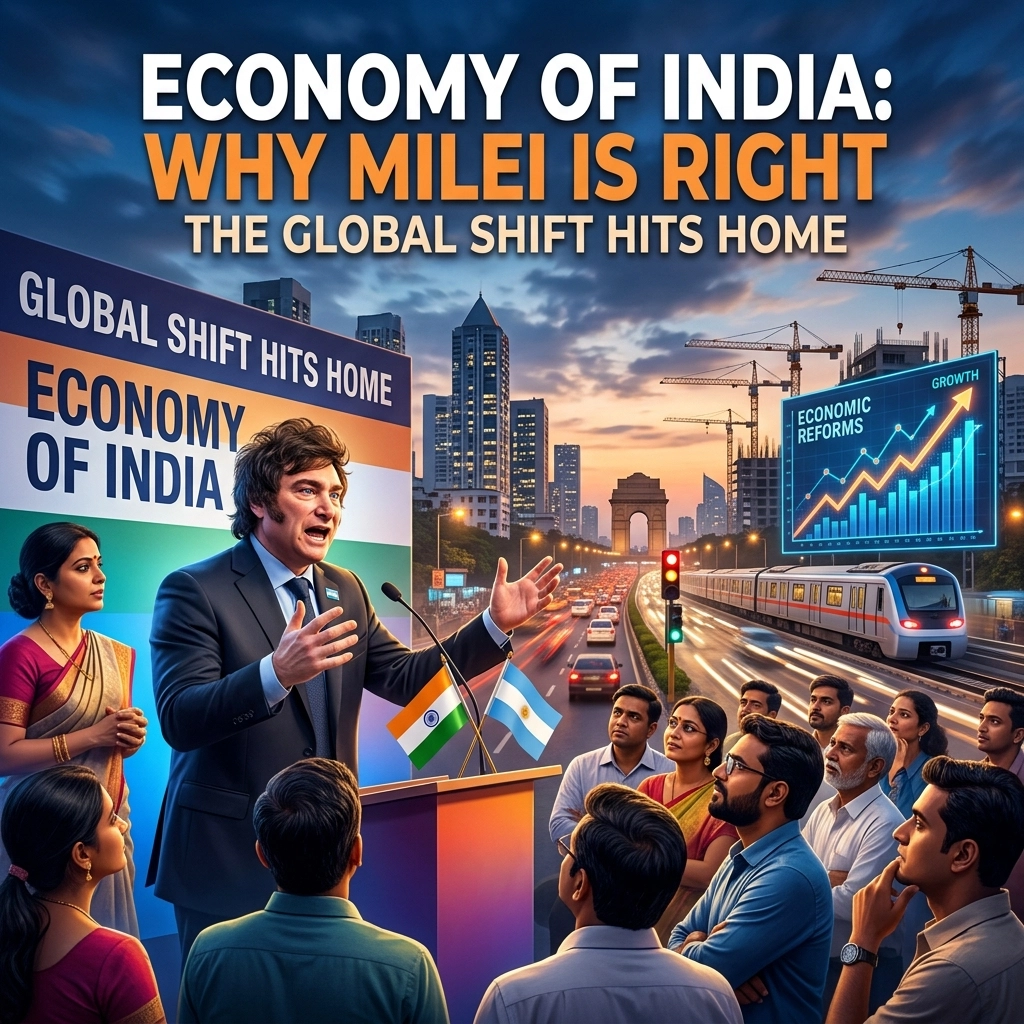
Economy of India: Why Milei is Right – The Global Shift Hits Home

If you’ve been keeping an eye on global headlines lately, you’ve probably seen a guy with a chainsaw and some very unruly hair making waves in Argentina. Javier Milei, the libertarian firebrand who became President, is often framed as a "radical" or a "disruptor." But if you look closer at the economy of India, you’ll realize that what Milei is trying to pull off isn't just a wild experiment: it’s actually a variation of a playbook that India started writing back in 1991.
At Business Tantra, we’ve been tracking how the global economic pendulum is swinging away from heavy-handed state control and toward the "liberty first" model. Interestingly, the very people leading the charge in South America are looking at the economy of India as their primary source of inspiration. It’s a fascinating "full circle" moment that tells us a lot about where the world: and our own domestic markets: are headed.
1. The Indian Blueprint: From 1991 to Now
It might surprise some to hear that Milei’s administration, specifically his Minister of Deregulation Federico Sturzennegger, has explicitly cited India's 1990s reforms as a "catalyst for change" for their own performance. When Narasimha Rao and Manmohan Singh dismantled the License Raj, they weren't just fixing a balance-of-payments crisis; they were setting the stage for India to become the fastest-growing large economy in the world.
The economy of India shifted from a sluggish "Hindu rate of growth" to a revitalized powerhouse by embracing deregulation. Today, as Argentina looks to dollarize and slash bureaucracy, they are essentially trying to replicate the "India Moment." For entrepreneurs and investors following Business Tantra, this global validation of the Indian model is a massive green flag for long-term domestic stability.

2. The Global Shift Toward Libertarian Trends
We are witnessing a global fatigue with "Big Government." From the streets of Buenos Aires to the tech hubs in Bengaluru, there is a growing demand to democratize economic opportunity by removing the middleman: the state. This libertarian trend isn't just about politics; it’s about efficiency.
In the context of the economy of India, this shift is visible in the push for "Minimum Government, Maximum Governance." By utilizing digital public infrastructure (DPI), India has managed to bypass traditional bureaucratic hurdles. Milei’s "chainsaw" approach to cutting government spending is the more aggressive, Western cousin of India’s steady push toward privatization and digital transparency.
3. Why Milei is Vindicating the Indian Model
Critics often call Milei’s policies "shock therapy." However, the Argentine Ambassador to India, Mariano Caucino, recently noted that the current administration seeks to "imitate" the deregulation initiated by India. Why? Because the data-driven insights from the last three decades prove that liberalization works.
The economy of India didn't just grow; it transformed. It moved from an agrarian-heavy base to a service and tech leader. This trajectory is what Milei wants for Argentina. By cutting the "dead weight" of state-owned enterprises that drain the treasury, Milei is following the logic that helped India survive the 2008 global crash and the 2020 pandemic with more resilience than most developed nations.
4. Deregulation as a Catalyst for Exponential Growth
One of the core tenets of the "Milei is right" argument is that deregulation is the only way to achieve exponential growth. In India, we’ve seen this play out in the telecom and aviation sectors. When the government stepped back, the private sector stepped up, leading to some of the lowest data costs in the world and a massive expansion of regional connectivity.
For the economy of India in 2026, the focus has shifted toward manufacturing and green energy. If we continue to prune the thicket of red tape: much like Milei is attempting: the potential for India to hit the $10 trillion mark becomes a "when," not an "if." You can check out more on our home-news page for daily updates on these sectors.

5. Pruning the State: Lessons India Can Re-learn
While Milei is learning from India's past, India can actually learn from Milei’s present. There is still significant scope in the economy of India to prune government spending. Even though we are in a position of strength, fiscal discipline remains a high-stakes game.
Milei’s experiment with aggressive fiscal consolidation: slashing ministries and cutting subsidies: provides a real-time laboratory for India. If Argentina manages to kill hyperinflation through these "libertarian" methods, it will provide a new set of tools for Indian policymakers to manage our own fiscal deficit without stifling the growth of the middle class.
6. The "Global Shift" Hits Home: What it Means for You
So, why should a business owner in Delhi or a startup founder in Pune care about a president in South America? Because the "Global Shift" means that capital is going to flow toward countries that respect market principles.
As the economy of India continues to align with these global libertarian trends: focusing on ease of doing business and reducing the compliance burden: we will see an influx of foreign direct investment (FDI) that dwarfs previous decades. We are no longer just a "back office" for the world; we are the blueprint for how a developing nation can leapfrog into the future by embracing economic freedom.
7. Overcoming the "Big State" Inertia
The biggest challenge for both Milei and the economy of India is the inertia of the "Big State." Vested interests often fight back against deregulation. In Argentina, it’s the labor unions; in India, it’s often the complex layers of state-level bureaucracy.
However, the "mission" remains the same: to empower the individual over the institution. When we talk about the "value proposition" of the Indian market, it’s precisely this transition that makes us an attractive destination for global investors. By staying the course on liberalization, India reinforces its status as a legitimate leader of the Global South.

8. Data-Driven Insights: The Numbers Don't Lie
If you look at the GDP growth rates of countries that have embraced these libertarian shifts versus those that have doubled down on state intervention, the contrast is stark. The economy of India has consistently outperformed peers that chose the path of protectionism.
Milei’s gamble is that by removing the state’s hand from the cookie jar, the resulting explosion in private productivity will more than compensate for the short-term pain of budget cuts. India’s experience in the 90s proves this theory correct. The "short-term pain" of the 1991 reforms led to three decades of unprecedented wealth creation.
Conclusion
The narrative that Javier Milei is an "outlier" is fast disappearing. In reality, he is a loud, flamboyant symptom of a much larger, global movement toward economic liberty: a movement that the economy of India has been leading for over thirty years.
Milei is "right" because he recognizes that the state should be a referee, not a player. As we move further into 2026, the synergy between these global libertarian trends and India's own domestic policies will likely create a "super-cycle" of growth. For the readers of Business Tantra, the takeaway is clear: the future belongs to the deregulated, the decentralized, and the daring.
Stay tuned to our blog-layout for more deep dives into how global politics are reshaping your portfolio. Whether it's a chainsaw in Argentina or a digital revolution in India, the shift is hitting home, and it's time to pay attention.
For more information on our mission and how we cover the stories that matter, visit our About Us page or Contact Us to join the conversation.

admin


Related Post


- By admin
- 07 Views