























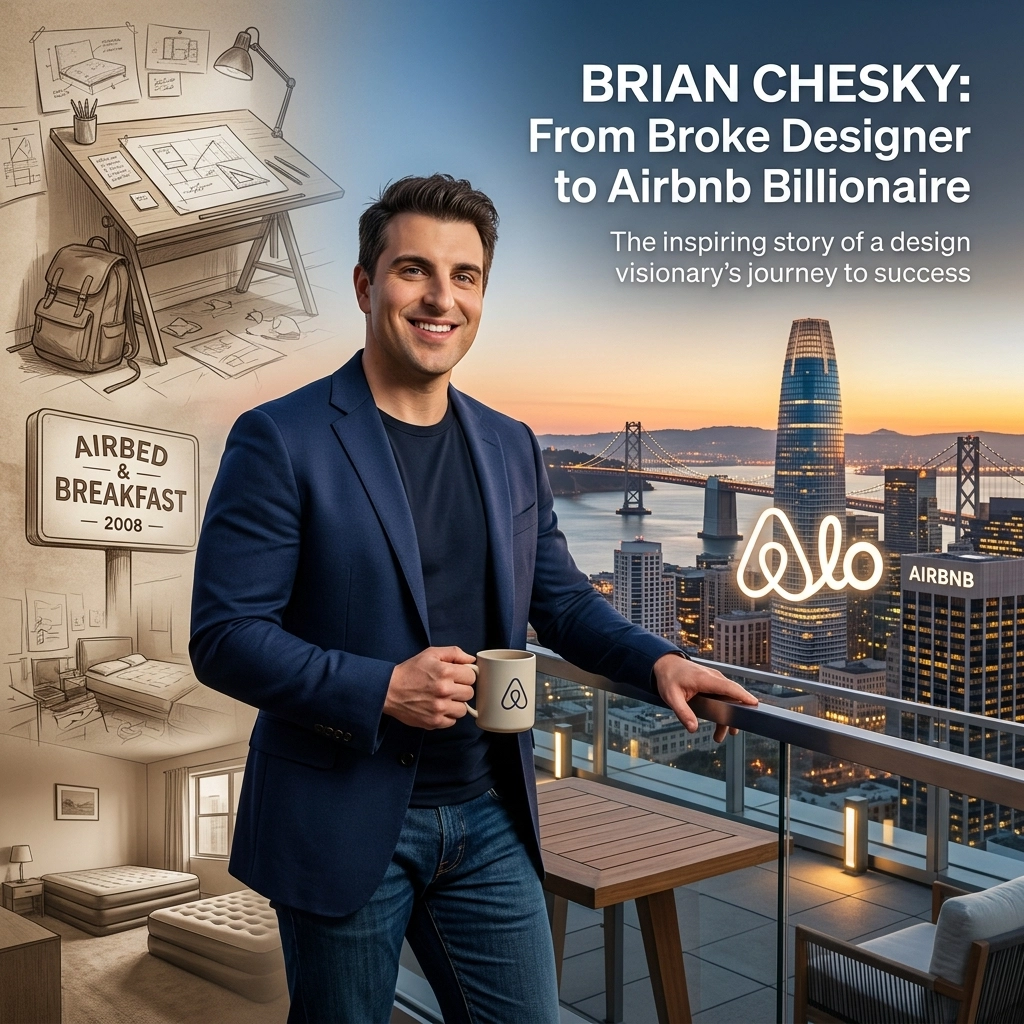
Brian Chesky: From Broke Designer to Airbnb Billionaire

The 'Air Mattress' Idea That Built a $100 Billion Empire
They were broke and couldn't pay rent. They sold cereal boxes just to survive. Today, they changed how the world travels.
The story of Brian Chesky and the founding of Airbnb is more than just a business case study; it is a masterclass in resilience, design thinking, and the "hustle" required to turn a radical idea into a global phenomenon. In the world of Business Tantra, where we analyze the intersection of innovation and market dynamics, the Brian Chesky Airbnb story stands as a testament to the power of solving your own problem.
Background: The Designer’s Blueprint
Long before he was a fixture on the Forbes billionaires list, Brian Chesky was an industrial design student at the Rhode Island School of Design (RISD). It was here that he met his future co-founder, Joe Gebbia. At RISD, Chesky wasn't learning about spreadsheets or venture capital; he was learning how to look at the world as something that could be redesigned.
Chesky often describes himself as an artist who happened to find his way into business. After graduating, he took a traditional job as an industrial designer in Los Angeles, working at a firm called 3DID. He designed toys, medical equipment, and guitars, but the rigid corporate structure didn't suit his vision. In October 2007, he packed his bags and moved to San Francisco with $1,000 in his bank account, ready to join Gebbia in an apartment they could barely afford.

The Struggle: Living on Cereal and Air Mattresses
The reality of San Francisco hit hard and fast. The rent for their apartment jumped to $1,150, and neither of them had a steady income. The situation was dire. However, a massive design conference was coming to town, and all the hotels were fully booked.
In a moment of "legitimate purpose" born from necessity, they saw an opportunity. They didn't have extra beds, but they had three air mattresses. They created a simple website, "Airbed & Breakfast," offering a place to sleep and a home-cooked breakfast for $80 a night. Three people showed up.
Despite this initial success, the business struggled to gain traction. For the next year, they were "cereal entrepreneurs" in the most literal sense. By the time the 2008 Democratic National Convention (DNC) rolled around in Denver, the founders were $20,000 in debt. They were maxing out credit cards and eating leftovers.
The Cereal Hustle: Obama O’s and Cap’n McCains
To keep the lights on, they pivoted: not the business, but their fundraising strategy. They bought thousands of boxes of generic cereal and designed custom boxes: "Obama O's" (The Breakfast of Change) and "Cap'n McCains" (A Maverick in Every Box).
They hand-glued these boxes and sold them as limited-edition collectibles for $40 each. They ended up making nearly $30,000. This "scrappy" mindset is what eventually impressed Paul Graham of Y Combinator. When they applied for the accelerator, Graham was famously skeptical of the idea but was won over by the cereal story. He famously said, "If you can convince people to pay $40 for a $4 box of cereal, you can probably convince people to sleep in each other's beds."
Turning Point: The 2008 DNC and the Pivot to Trust
The 2008 DNC was the first real "catalyst for change" for the platform. With hotels booked out for miles, people were forced to look at alternative lodging. The "Airbed & Breakfast" concept provided a solution to a massive market inefficiency.
However, the road was still rocky. After Y Combinator, they received a seed investment of $585,000 from Sequoia Capital. But growth was slow. People were hesitant to let strangers into their homes. To solve this, Chesky and Gebbia did something that most tech founders avoid: they did things that didn't scale.
They flew to New York, their biggest market at the time, and personally visited hosts. They realized the photos on the site were terrible. So, they rented a professional camera and took high-quality photos of the listings themselves. This small move led to a doubling of revenue in the city. It was a lesson in the "value proposition" of aesthetics: something Chesky’s design background had prepared him for perfectly.
Growth: Global Expansion and Exponential Growth
By 2010, the company had shortened its name to Airbnb and expanded beyond air mattresses to include entire apartments, houses, and even castles. The business model began to democratize the hospitality industry, allowing anyone with a spare room to become a micro-entrepreneur.
The growth was nothing short of exponential. Between 2011 and 2012, Airbnb grew by 800%. They weren't just a website; they were a community. Chesky focused heavily on the "11-star experience," a design exercise where he imagined what a perfect, mind-blowing trip would look like, and then worked backward to see how much of that Airbnb could provide.

Today, Airbnb is a global powerhouse, having survived the catastrophic impact of the 2020 pandemic through a "revitalized" focus on local travel. As of early 2026, the company remains a cornerstone of the travel industry, with a market cap that has at times exceeded $100 billion.
For more insights into how modern companies scale, you can visit our home news section or learn more about us at Business Tantra.
Lessons from the Brian Chesky Airbnb Story
The journey from a broke designer to a billionaire CEO offers several "data-driven insights" for any aspiring entrepreneur:
- Solve Your Own Problem: Airbnb started because the founders couldn't pay rent. If you are your own first customer, you understand the pain points better than any market research firm could.
- Focus on the ‘Unscalable’: In the early days, you must do the manual, difficult work that tech isn't supposed to require. Personal interaction with your first 100 customers is more valuable than an automated marketing campaign.
- Design Thinking is a Business Asset: Chesky proved that empathy and aesthetics are just as important as code and finance. Viewing a business as a "designed experience" creates a unique competitive advantage.
- Resilience is the Only Moat: The cereal box story isn't just a funny anecdote; it represents the level of commitment required to survive the "trough of sorrow" that every startup faces.

Conclusion
Brian Chesky’s journey illustrates that the path to a $100 billion empire is rarely a straight line. It is a series of pivots, "scrappy" survival tactics, and a relentless focus on the human experience. By transforming the "air mattress" idea into a global standard for travel, Chesky didn't just build a company; he changed how we perceive trust and community in the digital age.
At Business Tantra, we believe these stories are the pulse of the global economy. Whether you are a founder looking to register your next big idea or an investor seeking the next unicorn, the lesson remains the same: the most transformative solutions often begin with a simple problem and a lot of grit.
The world of business is constantly evolving, much like the streets of San Francisco where a designer once wondered how he’d make rent. Today, that same designer is leading one of the most influential companies on the planet, proving once and for all that design thinking is the ultimate business tantra.

admin


Related Post


- By admin
- 05 Views