
























The New Wave of Indian Entrepreneurs

The ground beneath the global economy is shifting, and the epicenter is no longer found solely in the valleys of California or the financial districts of London. A monumental transformation is underway within the borders of the subcontinent. The emerging entrepreneurs India is producing today are not merely participants in the global market; they are becoming its architects. We are witnessing an epochal change where the traditional "safe" career paths of the past are being incinerated in the fires of innovation, replaced by a relentless drive to build, disrupt, and dominate.
This is not a gradual evolution. It is a radical surge. As Business Tantra tracks the pulse of the nation, it is evident that the current startup ecosystem India has matured into a sophisticated engine of wealth creation and social problem-solving that the world can no longer ignore.
1. The Death of Mediocrity: A Paradigm Shift in Ambition
For decades, the Indian middle class dreamt of stability: the secure government job or the predictable corporate ladder. That dream has been revitalized into something far more potent. The modern Indian founder is characterized by a "global-first" mindset. They are no longer content with being the "back office" of the world. From AI-driven analytics to deep-tech hardware, the emerging entrepreneurs India currently celebrates are those who refuse to settle for incremental gains.
This shift is fueled by a demographic dividend that is finally paying off. With over 65% of the population under the age of 35, the hunger for self-actualization is at an all-time high. Founders like Punjarla Nivesh, who scaled an AI company across four countries by the age of 22, are the new benchmarks of success. They represent a generation that views failure as a data point and success as a moral imperative.

2. Democratizing the Startup Ecosystem India: Beyond the Metros
The narrative that innovation is confined to the glass towers of Bengaluru, Mumbai, or Gurgaon is officially dead. One of the most dramatic developments in the startup ecosystem India is the rise of Tier-2 and Tier-3 cities. The democratization of high-speed internet and digital public infrastructure (DPI) has leveled the playing field.
Indore, Jaipur, Kochi, and Ahmedabad are no longer just cultural hubs; they are becoming the breeding grounds for the next wave of unicorns. Founders in these cities have a unique advantage: they are closer to the "real" India. They are building solutions for the next half-billion users, focusing on vernacular language processing, rural fintech, and agritech solutions that address the core needs of the Indian economy. To understand how these changes are impacting the broader fiscal landscape, one must look at how India’s 92 million MSMEs are navigating GST 2.0.
3. The Digital Public Infrastructure: The Catalyst for Change
What makes the Indian entrepreneur's journey unique on the global stage is the unprecedented support from the nation's Digital Public Infrastructure (DPI). The "India Stack": comprising Aadhaar, UPI, and now ONDC: has acted as a massive catalyst for change. It has reduced the "cost of trust" and allowed startups to scale at a velocity that was previously unimaginable.
According to reports by Invest India, this infrastructure has allowed fintech startups to reach profitability faster than their Western counterparts by drastically lowering customer acquisition costs. When a tea seller in a remote village can accept digital payments, the market for a fintech founder isn't just the elite; it is the entire 1.4 billion population. This is the bedrock upon which the startup ecosystem India stands today.
4. From Profit to Purpose: The Rise of Green and Social Tech
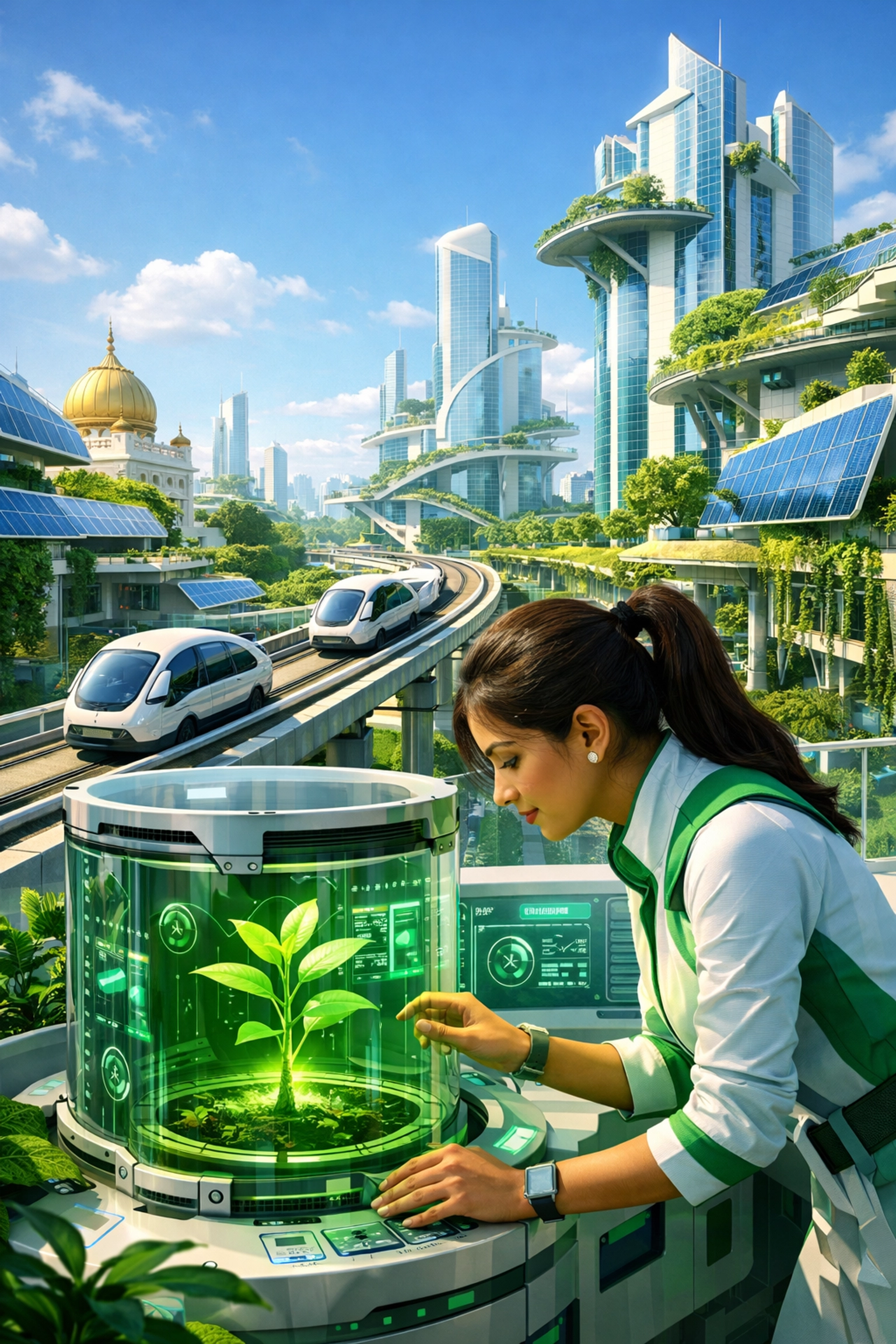
The new wave is not just about chasing valuations; it is about "purpose-driven capitalism." The emerging entrepreneurs India is currently fostering are deeply invested in sustainability and social impact. We are seeing a surge in green entrepreneurship, with startups focusing on electric vehicle (EV) infrastructure, circular economy waste management, and sustainable fashion.
This is a response to both global climate mandates and domestic necessities. Founders are realizing that solving for India’s environmental challenges is not just a "legitimate purpose" for a business, but a massive commercial opportunity. By integrating ESG (Environmental, Social, and Governance) principles from day one, these businesses are attracting global venture capital that is increasingly wary of "growth-at-all-costs" models.
5. Deep-Tech and the World War for Semiconductors
If the last decade was about consumer internet and e-commerce, the next decade belongs to Deep-Tech. Indian founders are moving into high-barrier-to-entry sectors like space-tech, biotechnology, and semiconductor design. With the government’s push for "Atmanirbhar Bharat" (Self-Reliant India), there is a strategic alignment between national interests and entrepreneurial ventures.
The global semiconductor shortage has highlighted the vulnerability of global supply chains. In response, Indian startups are stepping up to design chips and hardware that can compete on the world stage. This transition from software-as-a-service (SaaS) to "hard-tech" marks the maturation of the startup ecosystem India. It signifies a move toward creating intellectual property that can be exported, rather than just providing services to foreign IP holders. For more insights into our mission to cover these transformations, visit our About Us page.
6. Scaling the Global Wall: The US Expansion
A defining trait of the "New Wave" is the lack of geographical boundaries. Indian founders are no longer waiting for their domestic market to saturate before looking abroad. They are establishing footprints in Silicon Valley, London, and Singapore within the first two years of operation.
The strategy is clear: build in India, sell to the world. By leveraging India’s engineering talent and cost-efficiencies, emerging entrepreneurs India are offering "world-class" products at "India-scale" prices. This cross-border synergy is creating a new class of "transnational startups" that are as comfortable in a San Francisco boardroom as they are in a Mumbai co-working space. This trend is meticulously tracked by international observers like The Economic Times, noting that Indian-led startups are becoming a dominant force in the global SaaS landscape.
7. The Role of Institutional Capital and Regulatory Clarity
The exponential growth of the Indian startup scene would be impossible without the massive influx of both domestic and international capital. Despite global "funding winters," the long-term outlook for India remains bullish. High-net-worth individuals (HNIs) within India are increasingly diversifying their portfolios by investing in early-stage startups, moving away from traditional assets like real estate and gold.
Furthermore, the regulatory environment is becoming increasingly "startup-friendly." Policies aimed at simplifying the "Angel Tax," streamlining the registration process, and providing tax holidays for innovative firms have provided the necessary breathing room for young companies to survive their initial years. Aspiring founders can register on our platform to stay updated on these crucial regulatory shifts.

Conclusion
The new wave of Indian entrepreneurs is not a fluke; it is the result of a perfect storm where talent, technology, and capital have finally converged. These emerging entrepreneurs India are the vanguard of a new economic era. They are transforming the "Brain Drain" of the past into a "Brain Gain" of the future, where the brightest minds are choosing to build their legacies on Indian soil.
As the startup ecosystem India continues to evolve, the challenges will be significant: ranging from global economic volatility to the need for deeper infrastructure in rural areas. However, the trajectory is undeniable. India has moved from the periphery of the global business world to its very center. At Business Tantra, we remain committed to documenting this revolution, providing the data-driven insights and professional analysis required to navigate this high-stakes landscape. The era of the Indian entrepreneur has not just arrived; it is here to redefine the 21st century.
To join this community of thinkers and builders, explore our Contact Us page or dive deeper into our latest news.