























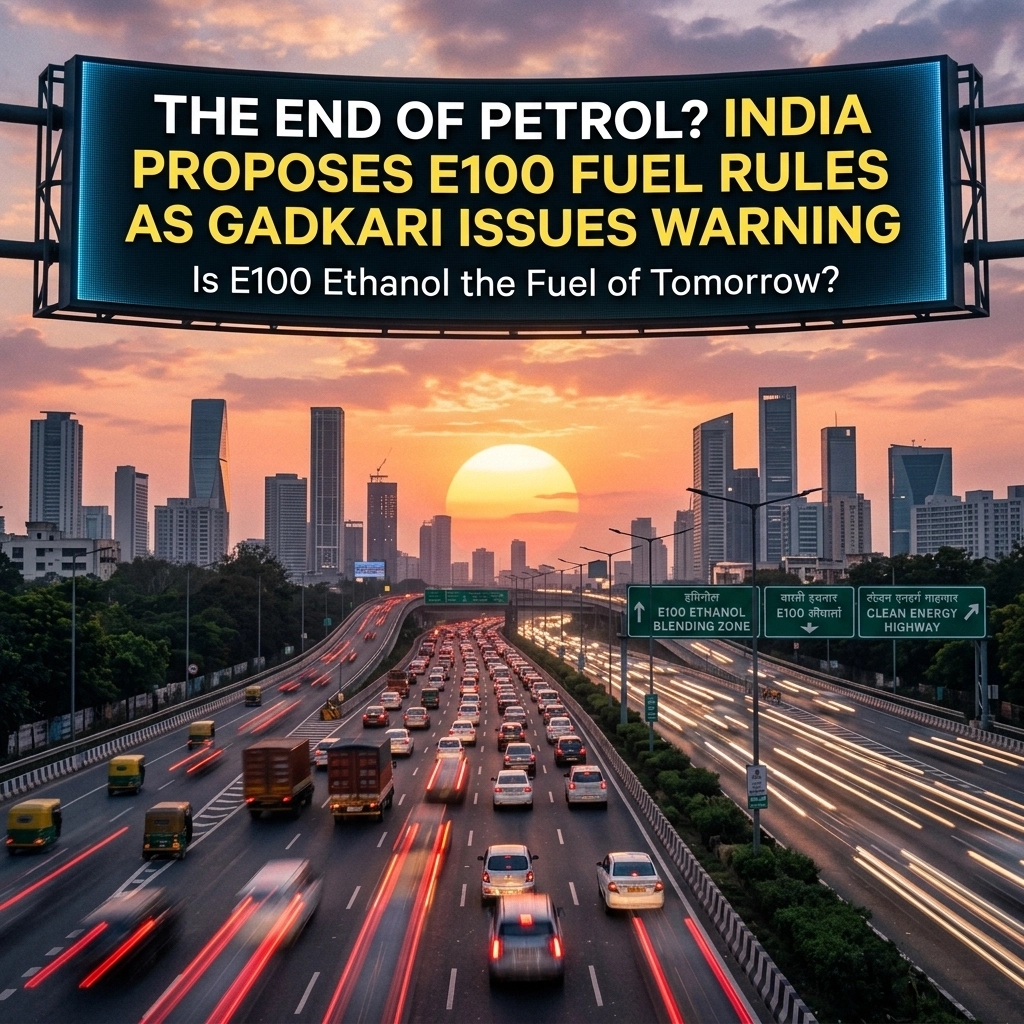

The Indian automotive landscape is currently navigating a tectonic shift as the government aggressively pivots toward a greener, self-reliant future. In a landmark move, the Ministry of Road Transport and Highways (MoRTH) has officially introduced draft amendments to include India's E100 fuel rules in the regulatory framework. This proposal, currently under public consultation, marks a significant departure from traditional fossil fuel dependence and aligns with Union Minister Nitin Gadkari’s recent, stark warning: there is simply "no future for petrol and diesel vehicles" in India’s long-term vision.
As the nation stares down a staggering ₹22 lakh crore import bill for crude oil, the transition to high-blend ethanol isn't just an environmental choice: it is a fiscal necessity. By proposing standards for E85 and E100 (pure ethanol), the government is laying the groundwork for a revitalized energy economy that seeks to democratize fuel production by shifting it from global oil cartels to Indian farmers.
1. The Regulatory Blueprint: Decoding India's E100 Fuel Rules
The recent draft notification from MoRTH serves as a sophisticated regulatory catalyst. By inviting public comments on the inclusion of E85 and E100 fuels under the Central Motor Vehicles Rules, the government is signaling to the industry that the era of experimentation is over; the era of implementation has begun.
Historically, India’s Ethanol Blended Petrol (EBP) program focused on lower concentrations. However, having achieved the E20 target ahead of schedule in 2025, the trajectory has now shifted toward "Flex Fuel" dominance. India's E100 fuel rules will provide the legal and technical standard for manufacturers to build engines capable of running on 100% ethanol. This transition is expected to reduce tailpipe emissions significantly while providing a legitimate purpose for the surplus sugar and grain production in the country’s agricultural heartlands.

2. The Gadkari Ultimatum: A Warning to the Automotive Industry
Nitin Gadkari, a vocal proponent of alternative fuels, has been unambiguous in his messaging to original equipment manufacturers (OEMs). His warning: that petrol and diesel have no future: is a call to action for the industry to revitalize its R&D pipelines. The Minister has consistently framed ethanol as a transformative solution to India’s energy security woes.
The government’s mission is clear: to move away from the volatility of the global oil market. With the Middle East currently embroiled in geopolitical turmoil and rumors swirling that the UAE may quit OPEC and OPEC+, the urgency to decouple the Indian economy from international crude prices has never been higher. For business leaders and investors tracking Business Tantra, this represents a massive opportunity in the green-tech and infrastructure sectors.
3. The ₹22 Lakh Crore Economic Imperative
The primary driver behind the rapid rollout of high-ethanol blends is the astronomical cost of energy imports. India currently spends approximately ₹22 lakh crore annually on importing crude oil. This massive drain on foreign exchange reserves limits the government’s ability to invest in social infrastructure and technological innovation.
Through the EBP program, India has already realized savings of ₹1.65 lakh crore in foreign exchange. Scaling this to E100 could provide an exponential growth trajectory for the domestic economy. By internalizing fuel production, the capital that previously flowed to oil-exporting nations will instead be circulated within the Indian rural economy.

4. Agri-Industrial Synergy: Empowering the Rural Economy
The move toward E100 is as much an agricultural reform as it is an energy policy. Ethanol is primarily derived from sugarcane, corn, and broken rice. By creating a consistent, high-volume demand for these crops, the government is effectively de-risking the agricultural sector.

This "farm-to-fuel" model ensures that farmers are no longer solely dependent on volatile food market prices. Instead, they become integral players in the national energy security hub. This synergy is expected to boost rural incomes and drive demand for industrial machinery and logistics services, creating a virtuous cycle of economic prosperity.
5. Global Energy Flux and the ATF Crisis
The timing of the E100 proposal is critical. The global energy market is currently facing extreme volatility. Domestic airlines like Air India, IndiGo, and SpiceJet are already seeking urgent relief as Aviation Turbine Fuel (ATF) prices soar due to West Asian turmoil. The industry has warned that they are on the verge of "stopping operations" if costs are not mitigated.
While the aviation sector struggles with high operating costs and airspace restrictions, the road transport sector has a clearer exit ramp through ethanol. The potential exit of the UAE from OPEC+ further complicates the global supply chain, making India's push for E100 even more visionary. By diversifying the energy mix, India is insulating itself from the "legitimate purpose" of global cartels that often manipulate supply to drive up prices.
6. Challenges and the Roadmap for Flex-Fuel Vehicles
Despite the optimistic outlook, the transition to E100 is not without its hurdles. To truly democratize green mobility, several factors must align:
- Engine Calibration: Standard petrol engines cannot run on E100 due to the corrosive nature of ethanol and different combustion properties. Manufacturers must accelerate the production of Flex-Fuel Engines.
- Infrastructure: Oil Marketing Companies (OMCs) must overhaul their storage and distribution networks to prevent moisture contamination in high-ethanol blends.
- Public Perception: Consumers need to be assured of the performance and longevity of E100 vehicles.

Automakers like Maruti Suzuki and Toyota have already showcased prototypes of flex-fuel vehicles, but a mass-market rollout requires the stable regulatory environment that India's E100 fuel rules aim to provide. For those looking to stay ahead of these market shifts, subscribing to our home news is essential for real-time updates.
7. The Competitive Landscape: Beyond Petrol
As petrol becomes a legacy fuel, the competition is heating up between various green alternatives. While Electric Vehicles (EVs) have gained significant traction, Ethanol offers a unique advantage: it utilizes existing liquid fuel infrastructure with minimal modifications compared to the massive grid upgrades required for total electrification.
Furthermore, India is exploring higher ethanol blends for commercial vehicles and even heavy-duty machinery. The proposed rules for E85 and E100 will likely lead to a surge in demand for specialized components, providing a boost to the "Make in India" initiative.
Conclusion
The proposal of E100 fuel rules by the Ministry of Road Transport and Highways marks a definitive turning point in India’s industrial history. Under the leadership of Nitin Gadkari, the government has transitioned from a defensive posture on energy to an offensive one. By targeting the ₹22 lakh crore import bill and leveraging the country's vast agricultural resources, India is creating a blueprint for energy independence that other developing nations may soon follow.
The "end of petrol" may not happen overnight, but the roadmap is now etched in regulation. For businesses, this is the time to pivot. Whether it is through investing in new automotive technologies or exploring the Business Tantra shop for digital solutions to navigate the new economy, the message is clear: the future is green, it is domestic, and it is powered by ethanol.
As we await the finalization of these draft rules, one thing is certain: the Indian tiger is no longer willing to be held hostage by global oil volatility. The transition to E100 is not just a policy change; it is a declaration of economic sovereignty.