























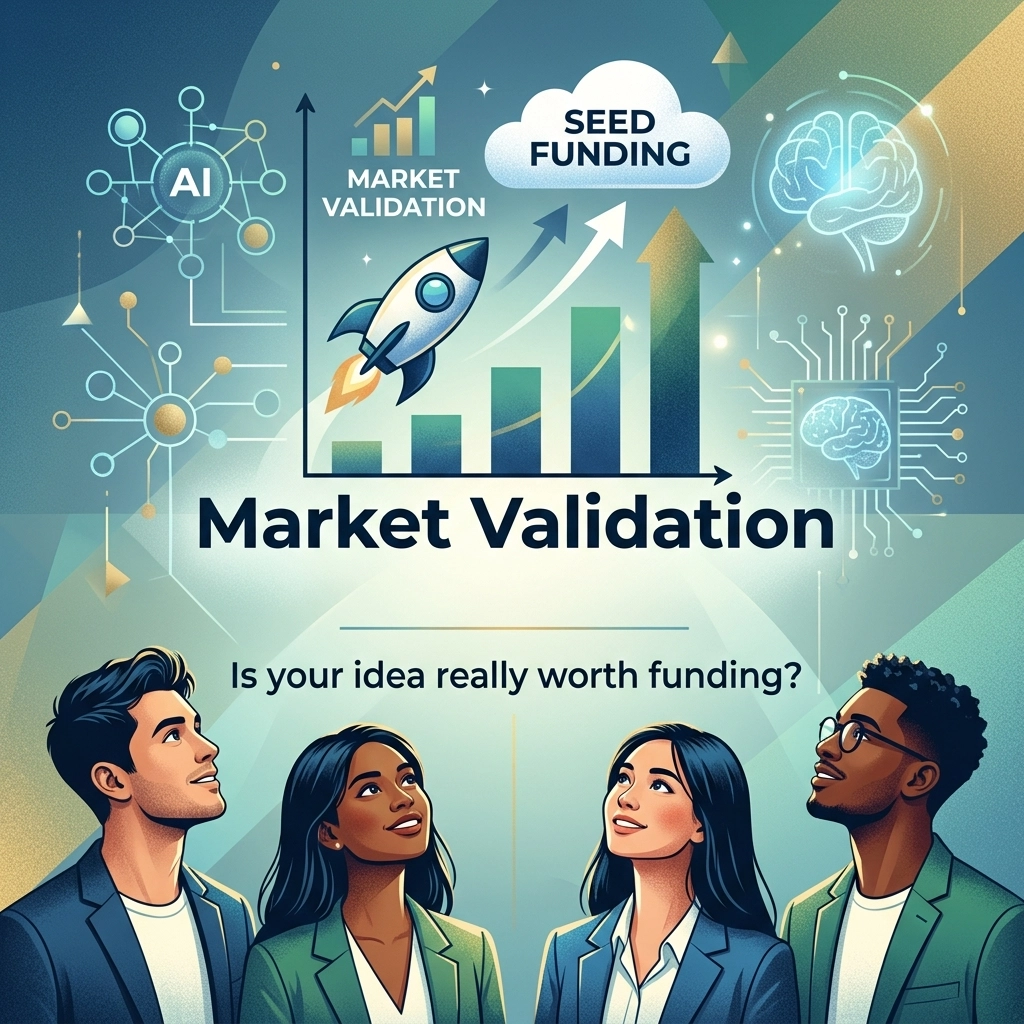
AI or Bust: Why Your Startup Needs “Market Validation” Before You Even Think About Seed Funding.

As of April 2026, the venture capital landscape has undergone a profound transformation. Gone are the days when a slick pitch deck and a "dot-ai" domain were sufficient to trigger a multimillion-dollar seed round. In the current fiscal climate, market validation has evolved from a "nice-to-have" metric into an absolute prerequisite for survival. For founders navigating the competitive corridors of 2026, the message from Sand Hill Road to Bengaluru is clear: prove the demand, or prepare for a quick exit.
The "funding winter" that many feared in previous years didn't just freeze capital; it revitalized the industry’s commitment to fundamental business logic. Investors are no longer subsidizing aggressive growth at all costs. Instead, they are looking for market validation: tangible, data-driven proof that a product solves a high-value problem for a specific, paying audience.
The 2026 Reality Check: From Hype to Utility
In the early 2020s, the "Growth at All Costs" mantra led to the rise of "GPT wrappers": startups that added a thin layer of user interface over existing large language models without creating proprietary value. By April 2026, the market has matured. We are now seeing a correction where "investor-grade evidence" is the only currency that matters.
Investors today are prioritizing startups that demonstrate a deep understanding of their unit economics from day one. This shift represents a catalyst for change in how entrepreneurs approach the ideation phase. Instead of building a solution and hunting for a problem, successful founders are spending months in the "validation trenches" before writing a single line of code.

Why Market Validation is the Ultimate Filter
From an analytical perspective, market validation serves as a vital risk-mitigation tool. Statistical data from late 2025 indicates that nearly 42% of startups failed not due to technical incompetence, but because there was simply no market need for their specific implementation of AI.
When you approach a seed-stage investor in 2026, they are looking for three specific pillars of validation:
- Reduced Demand Risk: Proof that you have identified a segment of customers who are actively seeking a solution to a quantified pain point.
- Revenue Potential Clarity: Understanding exactly how much a customer is willing to pay. In the current era, "intent to buy" is a weak metric; "paid pilots" are the gold standard.
- Founder Execution Discipline: Demonstrating that you can move beyond theoretical models and achieve early customer traction.
For more insights on how the current market is shaping up, you can explore our latest reports on Business Tantra News.
The "Edge Intelligence" Focus in SaaS and Fintech
A significant trend in April 2026 is the pivot toward "Edge Intelligence." While centralized cloud AI dominated the early decade, the new frontier involves AI SaaS and Fintech startups proving their models through localized, efficient, and privacy-centric processing.
Investors are particularly bullish on startups that can demonstrate market validation within the Edge Intelligence space. Why? Because these models offer lower operational costs and higher security: two factors that contribute directly to a sustainable business model. In the fintech sector, startups are using decentralized AI to provide real-time credit scoring and fraud detection, proving their value through reduced delinquency rates in paid beta groups.
This transition from broad, generalized AI to specialized, edge-based applications is a testament to the industry's drive to democratize advanced technology while maintaining rigorous standards of precision and data-driven insights.

Contrasting Eras: 2021 vs. 2026
The contrast between the previous era and the current one is stark. In 2021, the goal was to capture as many "eyeballs" or "users" as possible, regardless of the burn rate. In 2026, the focus has shifted to the "Quality of Revenue."
| Feature | 2021 Era (Growth at All Costs) | 2026 Era (Market Validation First) |
|---|---|---|
| Primary Metric | User Acquisition / MAUs | Revenue Retention / Unit Economics |
| Tech Focus | Generalized Cloud AI | Edge Intelligence & Vertical SaaS |
| Funding Trigger | Vision and TAM (Total Addressable Market) | SAM (Serviceable Addressable Market) Validation |
| Burn Strategy | High burn to capture market share | Lean operations until PMF is proven |
This shift toward sustainability is not just a trend; it is a permanent recalibration of the startup ecosystem. Founders who ignore this do so at their own peril. If you are looking to build a resilient company, understanding your value proposition is the first step toward legitimate success.
How to Achieve "Investor-Grade" Market Validation
To secure seed funding in today's environment, founders must move beyond surface-level feedback. Professional investors like those at Khosla Ventures or SoftBank are looking for sophisticated indicators of success.
1. Conduct Rigorous Problem Interviews
Before pitching, engage in at least 50 to 100 deep-dive interviews with potential stakeholders. Utilize technical and legalistic terminology to ensure you are speaking the language of the industry you intend to disrupt.
2. Secure Paid Pilots or Letters of Intent (LOIs)
A signed LOI with a clear "electronic communications network" protocol or a paid pilot program is worth more than a thousand "interested" sign-ups on a landing page. It proves that your solution has a legitimate purpose in the customer's budget.
3. Focus on Retention Intent
If you have a MVP (Minimum Viable Product), track how often users return. In 2026, AI startups are measured by their "stickiness." High churn in the early stages is a red flag that no amount of marketing spend can fix.

Sustainable Business Models: The New Gold Standard
The exponential growth of the AI sector has led to an increased scrutiny of the "cost of inference." Startups that haven't validated their pricing strategy against their compute costs will find it impossible to raise a Series A, let alone a Seed round.
Sustainability is now a core component of market validation. Investors are asking: "Can this business survive if the cost of GPUs rises by 20%?" or "Does the customer derive enough value to justify a 3x price increase over legacy software?" By focusing on sustainable business models early, founders demonstrate a level of maturity that was often missing in the previous decade.
For those looking to register their business and begin this journey, our registration guide provides a clear roadmap for establishing a professional entity in the Indian market.
The High Cost of Skipping Validation
Building without validation is essentially constructing a skyscraper on a foundation of speculation. The costs are not just financial; they are temporal. In a market that moves as fast as April 2026, losing six months building a product that nobody wants can be a terminal mistake.
The validation process shapes every downstream strategic decision: from your product roadmap and marketing strategy to your sales channels and pricing models. It ensures that when you finally do seek seed funding, you aren't just asking for a bet; you are offering an investment in a proven trajectory.

Conclusion
The "AI or Bust" era doesn't mean that AI is the only way to win; it means that if you are using AI, you must use it to solve real, validated problems. In April 2026, market validation is the ultimate filter that separates the visionaries from the tourists. By prioritizing sustainable business models, focusing on Edge Intelligence, and securing "investor-grade evidence" of demand, founders can navigate the current funding landscape with confidence.
Securing seed funding is no longer about who can shout the loudest about the future; it is about who can provide the clearest evidence of the present. As we look toward the remainder of the year, the startups that thrive will be those that viewed validation not as a hurdle, but as the very foundation of their exponential growth.
For further reading on the latest in business strategy and industry impacts, stay tuned to our blog layout for daily updates and expert analysis.

admin

Related Post