



















‘Prepare For The Worst’: Uday Kotak Warns of Economic Shock from US-Iran Conflict


In a stark address that has sent ripples through the Indian financial corridors, Uday Kotak, the Founder and Director of Kotak Mahindra Bank, has issued a definitive warning regarding the looming geopolitical instability. Speaking at the CII Annual Business Summit 2026 on May 12, the veteran banker articulated a grim prognosis for the Indian economy. As the US-Iran conflict escalates beyond localized skirmishes into a full-scale geopolitical crisis, Uday Kotak warns of economic shock that could potentially derail India’s growth trajectory if not met with immediate and "strategic paranoia."
The timing of this warning is critical. While the initial eight weeks of the conflict: which began in February 2026: saw a relatively muted impact on global markets, Kotak asserts that the "grace period" has officially concluded. With the collapse of ceasefire negotiations in April and the subsequent US naval blockade of Iranian ports, the secondary and tertiary effects are now beginning to manifest in India’s fiscal indicators.
1. The End of the 'Davos Mindset' and the Rise of Tribalism
Kotak’s analysis transcends mere market volatility; he posits that we are witnessing a fundamental shift in the global order. For decades, the world operated under what he terms the "Davos mindset": an era characterized by hyper-globalization, collaborative trade, and the belief that economic interdependence would preclude major conflict.
However, we have now transitioned into a "tribal phase," reminiscent of the pre-1945 era. In this new paradigm, nations are no longer seeking mutual prosperity but are instead competing for the control of physical assets and strategic trade routes.

"The world is moving from a collaborative network to a fragmented collection of tribes," Kotak observed. This shift has profound implications for India, which has historically benefited from open sea lanes and globalized supply chains. The potential control of chokepoints like the Strait of Hormuz and the Strait of Malacca poses an existential threat to energy-dependent economies.
2. Uday Kotak Warns of Economic Shock: The Oil Vulnerability
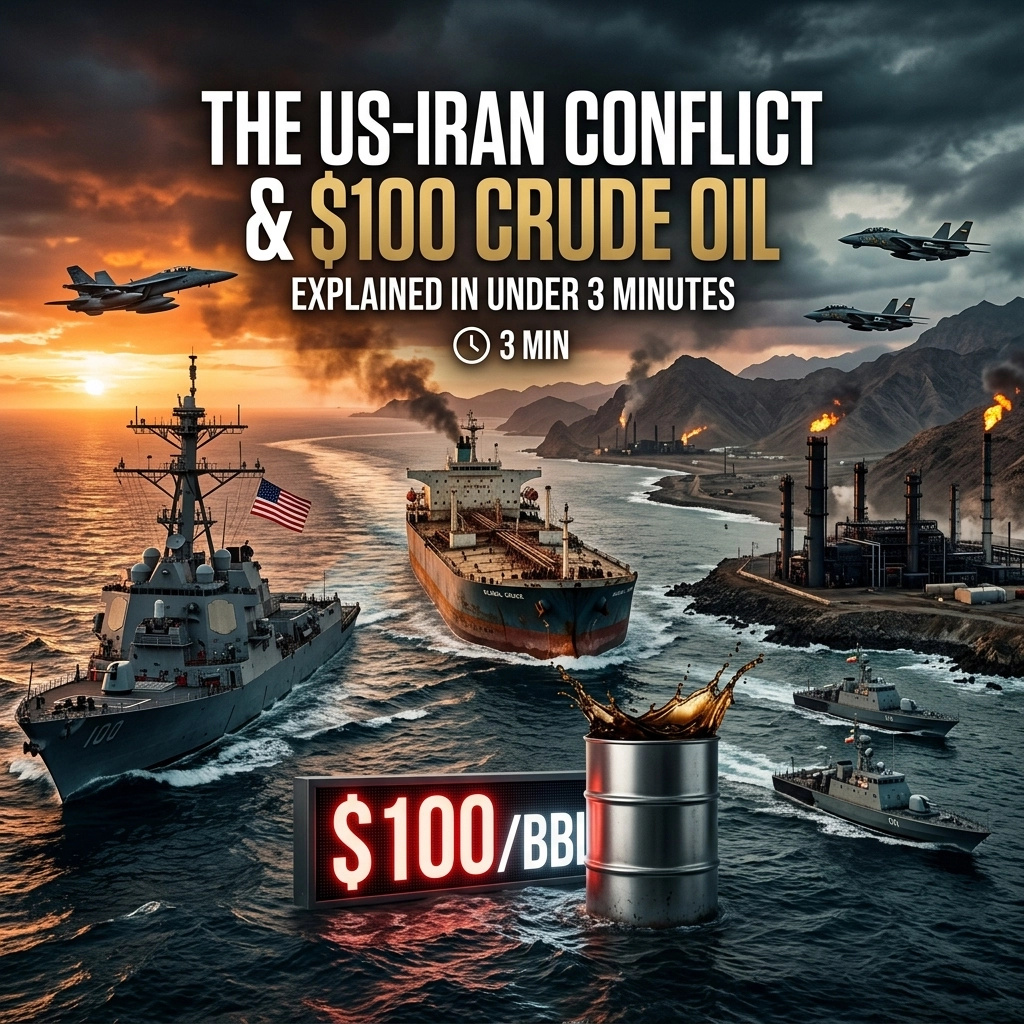
At the heart of the impending shock is India’s chronic dependence on imported energy. India currently imports over 85% of its crude oil requirements. When the conflict peaked in late March 2026, Brent crude surged past $120 per barrel, marking a 31% increase in less than five weeks.
While prices briefly retreated during the fragile April ceasefire, the recent breakdown in talks has pushed energy prices back into volatile territory. Kotak highlighted a critical fiscal threshold:
- At $60/barrel: India’s Current Account Deficit (CAD) remains manageable at approximately -1% of GDP.
- At $100/barrel: The CAD is projected to balloon to a dangerous -2.5%, exerting immense pressure on the national exchequer.
This widening deficit is not merely a macroeconomic statistic; it translates to higher costs for everything from logistics to fertilizers, directly impacting the common consumer.
3. The Rupee at a Record Low: Navigating Currency Volatility
As geopolitical tensions mount, the Indian Rupee has found itself in the crosshairs of a global "risk-off" sentiment. In early trade on May 12, 2026, the Rupee touched a record low of 95.63 against the U.S. dollar.

A weakening currency serves as a double-edged sword. While it may theoretically benefit exporters, the reality for a net-importing nation like India is "imported inflation." As the dollar strengthens, the cost of servicing external debt increases, and the price of essential imports: including electronics and energy: skyrockets. This phenomenon mirrors previous inflationary cycles where a key inflation gauge rose significantly, emphasizing the need for robust fiscal buffers.
4. Adopting a Mindset of 'Strategic Paranoia'
Perhaps the most evocative element of Kotak’s warning was his call for "strategic paranoia." He urged business leaders and policymakers to abandon optimism in favor of rigorous contingency planning. In a world where supply chains are weaponized, being "prepared for the worst" is the only legitimate purpose of corporate strategy.

Strategic paranoia involves:
- Low-cost Reshaping: Reconfiguring business models to be more resilient to external shocks without incurring massive capital expenditure.
- Resource Conservation: Moderating unnecessary consumption at both the corporate and individual levels to preserve liquidity.
- Supply Chain Diversification: Reducing reliance on single-source suppliers located in geopolitically sensitive zones.
This sentiment aligns with essential business management practices that prioritize long-term sustainability over short-term growth spurts.
5. Government Response and the Shift to Hybrid Models
The Indian government, led by Prime Minister Modi, has already begun advocating for measures to mitigate the economic impact. In a recent call to action, the PM requested a return to hybrid and work-from-home models to reduce national fuel consumption.
Industry bodies like Nasscom have responded, noting that the tech industry is already well-positioned with established hybrid models. By reducing the daily commute for millions of professionals, India can marginally decrease its crude oil demand, providing a small but necessary cushion against global price hikes. Furthermore, accelerating initiatives like the national battery swap scheme could further decouple the Indian economy from its fossil fuel dependency in the long run.
6. The Broader Impact on the Startup Ecosystem
The "Big Shock" warned of by Kotak will inevitably permeate the startup landscape. Venture capital, which thrives on stability and predictable growth, often retreats during periods of high geopolitical risk. We are already seeing Foreign Portfolio Investors (FPIs) pull billions out of Indian equities, seeking the safety of the U.S. Dollar and Treasury bonds.
Startups must now pivot from a "growth at all costs" mentality to a "unit economics" focus. The era of easy capital has been revitalized by a necessity for fiscal discipline. Those who fail to adapt to the new "tribal" economic reality risk being left behind in the impending market consolidation.

Conclusion
The warning from Uday Kotak serves as a catalyst for change for the Indian business community. The US-Iran conflict is no longer a distant news story; it is a direct threat to the economic stability of the subcontinent. By acknowledging the end of the "Davos mindset" and embracing a posture of strategic paranoia, India can navigate these turbulent waters.
The path forward requires a unified effort to democratize energy efficiency, revitalize domestic manufacturing, and maintain a rigorous focus on fiscal health. As we brace for the "Big Shock," the resilience of the Indian economy will be tested as never before. The mission now is clear: prepare for the worst, act with precision, and ensure that the value proposition of "Brand India" remains untarnished by external volatility.
For the latest updates on market movers and economic indicators, stay tuned to Business Tantra.

admin
Related Post