
























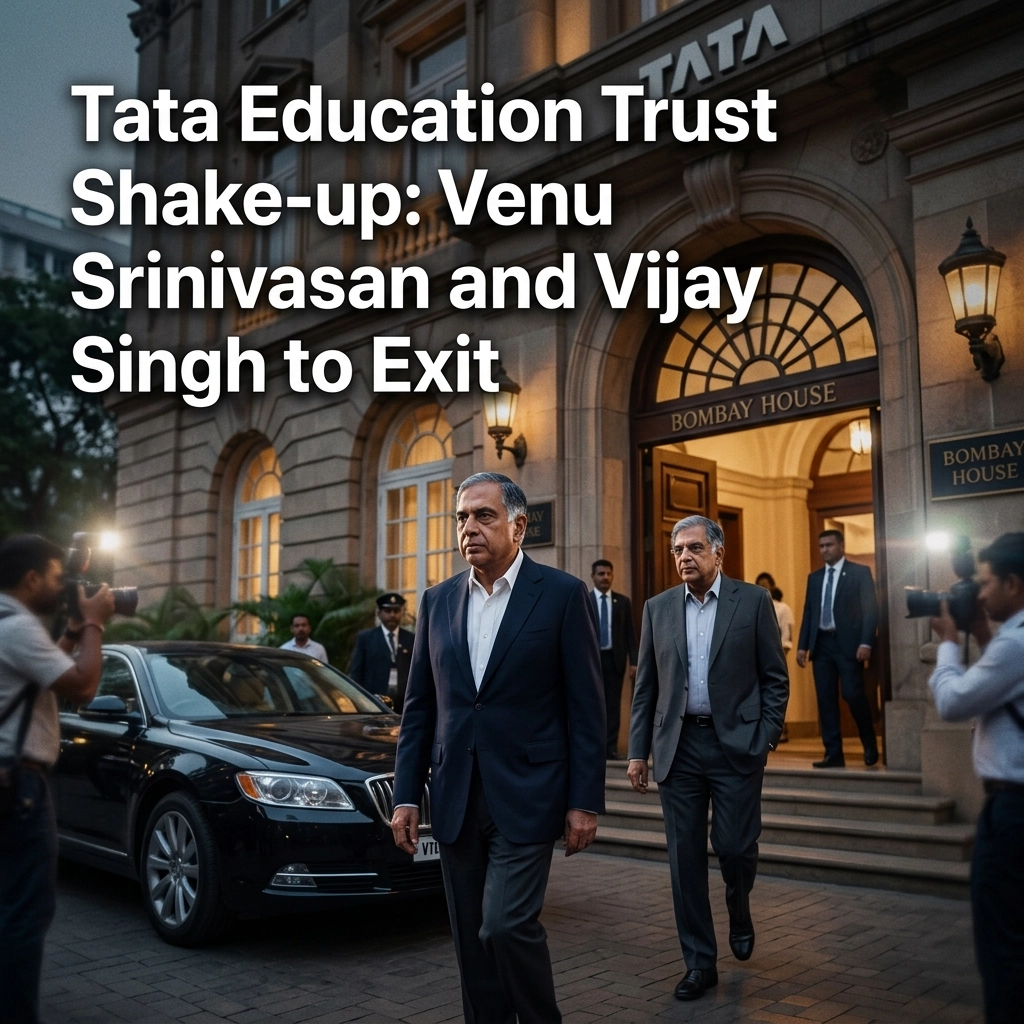
Tata Education Trust Shake-up: Venu Srinivasan and Vijay Singh to Exit

The landscape of Indian corporate governance and high-stakes philanthropy is currently witnessing a significant transformation as the Tata Education Trust shake-up sends ripples through the industry. The exit of stalwarts like Venu Srinivasan and the mounting pressure on Vijay Singh to vacate their positions mark a pivotal moment for one of India's most respected charitable institutions. This development is not merely a personnel change but a complex intersection of legal interpretations, historical mandates, and the evolving nature of fiduciary responsibility within the Tata Trusts framework.
As of May 2026, the internal dynamics of the Tata Group’s philanthropic arm have come under intense scrutiny. The friction stems from a governance row that pits traditional trust deeds against modern management practices. For an organization that serves as the bedrock of the Tata empire, these shifts are a catalyst for change that could redefine how large-scale Indian trusts operate in the 21st century.
1. The Core of the Conflict: A Governance Crisis
The current Tata Education Trust shake-up originated from a challenge to the eligibility of non-Parsi trustees. At the heart of the dispute is the interpretation of decades-old trust deeds, some dating back to 1923. Mehli Mistry, a former trustee and a significant figure in this narrative, has been a vocal advocate for strict adherence to the original charters of the Sir Ratan Tata Trust and its affiliates.
Mistry’s contention is built on the premise that the trusts were established with specific clauses requiring trustees to be Parsi Zoroastrians and permanent residents of Mumbai. The inclusion of Venu Srinivasan, Chairman Emeritus of TVS Motor, and Vijay Singh, a former Defence Secretary, was seen by some as a move to democratize the board with professional expertise. However, this diversity has now become the focal point of a legal and administrative battle before the Maharashtra Charity Commissioner.

2. Venu Srinivasan’s Resignation: More Than Meets the Eye
Venu Srinivasan, who serves as the Vice Chairman of seven Tata Group Trusts, recently tendered his resignation from the Bai Hirabai Charitable Trust, an affiliate of the Sir Ratan Tata Trust. While his official statement cited increasing professional responsibilities and the need to focus on his business ventures, the underlying circumstances suggest a more pressurized exit.
Reports indicate that the resignation followed a request from the CEO of Tata Trusts. However, the narrative took a turn when allegations surfaced that material information: specifically a legal opinion from former Chief Justice of India MH Kania: was withheld during the request for resignation. This legal opinion reportedly supported the eligibility of the trustees, raising questions about the transparency of the process. In the world of high-level business, such maneuvers are often analyzed as a "shaky start" to a larger restructuring, much like the shaky start for Stellantis in other global markets.
3. Vijay Singh’s Resistance and the Quest for Legitimate Purpose
Unlike Srinivasan, Vijay Singh has reportedly refused to step down immediately. His stance represents a significant pushback against the current administrative direction. Singh’s refusal to exit highlights a divide within the leadership regarding the legitimate purpose of the trust’s governance rules.
Singh has argued that the expertise brought by non-Parsi professionals is essential for the exponential growth and modernization of the trust’s philanthropic efforts. The stalemate between Singh and the current leadership underscores the tension between preserving heritage and ensuring contemporary efficiency. This debate mirrors broader discussions in the Indian business ecosystem regarding the professionalization of family-led and traditional institutions.

4. The Mehli Mistry Factor: An Analytical Observer’s View
Mehli Mistry’s role in this shake-up cannot be understated. As a cousin of the late Cyrus Mistry and a long-time associate of the Tata Group, his influence is substantial. By filing a petition with the Charity Commissioner, Mistry has forced the trusts to reconcile their current board composition with the 1923 charter.
From a corporate governance perspective, Mistry is acting as a watchdog for institutional fidelity. However, critics argue that such rigid interpretations could stifle the "mission" of the trusts by excluding global leaders who do not meet the specific religious or residential criteria. This situation provides a masterclass in the complexities of business management for startups and legacy firms alike, where growth must often be balanced against founding principles.
5. Implications for the Tata Group and Indian Philanthropy
The Tata Education Trust shake-up is a significant event for several reasons:
- Precedent for Other Trusts: Many of India's oldest philanthropic organizations are governed by colonial-era deeds. This case could set a legal precedent for how these documents are interpreted in the modern era.
- Board Diversity: The exit of Srinivasan and the potential exit of Singh raise questions about the future of board diversity in community-specific trusts.
- Governance Transparency: The allegations regarding the concealment of legal opinions highlight a need for revitalized transparency standards within charitable boards.
- Operational Stability: Tata Trusts hold a massive stake in Tata Sons, the holding company of the Tata Group. Any instability at the trust level can have a cascading effect on the entire conglomerate.

6. Navigating the Legal Labyrinth
The legal battle involves intricate arguments regarding the "Cy-pres" doctrine: a legal concept that allows a court to amend the terms of a charitable trust to as near as possible to the settlor's original intention when the original terms become impossible or impractical to carry out.
If the Charity Commissioner or the Bombay High Court finds that the 1923 rules are absolute, it could necessitate a mass exodus of several high-profile trustees. Conversely, if the courts decide that the "spirit" of the trust: to provide education and social welfare: supersedes the "letter" of the residency and religious clauses, it could lead to a modernization of trust laws across India.

7. Conclusion: The Road Ahead for Tata Trusts
The Tata Education Trust shake-up serves as a stark reminder that even the most established institutions are not immune to internal friction and the demands of governance reform. As Venu Srinivasan exits and Vijay Singh maintains his position, the eyes of the corporate world remain fixed on the Maharashtra Charity Commissioner’s office.
Ultimately, the goal of these trusts is to provide data-driven insights and material support to India’s educational and social sectors. Whether the board is composed of traditionalists or modernizers, the value proposition to the Indian public must remain intact. The resolution of this crisis will likely serve as a benchmark for corporate governance, proving that even in philanthropy, the balance between tradition and transformation is a delicate, yet essential, pursuit.
As we look toward the future of the entrepreneurial decade in India, the stability of institutions like the Tata Education Trust will remain a cornerstone of national progress. The outcome of this shake-up will determine if the trusts will continue to be led by a select community or if they will open their doors to a broader spectrum of Indian leadership.