
























Rupee Hits Record Low: Economic Impact of US-Iran Tensions

The Indian financial landscape witnessed a historic tremor this week as the rupee hits record low levels, breaching the psychological barrier of 95 against the US dollar. This unprecedented depreciation comes on the back of escalating geopolitical hostilities in the Middle East, specifically the renewed tensions between the United States and Iran. As the global markets brace for potential supply chain disruptions, the Indian economy finds itself at a critical juncture, navigating the volatile waters of currency devaluation and "imported inflation."
For investors and policymakers monitoring financial news India, the current trajectory of the Indian Rupee (INR) represents a significant "catalyst for change" in domestic fiscal strategy. The confluence of surging crude oil prices, a robust US dollar, and aggressive foreign capital outflows has created a perfect storm, forcing the Reserve Bank of India (RBI) into a high-stakes defensive posture.
1. The Geopolitical Catalyst: US-Iran Tensions and Global Markets 🌍
The primary driver behind the recent currency slide is the deteriorating diplomatic relationship between Washington and Tehran. In early 2026, a series of naval blockades and the seizure of oil tankers in the Strait of Hormuz led to an immediate "risk-off" sentiment across global trading floors. When geopolitical stability is threatened, investors traditionally seek refuge in "safe-haven" assets, primarily the US dollar and gold.
This "flight to safety" has systematically revitalized the Greenback, putting immense pressure on emerging market currencies. The Indian Rupee, often sensitive to global liquidity shifts, has borne the brunt of this realignment. As the US moves to tighten sanctions and reinforce its military presence in the region, the uncertainty regarding global trade routes has intensified, leading to a speculative sell-off of the INR.

2. Crude Oil: The Achilles' Heel of the Indian Economy 🛢️
India's economic vulnerability is inextricably linked to its energy dependence. As the world’s third-largest importer of crude oil, sourcing over 85% of its requirements from international markets, any spike in Brent crude prices acts as a direct drain on India’s foreign exchange reserves.
Following the US-Iran escalations, Brent crude prices surged toward the $120 per barrel mark. This spike creates a dual-pronged attack on the Indian economy:
- Widening Trade Deficit: A weaker rupee means India must shell out significantly more in domestic currency to purchase the same volume of oil.
- Current Account Pressure: The increased outflow of dollars to pay for energy imports further weakens the rupee’s valuation, creating a feedback loop of depreciation.
The "value proposition" of India's manufacturing sector is currently being tested by these rising input costs. If the energy crisis persists, the "exponential growth" witnessed in the post-pandemic recovery phase could face a sharp deceleration.
3. Monetary Policy and the Strength of the US Dollar 💵
Beyond the Middle East, the domestic currency is also battling a hawkish US Federal Reserve. Recent data suggests that the Fed is committed to maintaining elevated interest rates to combat persistent domestic inflation in the United States. This policy has kept US bond yields attractive, prompting Foreign Institutional Investors (FIIs) to pull capital out of Indian equities and debt markets to chase higher, risk-adjusted returns in the US.
When FIIs exit the Indian market, they sell rupees to buy dollars, directly contributing to the scenario where the rupee hits record low benchmarks. This capital flight is not merely a reflection of India's economic health but a systemic shift in global capital allocation.

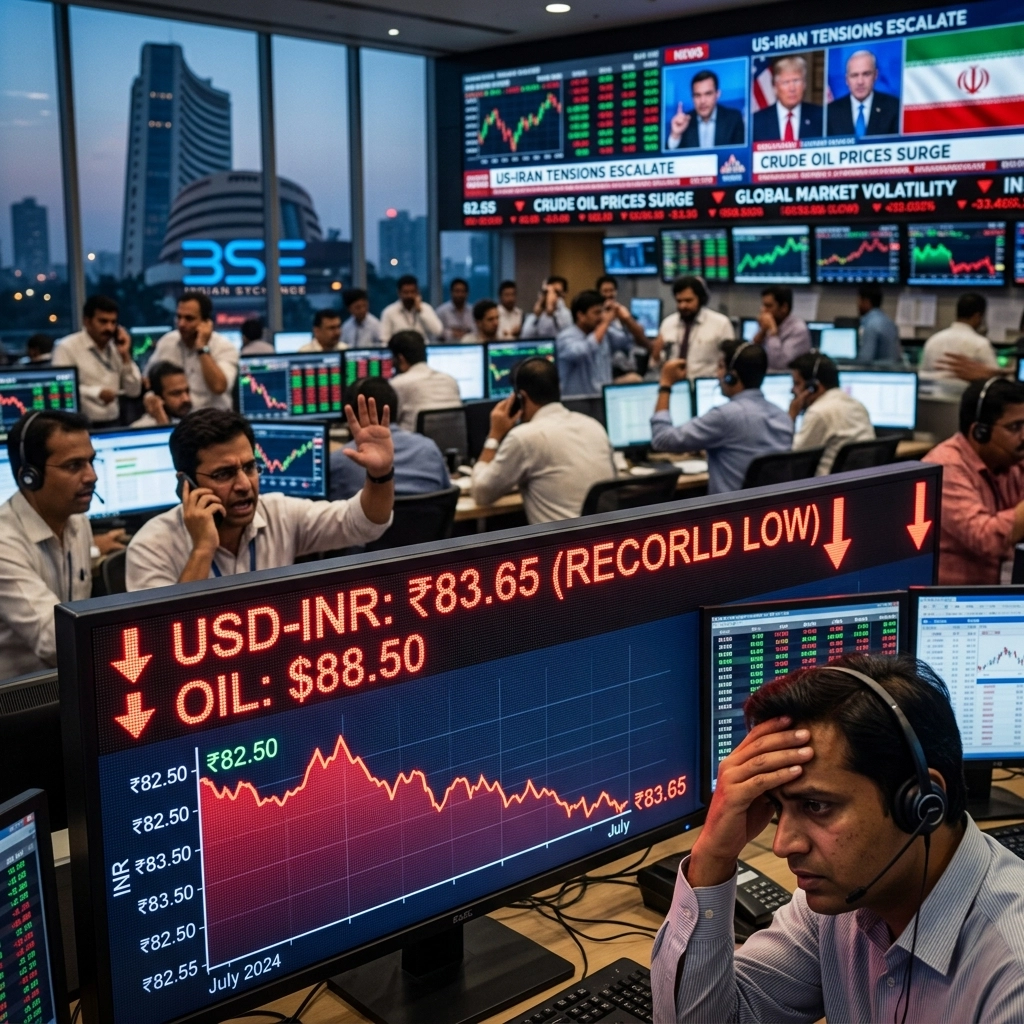
Suggested Image: A digital chart showing the steep decline of the Rupee against the Dollar with "95.00" highlighted.
4. The Domino Effect: Inflation and the Common Man 🛒
The impact of a record-low rupee is not confined to the skyscraper boardrooms of Mumbai; it trickles down to the average consumer with alarming speed. "Imported inflation" is the term economists use to describe the phenomenon where the rising cost of imported goods: due to currency weakness: pushes up domestic price levels.
- Fuel and Logistics: As oil companies pass on the higher cost of crude to consumers, transportation costs for essential commodities like fruits and vegetables rise, leading to food inflation.
- Electronics and Appliances: India relies heavily on imported components for smartphones, laptops, and consumer durables. A 5-6% depreciation in the rupee often translates to an immediate price hike for these goods.
- Fertilizers and Chemicals: Agriculture, the backbone of the Indian economy, is also hit as the cost of imported raw materials for fertilizers increases, potentially impacting the "mission" of achieving national food security.
5. Sectoral Analysis: Winners and Losers in a Weak Rupee Era 📉
While a falling rupee is generally viewed as an economic headwind, it creates a bifurcated landscape within the Indian corporate sector.
The Losers:
- Oil Marketing Companies (OMCs): Firms like IOCL and BPCL face massive pressure on their margins as the cost of raw materials skyrockets.
- Aviation and Paint Industry: These sectors are highly sensitive to crude derivatives. Higher fuel prices and chemical costs directly erode profitability.
- Importers: Any business relying on foreign raw materials without a natural hedge (export revenue) is currently struggling to maintain pricing power.
The Potential Winners:
- IT Services and Software: Companies like TCS and Infosys earn the majority of their revenue in dollars. A weaker rupee allows them to "democratize" their competitive pricing while reporting higher rupee-denominated profits.
- Textile and Pharma Exporters: These sectors benefit from increased price competitiveness in the global market, provided their raw material costs are not equally dollar-dependent.

6. The Role of the Reserve Bank of India (RBI) 🏛️
The central bank finds itself in a precarious position. While India possesses substantial foreign exchange reserves, the RBI must decide between intervening to support the currency or allowing the market to find its own level to preserve those reserves for a "legitimate purpose" in the future.
In recent weeks, the RBI has reportedly stepped into the non-deliverable forward (NDF) and spot markets to curb excessive volatility. However, intervention can only do so much when the fundamental drivers are global in nature. Market analysts expect the RBI to potentially look at the repo rate as a tool to support the currency, though this risks dampening domestic growth.
7. Remittances and the Diaspora Factor 🌏
India remains the world's top recipient of remittances, and a weaker rupee often acts as an incentive for the Indian diaspora, particularly in the Gulf and the US, to send more money home. However, the conflict in the Middle East complicates this. With nearly 9 million Indians working in the Gulf region, any prolonged instability could threaten the "electronic communications network" of remittance flows, which accounts for nearly 38% of India's total inflows.
The economic stability of these workers is tied to the regional peace, making the US-Iran tensions a direct concern for millions of Indian households.
8. Navigating the Volatility: Strategies for Businesses 🚀
For businesses operating in this climate, relying on "data-driven insights" is no longer optional. Companies must move from broad industry trends to specific operational tools to mitigate currency risk.
- Hedging Strategies: Utilizing forward contracts and options to lock in exchange rates for future transactions.
- Supply Chain Diversification: Reducing reliance on imports and exploring local sourcing to minimize dollar exposure.
- Dynamic Pricing: Implementing flexible pricing models that can adjust to rapid fluctuations in input costs.
At Business Tantra, we believe that while the current environment is challenging, it also serves as a "revitalized" call for Indian industries to move toward "Atmanirbharta" (self-reliance).

Conclusion
The fact that the rupee hits record low levels against the backdrop of US-Iran tensions is a stark reminder of how interconnected the global economy has become. India’s immediate future depends on its ability to manage the twin challenges of energy security and currency stability. While the geopolitical situation remains fluid, the resilience of the Indian macro-environment: supported by strong domestic demand and a proactive central bank: provides a glimmer of optimism.
As we move forward, the focus must remain on structural reforms that reduce import dependency and enhance export competitiveness. Only by addressing these core issues can India insulate its currency from the volatile winds of global politics and ensure sustainable, long-term growth.
For more updates on market movements and economic analysis, visit our Home Blog or Contact Us for expert insights.

admin


Related Post