

























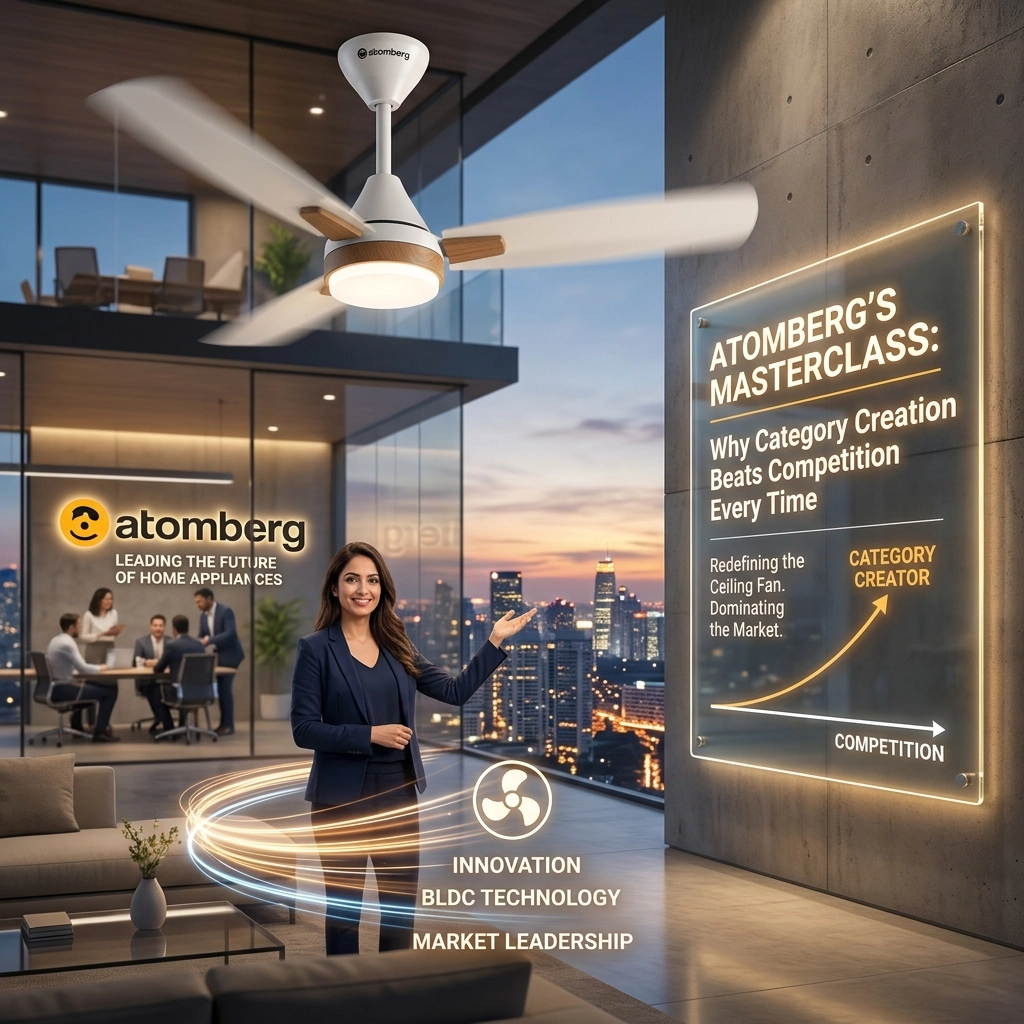
Atomberg’s Masterclass: Why Category Creation Beats Competition Every Time

In the hyper-competitive landscape of Indian consumer electronics, most brands are locked in a perpetual "feature war." They fight for the same slice of the pie, trying to be 5% faster, 10% cheaper, or slightly more colorful. However, every few decades, a company emerges that doesn't just want a slice of the pie: it decides to bake a completely different kind of pie. This is the essence of Atomberg’s Masterclass in category creation.
By the time the legacy giants realized the game had changed, Atomberg had already moved the goalposts. This isn't just a story about fans; it is a blueprint for how a startup can dismantle incumbents by redrawing the axis of competition. Today, as we look at their trajectory toward a $200 million IPO in 2026, the lessons are clearer than ever.
1. The Strategy: Don’t Compete on the Old Axis, Redraw It
For decades, the ceiling fan market in India was stagnant. The "axis of competition" was defined by two things: price and air delivery. If you wanted a better fan, you looked for higher RPM. If you wanted a cheaper fan, you went to the local hardware store. Legacy brands like Crompton and Orient owned this space through massive distribution networks and decades of brand trust.
Atomberg, however, realized that competing on this old axis was a losing game for a newcomer. Instead of trying to build a better induction motor fan, they introduced the Brushless Direct Current (BLDC) motor to the Indian household. They shifted the conversation from "How much air does it move?" to "How much money does it save you on your electricity bill?"
By focusing on energy efficiency: a catalyst for change in a country with rising power costs: Atomberg created a new category. They didn’t just enter the fan market; they owned the "Smart, Energy-Efficient Fan" segment before anyone else even bothered to label it.

2. Category Creation vs. Legacy Competition: The 60% Dominance
The numbers tell a staggering story of market capture. In the BLDC segment, which is the fastest-growing sub-sector of the fan industry, Atomberg holds a massive 60% market share. Compare this to a legacy giant like Crompton, which, despite its massive scale, holds only about 28% of the same segment.
Why did the incumbents miss this? It’s a classic case of the Innovator’s Dilemma. For Crompton or Usha to push BLDC fans aggressively, they would have to cannibalize their own high-volume, low-margin induction fan sales. They were incentivized to protect their "Legacy" status, while Atomberg had everything to gain by disrupting it.
This discrepancy highlights the power of owning a category. When a consumer thinks "energy-saving fan," they think Atomberg. This mental real estate is far more valuable than shelf space in a retail outlet. You can find more updates on how these market dynamics shift in our home news section.
3. Product Positioning: From Appliance to Lifestyle Furniture
One of the most brilliant moves in Atomberg’s playbook was the shift in product positioning. Traditionally, fans were viewed as functional appliances: utility items that you’d buy once and forget about until they started squeaking.
Atomberg reimagined the fan as a piece of lifestyle furniture. They integrated LEDs, utilized "earth tones" that match modern interior design, and introduced remote-controlled functionality as a standard rather than a luxury. They understood that the modern Indian homeowner doesn't just want a cool room; they want a room that looks "aesthetic."
By framing the product as a lifestyle choice rather than a hardware purchase, they managed to:
- Democratize high-end tech for the middle class.
- Command a premium price point that induction fans couldn't touch.
- Create a "hook" (the remote control and silent operation) that became a talking point for customers, driving organic growth.

4. Financial Growth: The Road to a $200M IPO
Growth without sustainability is a trap many startups fall into, but Atomberg seems to have found a balance. Their financial performance in FY25 reflects a company that is maturing rapidly.
- Revenue Milestone: The company reported a revenue of ₹958.4 crore in FY25, marking a solid 20% year-on-year growth.
- Path to Profitability: Perhaps more impressively, they narrowed their losses by 41%. In an era where investors are demanding "profit over growth," this trajectory is exactly what the market wants to see.
- Institutional Backing: With a Series C round led by Temasek, Atomberg has the "dry powder" needed to expand its manufacturing and R&D.
The ultimate goal? A $200 million IPO in 2026. This isn't just a liquidity event; it's a validation of their entire business model. They aren't just selling fans; they are selling a data-driven insight into the future of the Indian home. For more on how we analyze these business shifts, check out our about us page.
5. Insights from Khurshid Alam: The Founder’s Perspective
Analysis provided by Khurshid Alam, Founder at Pixel Street, suggests that Atomberg’s success was not an accident but a result of "redrawing the axis." Alam points out that most companies fail because they try to be "better" rather than "different."
Atomberg’s decision to own the BLDC category before incumbents even noticed was a masterstroke. By the time the big players started launching their own BLDC lines, Atomberg had already established the value proposition in the consumer's mind. They didn't just have a head start; they had the map.
Alam’s analysis emphasizes that for any new-age brand to succeed against a giant, it must find a "legitimate purpose" for its existence beyond just "selling stuff." For Atomberg, that purpose was energy conservation paired with superior user experience.

6. The Lesson: Own the Category Before Incumbents Notice
The biggest takeaway for entrepreneurs and business leaders is simple: Redraw the axis.
If you are entering a mature market, do not compete on the established metrics of price and features. Those metrics are owned by the people with the biggest budgets. Instead, find a new metric: whether it’s sustainability, IoT integration, or aesthetic lifestyle fit: and make it the most important thing to the consumer.
Atomberg didn't win because they had better distribution than Crompton; they won because they made Crompton’s distribution of "old fans" look obsolete. They utilized an electronic communications network of digital-first marketing and e-commerce dominance to build a brand before they ever needed to fight for shelf space in a Tier-3 city hardware store.
Conclusion
Atomberg’s journey from a small hardware startup to a category-defining leader is a testament to the power of strategic positioning. By focusing on BLDC technology, reimagining fans as lifestyle furniture, and maintaining a disciplined path toward profitability, they have set a new standard for Indian consumer durables.
As they gear up for their 2026 IPO, they serve as a catalyst for change for other startups. The message is clear: You don't have to be the biggest to win, but you do have to be the one who defines what "winning" looks like.
For those looking to follow in these footsteps or stay updated on the latest in Indian business, stay tuned to Business Tantra. Whether you are a founder looking for your next big move or an investor seeking the next unicorn, understanding the "Tantra" of category creation is your first step toward exponential growth.