
























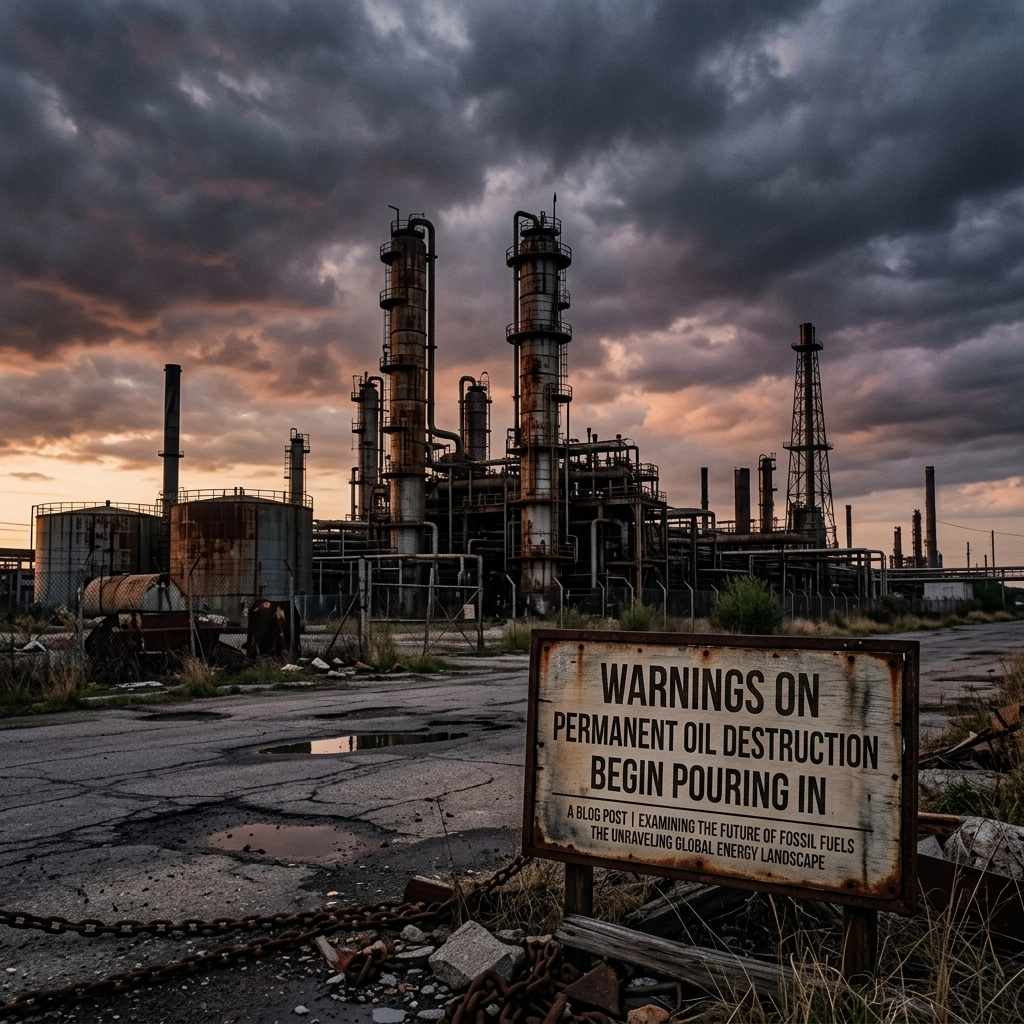
Warnings on Permanent Oil Demand Destruction Begin Pouring In

As of April 28, 2026, the global energy landscape is undergoing a seismic shift that many analysts believe is irreversible. The specter of permanent oil demand destruction has moved from the realm of theoretical climate modeling into the immediate strategic calculations of the world’s largest economies. Driven by an escalating conflict in the Middle East and a Brent crude price stubbornly hovering near the $110 mark, the "mission" for energy security is being fundamentally redefined.
At Business Tantra, we have observed that the current supply shocks: exacerbated by the loss of approximately 13 million barrels per day: are acting as a "catalyst for change" that may permanently diminish the world's reliance on fossil fuels. This transition is not merely a environmental preference but a survivalist economic strategy as the Indian Rupee opens at 94.37 against the dollar, putting unprecedented pressure on import-dependent emerging markets.
1. The Macroeconomic Tipping Point: Brent at $110 and the Rupee Slide
The economic reality of 2026 is one of stark volatility. With Brent crude nearing $110 and the Indian Rupee hitting record lows of 94.37 against the dollar, the cost of maintaining a traditional hydrocarbon-based economy has become prohibitive. For a nation like India, which imports the vast majority of its crude requirements, these figures represent more than just market fluctuations; they signify a structural threat to the national balance sheet.
When fuel prices remain elevated for an extended period, we witness a phenomenon known as demand destruction. However, unlike the cyclical dips seen in 2008 or 2020, the current trend points toward permanent oil demand destruction. Industrial consumers and logistics fleets are not just "waiting out" the high prices; they are utilizing data-driven insights to divest from internal combustion engines entirely. This "revitalized" approach to energy efficiency is a direct response to the unsustainable fiscal burden of $110 oil.

2. Geopolitical Shocks: The Middle East Conflict and the "Lost Billion"
The International Energy Agency (IEA) has recently issued its most dire warnings yet. The ongoing war in the Middle East has not only disrupted immediate shipping lanes but has effectively removed a significant portion of the global supply buffer. Experts estimate that the total lost supply could reach up to 1 billion barrels.
According to IEA Secretary General Fatih Birol, "governments will review their energy strategies" in light of these vulnerabilities. The "value proposition" of oil: once its reliability and density: has been compromised by geopolitical instability. This has led to a significant boost in nuclear and renewable investments. In this context, the demand is not being "suppressed"; it is being "replaced." As supply chains fracture, the move toward an electrified future becomes a matter of national security rather than just a climate goal.
3. The Asian Precedent: Why the East is Pivoting First
Asia, particularly the Indian and Chinese markets, is currently the epicenter of this demand shift. Because these regions are the most sensitive to dollar-denominated commodity spikes, they are the first to experience the "waves of destruction."

The destruction began in the transport sector but has rapidly moved into heavy industry. We are seeing a "democratize" effect of energy production, where localized solar and wind grids are replacing centralized, oil-dependent power structures. As mentioned in our latest market updates, the rapid adoption of electric vehicles (EVs) in Indian metropolitan areas is no longer a trend: it is a structural necessity to bypass the 94.37 USD/INR exchange rate penalty.
4. Infrastructure Shifts: From Pipelines to Data Centres
A fascinating byproduct of this energy crisis is the redirection of capital into digital infrastructure. A prime example is Reliance Industries' decision to set up India’s largest data centre cluster in Andhra Pradesh. While this may seem unrelated to oil, it represents a pivot toward the "new economy."
Data centers, while energy-intensive, are more compatible with renewable energy micro-grids than traditional manufacturing plants. This shift signals a broader move where major conglomerates are hedging against permanent oil demand destruction by building assets that flourish in an electrified, data-centric world. The "exponential growth" expected in the AI and data sectors is providing a legitimate purpose for the massive capital flight out of the traditional energy sector.

5. The $250 Threshold vs. Policy-Driven Destruction
Economists at major financial institutions often argue that "market-clearing" demand destruction requires oil prices to hit $250 per barrel to force consumers into permanent behavioral changes, such as the mass abandonment of air travel. However, the 2026 reality suggests that policy-driven destruction is happening much sooner.
Governments are not waiting for $250 oil. Through carbon taxes, EV subsidies, and strict "electronic communications network" regulations that favor green logistics, the state is mandating the end of oil demand. This top-down approach ensures that even if oil prices were to crash tomorrow, the infrastructure to consume that oil would no longer exist. This is the definition of permanent oil demand destruction: a state where the demand cannot return because the consumption apparatus has been dismantled.
6. Historical Resistance: Why 2026 is Not 2008
Critics of the "permanent destruction" theory often point to the 2008 Great Recession, where oil demand plummeted only to roar back to new highs within a few years. However, the technological landscape of 2026 is fundamentally different.
In 2008, electric vehicles were a novelty, and solar energy was prohibitively expensive. Today, the cost-parity of renewables, combined with advances in battery storage and semiconductor efficiency, means there is a viable "exit ramp" for consumers. Once a logistics firm switches its fleet to electric or hydrogen, they do not switch back when oil prices drop. The capital expenditure is sunk, and the operational benefits: lower maintenance and predictable energy costs: create a "lock-in" effect.

7. The Corporate Response: Strategic Divestment
Boardrooms across the globe are reacting to these warnings with a level of urgency not seen in decades. Senior executives are no longer viewing oil as a stable commodity but as a high-risk asset. We are seeing a surge in "green-washing" being replaced by "green-doing," as firms recognize that their long-term viability depends on decoupling from the hydrocarbon supply chain.
For more insights into how companies are navigating these shifts, you can visit our about-us page to see how Business Tantra tracks these transformative solutions. The focus is now on resilience and creating a "data-driven" roadmap to navigate the post-oil era.
8. Implications for the Indian Stock Market
The Indian stock market is currently a theater of this energy war. While sectors like Tata Chemicals are seeing gains on heavy volumes due to diversified interest, traditional oil and gas stocks are facing a long-term valuation discount. Investors are increasingly looking at the "mission" of a company: is it part of the old-world fossil fuel paradigm, or is it building the infrastructure for the electrified future?
The depreciation of the Rupee to 94.37 has also made foreign-denominated energy debt significantly more expensive, leading to a wave of refinancing and strategic defaults in the mid-cap energy sector. For individual investors, the Terms and Conditions of the market have changed; volatility is the new baseline.
Conclusion
The warnings of permanent oil demand destruction are not merely cautionary tales for the distant future; they are the reality of the 2026 global economy. The combination of a $110 Brent crude price, geopolitical instability in the Middle East, and a weakening Rupee has created a "perfect storm" that is forcing a definitive transition away from oil.
As governments and corporations move toward a "revitalized" energy strategy focused on renewables and electrification, the structural demand for crude is being eroded at its foundation. While the transition will be fraught with volatility, the move toward an electrified, decentralized energy future appears inevitable. At Business Tantra, we believe that those who recognize this "catalyst for change" early will be the ones to lead the next era of global economic growth.
For further analysis and daily updates on how these trends affect your portfolio, stay tuned to our home-news section. If you are a new reader, you can register to receive our deep-dive reports directly in your inbox.

admin


Related Post