
























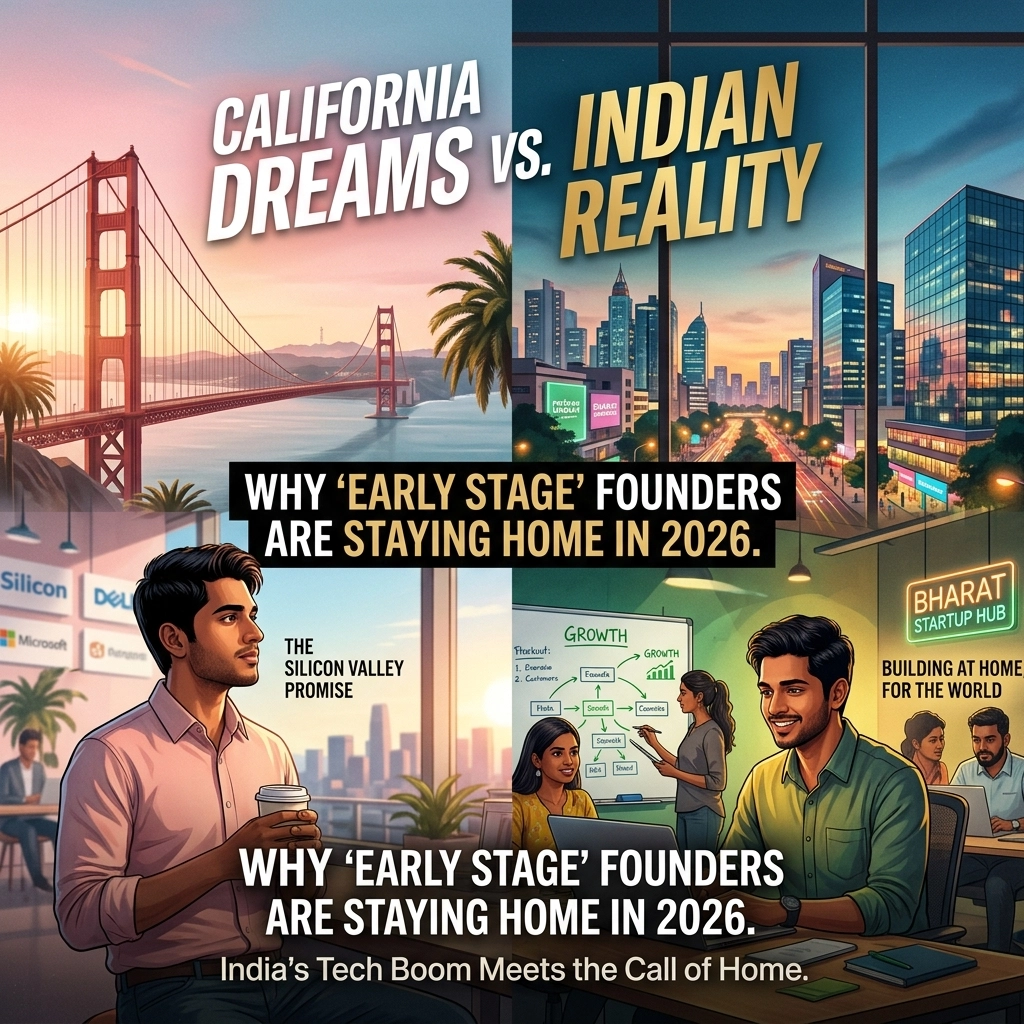
California Dreams vs. Indian Reality: Why “Early Stage” Founders are Staying Home in 2026.

For decades, the narrative of the "successful founder" followed a predictable trajectory: a brilliant idea born in a garage in Bengaluru or Delhi, followed by a one-way ticket to San Francisco. The allure of Sand Hill Road, the proximity to the titans of Silicon Valley, and the prestige of a California-based headquarters were considered the ultimate validation for any burgeoning venture. However, as we navigate through the second quarter of 2026, a seismic shift has occurred in the global entrepreneurial landscape.
The Indian startup ecosystem has transitioned from a supporting player to a primary destination. In a startling reversal of the historic "brain drain," early-stage founders are increasingly choosing to build, scale, and remain within the Indian subcontinent. This phenomenon is not merely a byproduct of nationalistic sentiment but a calculated strategic response to shifting economic realities, regulatory maturity, and the emergence of India as a global epicenter for sovereign technology.
The $10.1 Billion Catalyst: A New Era of Liquidity
The most quantifiable driver of this trend is the sheer volume of capital now available on domestic soil. For the fiscal year ending March 2026, the Indian startup ecosystem witnessed a robust influx of $10.1 billion in funding, specifically concentrated in early-stage and Series A rounds. This level of liquidity represents a revitalized investor confidence that was unthinkable during the "funding winters" of years past.

Unlike previous cycles where founders were dependent on foreign venture capital firms with strict "move to the US" clauses, the current landscape is dominated by domestic dry powder and sophisticated local GPs (General Partners). These investors understand the nuances of the local market and no longer demand that a company flip its structure to a Delaware C-Corp as a prerequisite for investment. The availability of high-ticket capital at home has effectively removed the financial desperation that once drove founders toward the California coast.
The Cost of Innovation: Palo Alto vs. Pune
One cannot discuss the migration patterns of founders without addressing the sheer economic friction of operating in the United States. In 2026, the cost of living and operational overhead in traditional tech hubs like San Francisco, Los Angeles, and even the "emergent" hubs like Las Vegas has reached a breaking point. For a pre-seed or seed-stage startup, the "burn rate" associated with a California presence is often the primary cause of premature failure.
A comparative analysis reveals a stark contrast:
- Talent Acquisition: The cost of hiring a senior full-stack engineer in the Bay Area now commands a premium that can sustain an entire 10-person engineering team in Hyderabad or Gurgaon.
- Real Estate and Infrastructure: While remote work remains a staple, the need for collaborative hubs continues. The rent for a modest office in Palo Alto can eclipse the cost of a state-of-the-art R&D center in India’s Tier-2 cities, which have become the new frontier for the Indian startup ecosystem.
- Runway Extension: By staying in India, founders are finding they can extend their "runway" by 3x to 4x compared to their counterparts in California, allowing for more experimentation and pivots before needing the next round of funding.
For more insights into how businesses are optimizing their operations in this new economy, you can explore our blog-layout-01 for detailed case studies.
Regulatory Maturity and Government as an Enabler
Perhaps the most significant "soft" factor in this shift is the evolving regulatory landscape. Historically, Indian founders fled to California to escape "Inspector Raj" and complex compliance requirements. In 2026, the roles have arguably reversed. While the US tech sector grapples with intense antitrust scrutiny, fragmented state-level data privacy laws, and volatile immigration policies, the Indian government has positioned itself as a "catalyst for change."
The digitalization of the economy: fueled by the Unified Payments Interface (UPI) and the Open Network for Digital Commerce (ONDC): has created a "plug-and-play" infrastructure for founders. Navigating the regulatory landscape in India has become more streamlined, with digital single-window clearances and tax incentives for registered startups. This ease of doing business has democratized entrepreneurship, making it feasible for a founder to focus on product-market fit rather than bureaucratic hurdles.
The Rise of Sovereign AI and Data Sovereignty
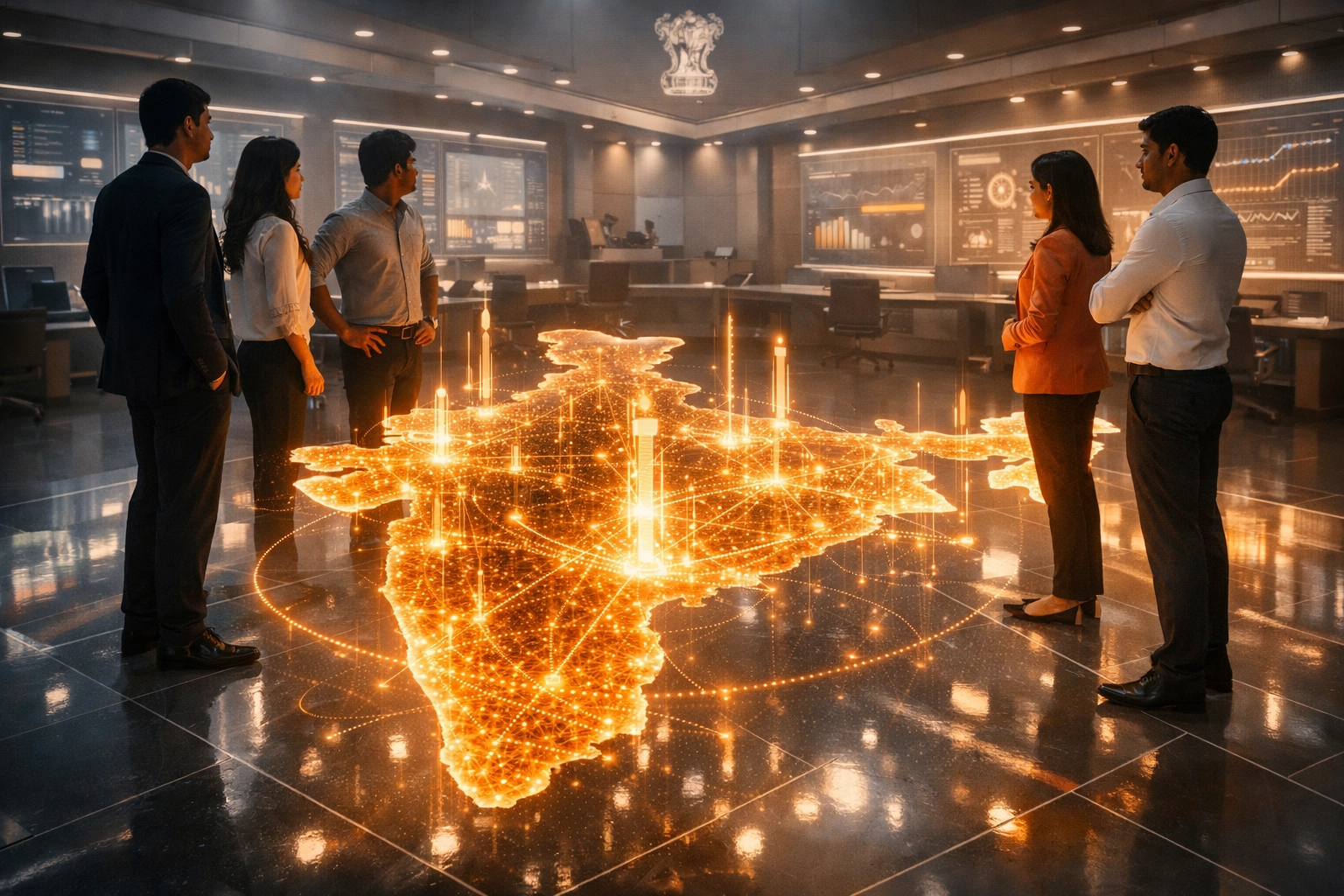
As we delve deeper into 2026, the global tech discourse is dominated by "Sovereign AI." India has taken a definitive stand in building its own foundational models and AI infrastructure, tailored specifically for its unique demographic and linguistic diversity. Founders building in the AI space are realizing that the "California Dream" often involves building on top of Western-centric models that lack the context needed for the "next billion" users.
The Indian government's push for data sovereignty and the development of indigenous AI stacks has created a protected yet expansive playground for local founders. By staying home, these entrepreneurs have direct access to massive local datasets that are essential for training high-precision models. This "data-driven insight" is a competitive moat that a Silicon Valley-based startup simply cannot replicate from afar.
The Massive Local Market: 1.4 Billion Reasons to Stay
In the past, the Indian market was often viewed as a "testing ground" before an eventual global launch. Today, the Indian domestic market is the "main stage." With a rapidly expanding middle class and the world's largest young population, the sheer scale of the opportunity within India is unparalleled.
Founders are discovering that solving "India-specific" problems: be it in agritech, deep-tech healthcare, or hyper-local logistics: offers a faster path to unicorn status than competing in the saturated markets of the West. The value proposition of an Indian startup ecosystem that caters to 1.4 billion people is no longer a secondary consideration; it is the primary objective.
If you are a founder looking to establish your presence in this thriving market, consider the importance of networking and professional identity. Our digital-business-card-nfc-enabled is an essential tool for modern entrepreneurs navigating this high-growth environment.

Comparison at a Glance: 2026 Landscape
| Feature | California / US Hubs | India (Modern Ecosystem) |
|---|---|---|
| Early Stage Funding | Highly competitive, high valuation | $10.1B pool, focused on fundamentals |
| Operational Cost | Exorbitant (Burn rate is high) | Optimized (High ROI on talent) |
| Market Saturation | High; focus on incremental innovation | Low to Medium; focus on foundational solutions |
| Talent Pool | Global but expensive | Deep technical talent, increasing retention |
| Regulatory Tone | Restrictive / Scrutinizing | Enablement-focused / Digital Infrastructure |
Conclusion
The exodus to California was once a rite of passage for the ambitious. However, in 2026, ambition has found a new home. The combination of robust funding, a supportive regulatory environment, and the strategic advantages of the "Sovereign AI" movement has made India the most logical place to build the next generation of global giants.
The Indian startup ecosystem has matured beyond its role as a back-office or a mirror of Silicon Valley. It is now a self-sustaining powerhouse of innovation. While the "California Dream" will always hold a certain cinematic charm, the "Indian Reality" offers something far more valuable to the 2026 founder: a legitimate purpose, exponential growth potential, and the tools to build a world-class company from the ground up, right where they are.
As the lines between global and local continue to blur, the message to early-stage founders is clear: you don't need to leave home to change the world.
For further inquiries or to stay updated on the latest business trends, feel free to visit our about-us page or contact-us directly. To explore our full range of business insights, you can view our post-sitemap.

admin

Related Post