

























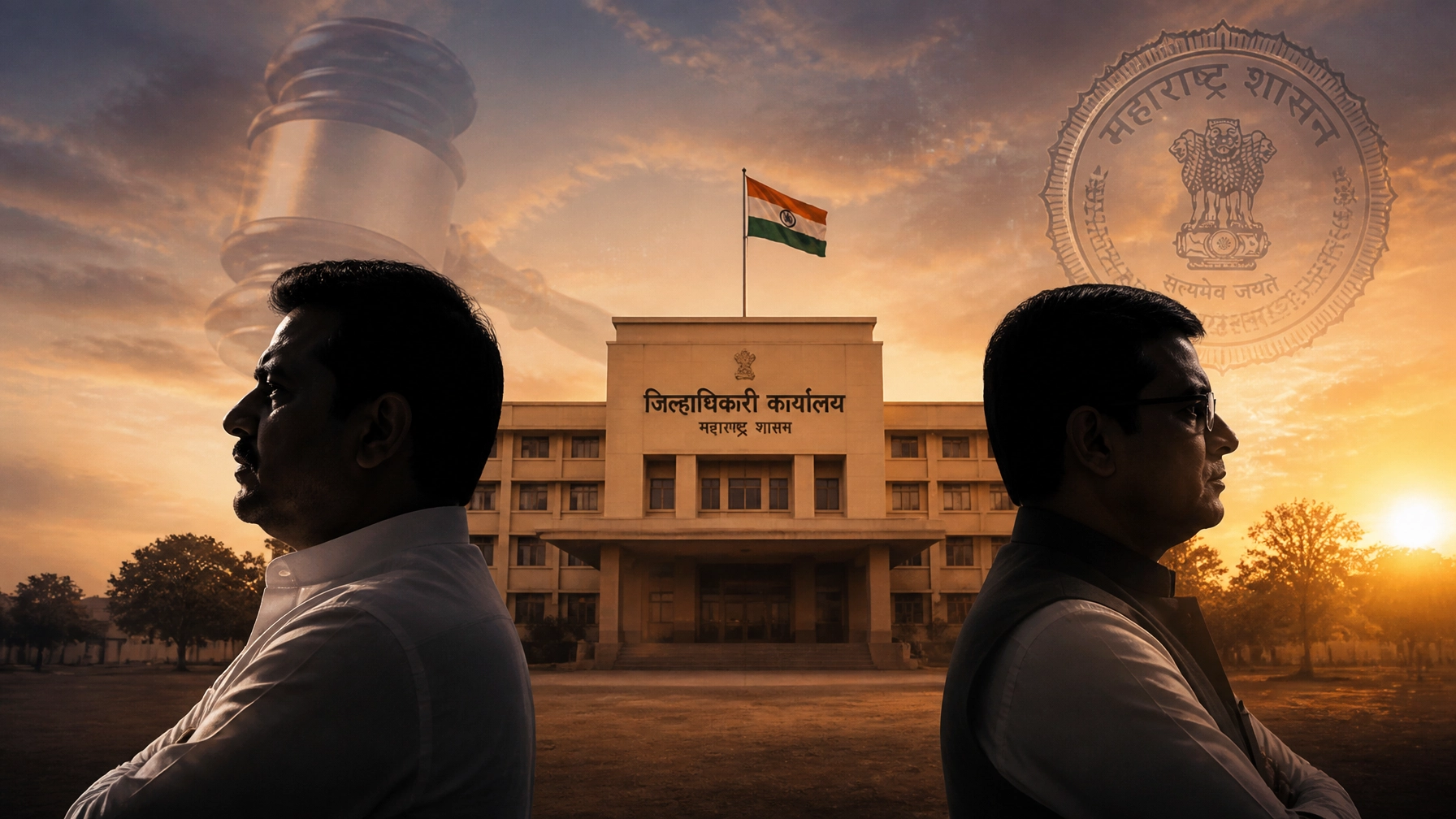

In a move that has sent ripples through the political corridors of Maharashtra, Member of Parliament (MP) Nilesh Lanke has leveled a grave accusation against Guardian Minister Radhakrishna Vikhe Patil. The core of the Nilesh Lanke vs Radhakrishna Vikhe controversy centers on the alleged strategic relocation of several government offices from their established administrative centers to Loni, the native village of Minister Vikhe Patil. This development has sparked a heated debate regarding the ethics of regional governance and the potential democratization: or lack thereof: of public resources.
The friction between these two prominent leaders is not merely a localized dispute; it represents a fundamental clash between a rising grassroots leadership and an established political dynasty. As Ahmednagar grapples with these administrative shifts, the broader implications for rural development and equitable resource distribution come into sharp focus.
1. The Allegation: Centralizing Power in Loni
The primary catalyst for this latest escalation is MP Nilesh Lanke’s public assertion that Radhakrishna Vikhe Patil is utilizing his ministerial influence to "hollow out" district administrative hubs. Lanke claims that by shifting key government offices to Loni, the Guardian Minister is creating a "parallel capital" that serves a narrow political interest rather than the legitimate purpose of serving the entire district.
According to Lanke, this administrative migration is a calculated effort to consolidate power. By placing essential services and bureaucratic machinery within his own stronghold, the Minister reportedly aims to fortify his family’s decades-long influence over the region. For the average citizen, this means increased travel time, logistical hurdles, and a perceived "exclusivity" of government access that contradicts the principles of decentralized governance.

2. A Deep-Rooted Political Rivalry
To understand the current tension, one must look at the recent electoral history of Ahmednagar. The 2024 Lok Sabha elections served as a transformative event when Nilesh Lanke, contesting on a Sharad Pawar-led NCP (Sharadchandra Pawar) ticket, defeated Sujay Vikhe Patil, the son of Radhakrishna Vikhe Patil. This victory was hailed as a "giant-killing" feat, as it breached the long-standing fortress of the Vikhe Patil dynasty.
Since then, the district has become a theater of "tit-for-tat" politics. While the Vikhe Patil family remains a powerhouse in the cooperative and educational sectors, Lanke has successfully positioned himself as a "people’s man," or a "Covid warrior," emphasizing grassroots connection over hereditary privilege. The current accusation of shifting offices is seen by many analysts as Lanke’s latest move to keep the Minister on the defensive, especially as the state gears up for further political transitions.
3. Impact on Local Governance and Accessibility
The mission of any regional government should be the equitable distribution of services. However, when government offices are relocated based on political proximity rather than geographical centralism, the value proposition of public administration is significantly diminished.
- Logistical Inefficiency: Moving offices away from the district headquarters often forces residents from distant tehsils to travel much longer distances to access basic services.
- Infrastructure Strain: Concentrating offices in a single village like Loni puts an exponential growth strain on local roads and communications networks while leaving existing hubs underutilized.
- Administrative Fragmentation: When departments are scattered to suit political whims, the synergy required for rapid governance is lost.
Lanke’s critique suggests that such moves are a "catalyst for change" in the wrong direction: prioritizing the convenience of a few over the needs of the many. In a state that has seen significant startup growth and administrative modernization, these alleged regressions into "fiefdom-style" governance are viewed with skepticism.

4. The Economic Fallout: Real Estate and Local Markets
The shifting of government offices is rarely just about bureaucracy; it is an economic driver. When a government office moves, it brings with it a steady flow of employees, visitors, and legal professionals. This influx revitalizes local economies, creates demand for commercial real estate, and boosts retail businesses.
By allegedly diverting these offices to Loni, Lanke argues that Vikhe Patil is effectively siphoning off economic opportunities from other parts of the district to benefit his home turf. This mirrors broader economic concerns in the state, such as how rising consumer prices and inflation impact the average rural entrepreneur. If administrative hubs are moved, the local ecosystems surrounding the previous locations: from small xerox shops to local canteens: face potential financial ruin.
5. Legislative and Legalistic Scrutiny
From a legalistic perspective, the relocation of government offices often requires a "legitimate purpose" verified through official channels. MP Nilesh Lanke has called for transparency in the decision-making process, questioning whether these moves were backed by any formal feasibility study or data-driven insights.
The controversy also brings into question the role of the Guardian Minister. While the position is intended to oversee and facilitate development, it is not a mandate for unilateral administrative restructuring. Critics argue that such actions must be scrutinized under the lens of the "electronic communications network" and modern administrative standards that favor digital accessibility over physical proximity.
Reports from Hindustan Times suggest that the Vikhe Patil family has been striking back through various local assembly victories, but the ethical cloud of "favoritism" continues to hang over these administrative shifts.

6. Comparison with State-Level Development Trends
At a time when Maharashtra is looking to democratize technology through schemes like battery swapping, the centralization of physical offices seems counter-intuitive. Modern business management for startups and public administration alike emphasizes "lean" operations and distributed networks.
For instance, Business Tantra’s insights on business management highlight that growth is most sustainable when it is inclusive. When political leaders prioritize their "village" over the "district," they risk creating a lopsided development model that cannot withstand the pressures of a modernizing economy.
7. The Narrative of the "Giant Killer" vs the "Dynast"
Nilesh Lanke’s rhetoric is carefully crafted to appeal to the "Aam Aadmi" of Ahmednagar. By accusing Vikhe Patil of "stealing" offices for his village, Lanke reinforces his image as a defender of the common citizen against an entitled elite. On the other hand, the Vikhe Patil camp maintains that any shifts are made for administrative convenience and better service delivery to the rural population.
However, the optics of the situation favor Lanke’s narrative. In the world of 24/7 news cycles, the image of a minister "running away" with government offices to his home is a powerful political weapon. This Nilesh Lanke vs Radhakrishna Vikhe controversy is likely to remain a central theme in the upcoming political cycles, as both leaders vie for territorial and moral supremacy.

Conclusion
The allegations leveled by MP Nilesh Lanke against Guardian Minister Radhakrishna Vikhe Patil represent more than just a local political spat; they highlight a critical tension in the evolution of Indian governance. As we navigate through 2026, the demand for transparency, equity, and decentralization has never been higher.
The "mission" of a public servant is to serve the collective, not to revitalize a personal stronghold. Whether these accusations lead to an official probe or simply remain as political fodder for the next election, they have successfully brought the issue of administrative accountability to the forefront. For the people of Ahmednagar, the ultimate value proposition of their government lies in its accessibility and fairness: qualities that must not be sacrificed on the altar of political convenience.
As the situation develops, stay tuned to Business Tantra for the latest updates on regional politics and economic indicators that shape our nation.