


























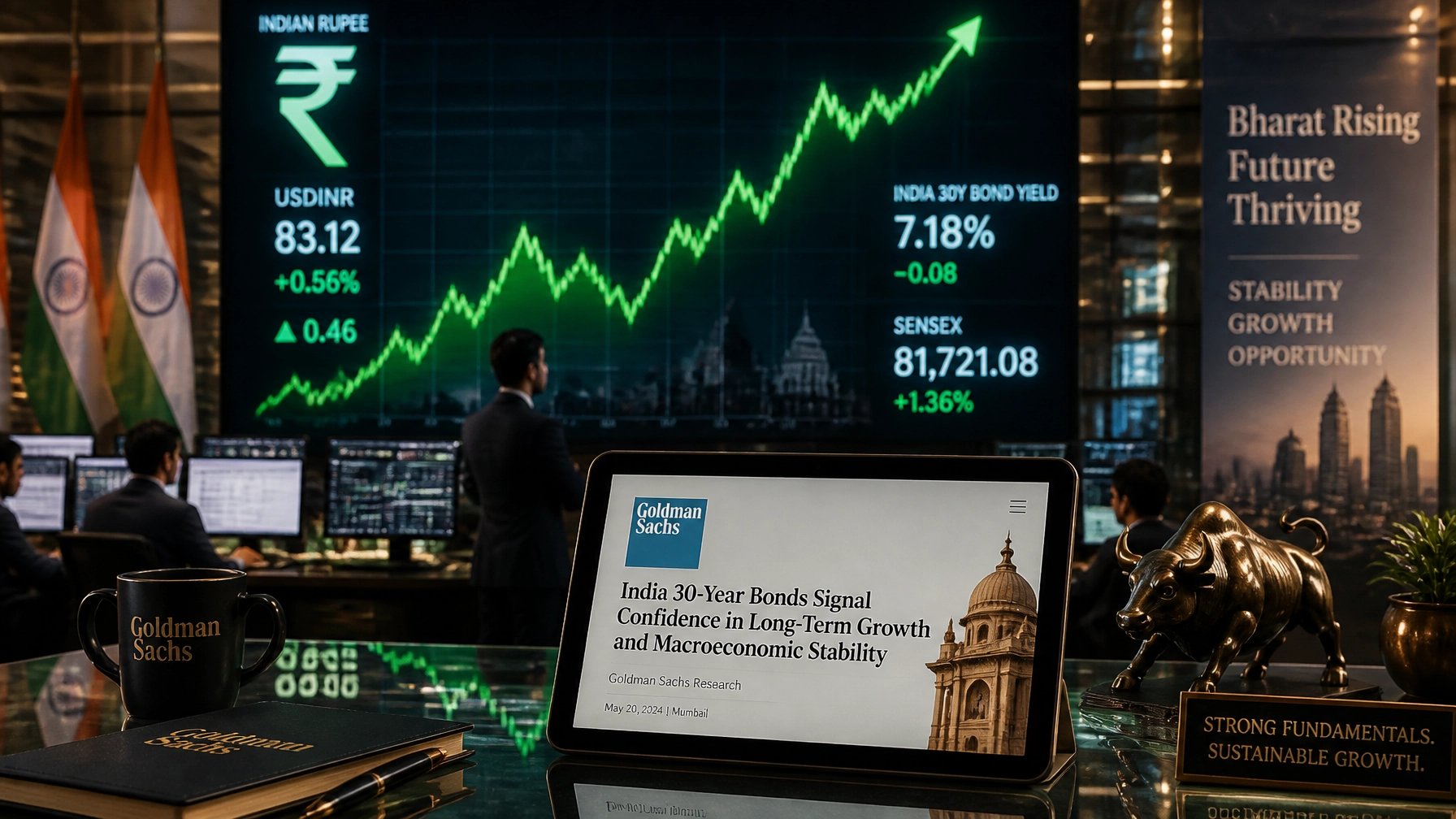

The global financial landscape is witnessing a significant pivot as Goldman Sachs, one of the world's leading investment banking firms, has officially turned bullish on India’s ultra-long-duration sovereign debt. In a detailed research note released on June 29, 2026, the firm recommended that institutional investors shift their focus toward India’s 30-year government bonds, citing a rare convergence of easing domestic inflation, stabilizing global energy markets, and a transformative regulatory environment for foreign capital.
This strategic upgrade comes at a pivotal moment for the economy of India. As the stock market today continues to navigate the complexities of a post-geopolitical volatility era, the fixed-income sector is emerging as a "catalyst for change" for the nation’s broader fiscal health. Goldman Sachs has not only spotlighted the bond market but has also revitalized its optimism for the country’s productivity, raising India’s CY26 GDP growth forecast to a robust 6.8%.
1. The Rationale Behind the Ultra-Long Duration Call
Goldman Sachs’ preference for the 30-year segment of the yield curve is a calculated move based on the "democratize-ation" of credit access and a sharp reduction in macro-volatility. Analysts led by Danny Suwanapruti argue that long-dated bonds currently offer superior value compared to the front end of the curve. The primary reason is that shorter maturities have already largely priced in the Reserve Bank of India’s (RBI) recent pause in rate hikes, leaving the most significant "alpha" potential in the ultra-long duration space.

As of late June 2026, the India 30-year yield is hovering around 7.33%. While this represents a 30-basis-point drop over the previous month, the underlying fundamentals suggest further room for yield compression. Goldman’s thesis is built on three foundational pillars:
- Easing Inflation Expectations: Domestic consumer price index (CPI) data has consistently trended toward the RBI's median target. This disinflationary trend has significantly improved real yields, making long-term locking of interest rates a high-conviction trade for global asset managers.
- The US-Iran Peace Dividend: A pivotal interim deal between the US and Iran has served as a massive de-risking event for the economy of India. With oil prices stabilizing at lower levels, India’s massive energy import bill has shrunk, directly reducing fiscal deficit concerns.
- Fiscal Consolidation: The Indian government’s commitment to staying the course on its fiscal glide path has reassured international rating agencies, providing a stable backdrop for sovereign debt.
2. The Bloomberg Index Inclusion: A $15 Billion Tsunami
Perhaps the most significant structural driver mentioned in the Goldman report is the imminent inclusion of Indian sovereign debt in the Bloomberg Global Aggregate Index. This move is no longer a matter of "if" but "when," with a mid-year announcement expected to trigger a tectonic shift in capital flows.

Goldman Sachs estimates that India will command an index weight of approximately 0.7%. While this percentage might seem modest in isolation, it translates to an estimated $15 billion in passive inflows over the phase-in period. These are not speculative "hot money" flows but rather structural, long-term capital from global pension funds, insurance companies, and index-tracking ETFs.
The inclusion acts as a "legitimate purpose" for many conservative European and North American funds to finally allocate capital to the Indian rupee-denominated market. This massive influx of liquidity is expected to anchor demand at the long end of the yield curve, providing a "data-driven insight" into why the 30-year bond is the most attractive vehicle for capturing this shift.
3. Regulatory Revitalization: Tax Relief for Foreign Investors
The government’s proactive stance in "democratizing" the bond market for international players cannot be overstated. A series of recent policy shifts, including the expansion of the Fully Accessible Route (FAR), has paved the way for this bullish cycle.
Historically, foreign portfolio investors (FPIs) were deterred by complex tax structures and withholding taxes on interest income. However, the latest round of tax relief: specifically targeting certain sovereign debt instruments held by foreigners: has significantly boosted the after-tax internal rate of return (IRR).

In June 2026 alone, foreign holdings of index-eligible bonds increased by nearly ₹40,000 crore, marking the largest single-month purchase in Indian history. This surge in overseas buying validates the "value proposition" of the Indian sovereign bond as a safe-haven asset with emerging-market returns. For the Business Tantra Economics section, this marks a transition from a closed domestic market to a truly globalized financial ecosystem.
4. Synergy Between Bonds and the Stock Market Today
The relationship between the bond market and the stock market today is highly symbiotic. As yields on the 30-year bond begin to compress, the cost of equity for Indian corporations naturally falls. Lower long-term borrowing costs act as an "exponential growth" engine for capital-intensive sectors like infrastructure, green energy, and manufacturing.
Furthermore, the banking sector: a heavyweight in Indian indices: stands to benefit immensely. Indian banks hold massive portfolios of government securities (G-Secs). A rally in bond prices (which occurs when yields fall) leads to significant treasury gains, strengthening bank balance sheets and enabling them to lend more aggressively to the private sector. This creates a virtuous cycle that supports Goldman's 6.8% GDP growth forecast.
Investors watching the stock market today should view the bond rally not just as a fixed-income event, but as a leading indicator of macroeconomic stability. When global giants like Goldman Sachs commit to the long end of the Indian curve, it signals deep confidence in the long-term sovereignty and stability of the economy of India.
5. Navigating the Risks: Oil and Geopolitics
Despite the laudatory outlook, Goldman Sachs maintains a journalistic neutrality by highlighting potential headwinds. The primary risk remains the volatility of energy prices. While the US-Iran interim deal has provided a "revitalized" sense of calm, any breakdown in diplomatic relations could send crude prices skyrocketing, reigniting inflationary pressures.
Additionally, the ultra-long duration of 30-year bonds makes them highly sensitive to interest rate changes. A 1% shift in market rates can lead to double-digit price swings in these instruments. Investors must therefore utilize "data-driven insights" and sophisticated risk-management tools to navigate the potential for volatility in an increasingly interconnected electronic communications network.

Conclusion
Goldman Sachs’ bullish stance on India’s 30-year bonds is a definitive endorsement of the nation's macroeconomic trajectory. By combining easing inflation, strategic tax relief, and the massive catalyst of Bloomberg index inclusion, the firm has framed Indian sovereign debt as a transformative solution for global portfolios seeking duration and yield.
For the economy of India, this transition signifies a move toward global financial integration, providing the necessary fiscal space to fund the country's "mission" of becoming a top-three global economy. As we observe the stock market today, it is clear that the stability found in the bond market is providing the foundation upon which the next leg of Indian corporate growth will be built.
The convergence of $15 billion in passive inflows and a 6.8% GDP growth forecast paints a picture of a nation that is not just participating in the global economy but is increasingly leading it.
External Resources:
- Reserve Bank of India (RBI) – Official Website
- Bloomberg Professional Services – Index Inclusion Updates
- Goldman Sachs Asset Management – Global Market Outlook
Internal Links: