


























In a move that has reverberated across the global technology sector, Salesforce CEO Marc Benioff has signaled a profound transformation in the company’s operational architecture. As the software industry navigates the complexities of a post-SaaS world, Salesforce has made a definitive decision: a Salesforce engineering hiring freeze 2025 is now in effect. This is not merely a cost-cutting measure but a strategic pivot, as the company redirects millions of dollars away from traditional headcount and toward the "exponential growth" potential of autonomous AI agents.
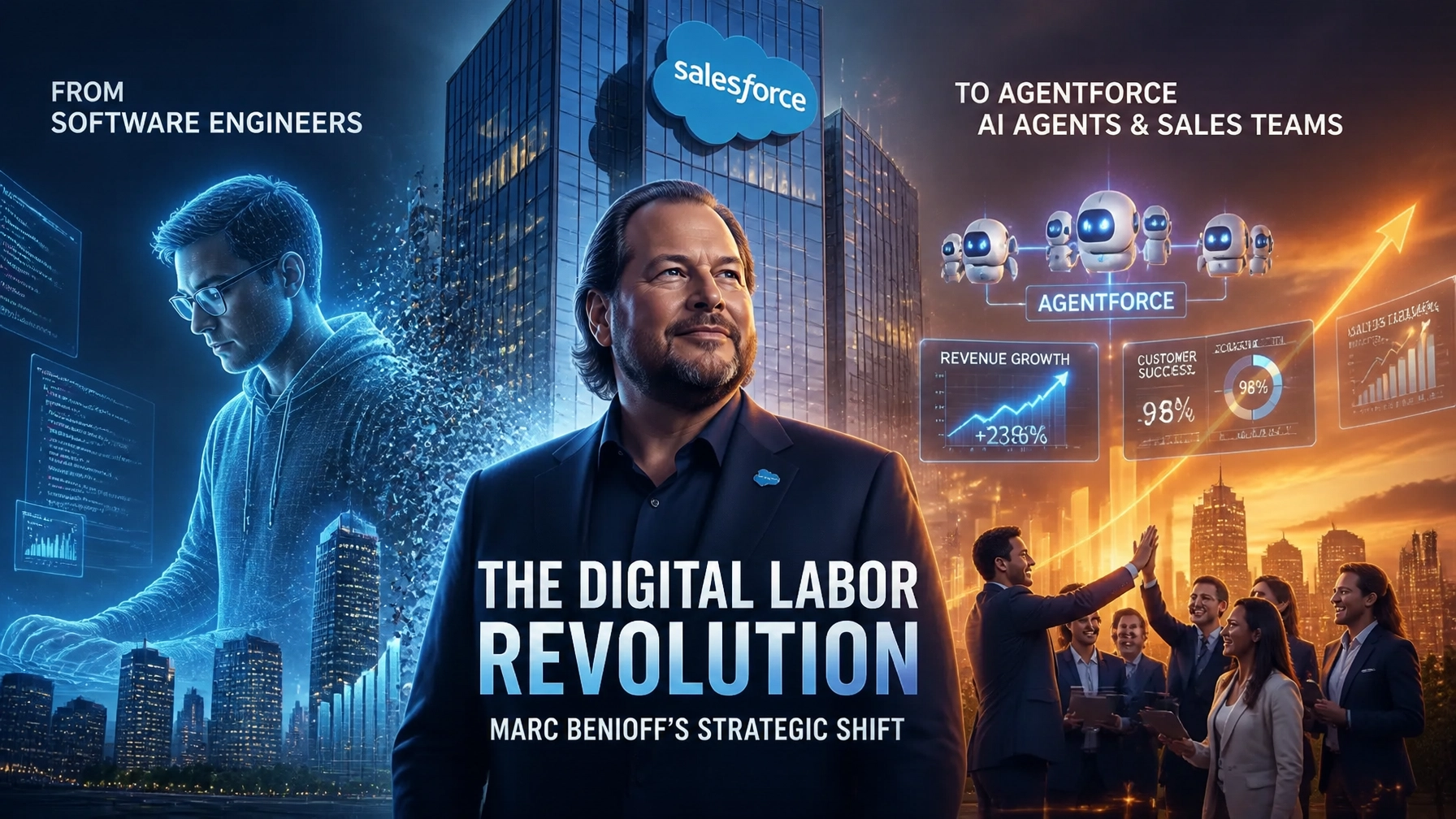
Benioff’s recent public statements have been nothing short of revolutionary. By declaring that the company will not add any more software engineers in the upcoming fiscal year, he is challenging the long-held industry belief that "more developers equals more innovation." Instead, Salesforce is betting on a "digital labor revolution" fueled by its own internal AI tools and the newly unveiled Agentforce platform.
The Digital Labor Revolution: A 30% Productivity Catalyst
The primary justification for the Salesforce engineering hiring freeze 2025 lies in the staggering productivity gains the company has already observed. According to Benioff, the integration of AI-driven coding agents and internal "agentic" systems has boosted the productivity of Salesforce’s existing engineering team by more than 30%. In a business environment where efficiency is the ultimate currency, a 30% gain essentially allows the current workforce to perform the tasks of a significantly larger organization without the overhead of additional salaries, benefits, and office space.

This shift is a prime example of how business management for startups and legacy corporations alike must evolve. When a tool can provide such a massive leap in output, the "mission" of the firm shifts from talent acquisition to talent optimization. For Salesforce, this means "revitalized" workflows where human engineers focus on high-level architecture and strategic problem-solving, while AI agents handle the repetitive, "legitimate purpose" tasks of boilerplate coding and bug fixing.
Reallocating Capital: From Code to Closing Deals
While the engineering department sees a freeze, other areas of Salesforce are experiencing a surge in investment. Benioff is not simply hoarding the savings from the engineering freeze; he is shifting those millions into aggressive go-to-market strategies. The company has announced plans to hire between 1,000 and 2,000 new salespeople specifically to drive the adoption of its AI products.
This rebalancing reflects a clear "value proposition": the technology is now so advanced that the bottleneck is no longer building the product, but rather educating the market on how to use it. Benioff has stated that humans are still essential for the "last mile" of sales: explaining complex AI transformations to C-suite executives and navigating the human nuances of a deal. As noted in recent reports by Reuters and Bloomberg, this reallocation of resources is a classic move to "democratize" AI across the enterprise, ensuring that every customer can leverage the power of "Agentforce."

For those looking at 3 covid pivots, the Salesforce transition serves as a masterclass in modern corporate agility. By pivoting from a development-heavy model to a sales-and-AI-heavy model, Salesforce is positioning itself to lead the next decade of enterprise software.
Agentforce: The Catalyst for Structural Change
At the heart of the Salesforce engineering hiring freeze 2025 is "Agentforce." This is not just another chatbot; it is a sophisticated electronic communications network of autonomous agents capable of performing complex business processes with approximately 93% accuracy. These agents are already handling the work of thousands of customer service representatives, providing "data-driven insights" and resolving issues without human intervention.

The implementation of Agentforce allows Salesforce to maintain a "journalistic" objectivity about its own workforce. If an AI agent can handle customer support or legal document review more efficiently than a human, the "mission" of the company dictates that the AI should take over. This is the "transformative solution" that Benioff is banking on. The company is even hiring 1,000 new graduates and interns "to ride the AI exponential," focusing on those who can build and manage these agentic systems rather than traditional full-stack developers.
Industry Impact: A New Precedent for Big Tech
The Salesforce engineering hiring freeze 2025 is likely the first of many such announcements from the tech elite. If a behemoth like Salesforce can achieve 30% more output with zero headcount growth in engineering, then every CTO from Silicon Valley to Bengaluru will be asking the same question: "Why are we still hiring?"
This trend may have significant implications for global tech hubs. While India remains a powerhouse for software development, as seen in the Indian startup flood, the type of talent required is shifting. The demand is moving away from manual coding and toward AI orchestration, prompt engineering, and agentic architecture.
Furthermore, the focus on "data-driven insights" and "electronic communications networks" brings new challenges in privacy and security. Just as Apple has raised concerns about sideloading, the rise of autonomous AI agents in enterprise systems will require new "legalistic terminology" and regulatory frameworks to ensure that AI-to-AI interactions remain within "legitimate purpose" boundaries.
Conclusion: The Definitive Shift in Corporate Architecture
The Salesforce engineering hiring freeze 2025 marks the end of an era where success was measured by the size of one’s engineering department. Marc Benioff has made it clear: the future of Salesforce is built on a foundation of AI efficiency, where "millions" are spent on "agentic" intelligence rather than human headcount.
This "digital labor revolution" is a definitive "catalyst for change" that will force every modern enterprise to re-examine its "mission" and "value proposition." By prioritizing the "exponential growth" of AI and the strategic reach of its sales force, Salesforce is not just surviving the AI wave: it is directing its flow. For investors, professionals, and competitors, the message is clear: the age of the developer-heavy tech giant is over; the age of the AI-integrated enterprise has begun. 🚀
As we watch this transition unfold, Business Tantra will continue to provide the latest stories and analytical perspectives on how the world’s most influential companies are "revitalizing" their business models for the 2026 landscape and beyond. 📈