



























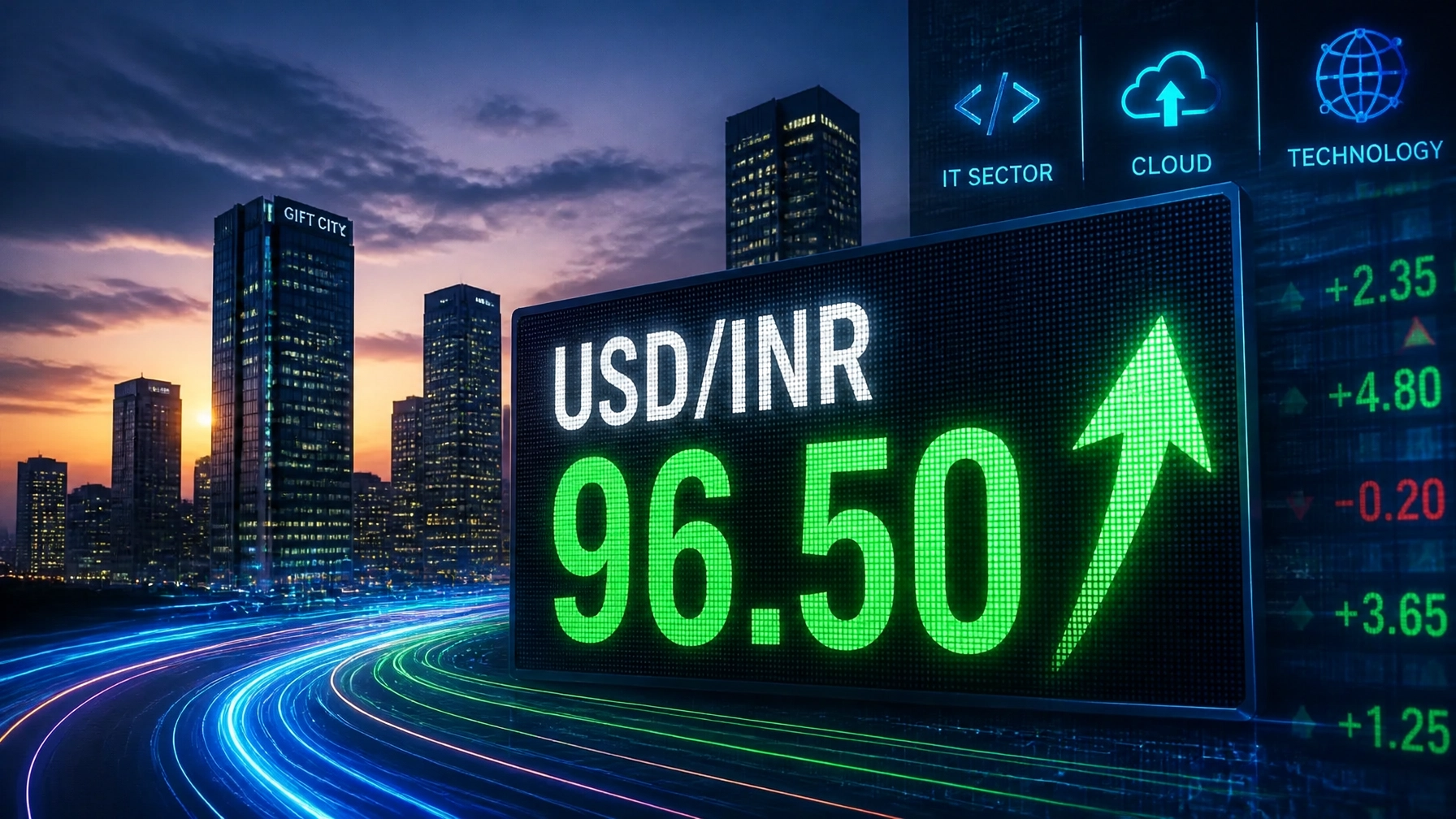

The Indian financial landscape is currently undergoing a tectonic shift as the Rupee touches a historic low of 96.5 against the US Dollar. For most sectors, this depreciation is a clarion call for caution, particularly amidst surging oil prices and geopolitical instability. However, in the realm of indian stock market news, one sector is standing resilient, basking in the glow of emerald-green tickers: Information Technology (IT).
While the broader Nifty 50 and Sensex have faced intense volatility: marking some of the most challenging sessions since early 2020: IT portfolios are witnessing a significant "revitalization." This paradox, where a weakening domestic currency acts as a massive catalyst for equity growth, is not merely a coincidence; it is the result of a sophisticated interplay between global macroeconomics and the specific revenue models of India’s tech giants.
The Mechanics of Currency Depreciation and IT Dominance
In the world of financial news india, the inverse correlation between the value of the Rupee (INR) and the performance of IT stocks is a well-documented phenomenon. To understand why your IT portfolio is turning green while the rest of the market struggles, one must look at the fundamental business architecture of companies like TCS, Infosys, and HCL Tech.
These organizations operate on a global scale, providing high-end services to clients across the United States, Europe, and the Middle East. Crucially, their contracts are typically denominated in US Dollars (USD), while their operational costs: primarily the salaries of millions of engineers in India: are paid in INR.
1. The Revenue Conversion Arbitrage
When the Rupee slides to 96.5, every dollar earned by an IT firm suddenly translates into more Rupees. For instance, a contract worth $1,000,000 that was worth ₹83,000,000 just a year ago is now worth ₹96,500,000. This ₹13.5 million difference represents pure revenue growth that requires no additional labor, no extra marketing, and no operational changes.
2. Operational Leverage and Margin Expansion
The "mission" of modern IT firms has shifted toward efficiency and data-driven insights. As the top-line grows due to currency tailwinds, the bottom-line expands even faster. Since a vast majority of their costs remain fixed in local currency, the depreciation provides an immediate boost to operating margins. This phenomenon is often referred to as "forex gains," and in the current stock market today, it is the primary driver of the sector's outperformance.

Navigating the Volatility of Stock Market Today
The current session in the stock market today is a tale of two Indias. On one hand, you have the "old economy" sectors: manufacturing, aviation, and oil marketing: which are struggling under the weight of "imported inflation." On the other hand, the "new economy" and export-oriented sectors are providing the necessary hedge for savvy investors.
Investors tracking indian stock market news have noticed that despite a massive sell-off by Foreign Institutional Investors (FIIs) in domestic cyclicals, there is a distinct "sector rotation" occurring. Capital is flowing out of high-leverage sectors and into the safety of debt-free, cash-rich IT stocks.
Why IT is the Ultimate Defensive Play
- Zero Debt Profiles: Most top-tier Indian IT firms are net cash positive, making them immune to the rising interest rates often used to combat currency depreciation.
- Global Demand Resilience: Despite the Rupee's fall, global enterprises continue to prioritize digital transformation and AI integration as essential "catalysts for change."
- Dividend Yields: With higher INR profits, these companies are likely to announce enhanced dividends and buybacks, further incentivizing long-term holding.
For more detailed analysis on market movers, you can explore the latest updates on the Business Tantra homepage or read more about us and our mission to democratize financial literacy.
The Geopolitical Context: West Asia and $110 Oil
The Rupee's descent to 96.5 is not occurring in a vacuum. It is deeply intertwined with the escalating tensions in West Asia, which have pushed crude oil prices toward the $110 mark. As India imports over 80% of its crude requirements, a higher dollar value combined with high oil prices creates a "twin deficit" pressure.

This macro environment typically leads to a "risk-off" sentiment. However, the IT sector’s ability to act as a natural dollar hedge makes it a unique beneficiary. While the Reserve Bank of India (RBI) works to manage liquidity and support the currency through legitimate purposes of intervention, the market is already pricing in the multi-quarter benefit for exporters.
Is This Growth Sustainable?
Critics often point to "hedging losses" as a potential risk. Most large IT companies use forward contracts to lock in exchange rates for future periods. If a company hedged its dollar inflows at ₹88 when the market moved to ₹96.5, it wouldn't realize the full benefit of the depreciation immediately.
However, as these older hedges expire and are replaced by new contracts at higher levels, the "exponential growth" in profitability becomes more apparent. According to data from the NSE India, the IT index has historically outperformed the broader market by significant margins during periods of sustained Rupee weakness.

Strategic Allocation: How to Rebalance Your Portfolio
In this environment, a "passive" investment strategy may not be sufficient. Investors need to be proactive in identifying which companies have the most favorable "electronic communications network" of global clients and the least exposure to local inflation.
Key Considerations for Your IT Portfolio:
- Client Concentration: Companies with a higher exposure to the US market will benefit more from the USD strength than those focused on Europe or Japan.
- Tier-1 vs. Mid-cap: While Tier-1 players like Infosys offer stability, certain mid-cap IT firms in the ER&D (Engineering Research and Development) space may offer higher "alpha" due to their specialized value propositions.
- Hedge Book Transparency: Analyze the management's commentary on their hedging policies to gauge when the full benefit of the 96.5 rate will hit the P&L statement.
The Broader Impact on Financial News India
Beyond the IT sector, the Rupee's fall serves as a reminder of the volatility inherent in emerging markets. It underscores the importance of diversifying across asset classes and geographies. For the general reader, this might mean a higher cost of international travel or imported gadgets, but for the investor, it represents a strategic opportunity to capitalize on the "data-driven insights" of the global economy.

Conclusion: A Catalyst for Change
The Rupee hitting 96.5 marks a definitive moment in India's economic journey for 2026. While the headlines may focus on the "free fall" of the currency, the astute observer of indian stock market news recognizes this as a period of profound sector rotation and opportunity.
The IT sector has once again proven its mettle as the backbone of the Indian export economy. By transforming a macro challenge into a balance-sheet strength, these firms have "revitalized" investor confidence at a time when uncertainty is at its peak. As we look toward the future, the integration of AI and the continued depreciation of the INR may well be the dual engines that drive the next leg of growth for the Indian tech industry.
Stay informed with the latest financial news india and keep your portfolio prepared for the dynamic shifts of the stock market today.