







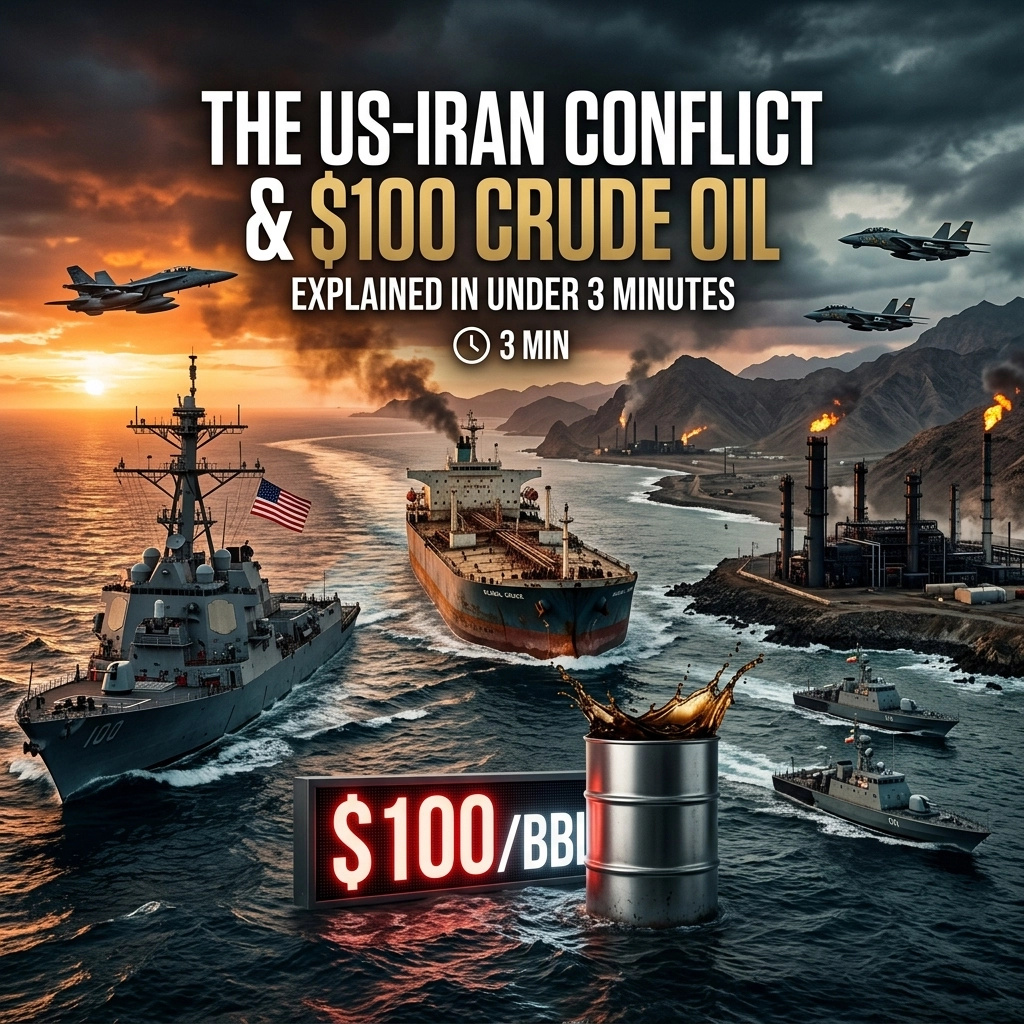



















As of May 2026, the global financial landscape is undergoing a seismic shift. If you have glanced at the latest financial news India, you have likely noticed two numbers dominating the headlines: $110 Brent crude and a Rupee trading at a historic low of 96.5 against the US Dollar. At the heart of this volatility lies the escalating geopolitical friction in West Asia.
The "West Asia Tensions" are no longer just a distant conflict discussed in diplomatic circles; they are a direct catalyst for change in how Indian households and businesses must manage their finances. With the Budget 2026 India framework now facing the heat of these external shocks, the "mission" for every investor has shifted from simple growth to strategic resilience and asset protection.
1. The Geopolitical Flashpoint: Why $110 Crude is the New Reality
The current disruption in the Strait of Hormuz: a vital artery through which approximately one-fifth of the world’s oil supply flows: has sent shockwaves through the global electronic communications network of commodity trading. Iran’s restricted traffic through this maritime corridor in early 2026 has created a physical supply vacuum that alternative pipelines simply cannot fill.
For India, this isn't just an energy crisis; it’s a fiscal one. When crude oil hovers above the $100 mark, the "value proposition" of India’s economic stability is tested. High fuel prices act as a regressive tax, trickling down into the cost of everything from logistics to the vegetables on your dinner table. This inflationary pressure is reminiscent of historical peaks where key inflation gauges forced a complete rethink of monetary policy.

2. The Rupee at 96.5: A Double-Edged Sword for Your Portfolio
The Indian business updates regarding the Rupee’s depreciation to 96.5 have caused a paradoxical reaction in the domestic markets. While a weaker currency generally signals economic stress, it has revitalized the Indian IT and export-oriented sectors.
Why Your IT Portfolio is Turning Green
If you are holding stocks in the "Big Four" IT firms or mid-cap SaaS companies, your portfolio is likely seeing significant "green" today.
- Export Earnings: Since these companies earn in Dollars and spend in Rupees, the margin expansion is massive.
- Competitive Pricing: The depreciated Rupee makes Indian services more affordable for Western clients, driving volume growth.
- Safe Haven Status: In times of high domestic inflation, export-heavy stocks serve as a natural hedge.
However, for the broader economy, this currency slide is a "legitimate purpose" for concern. It inflates the cost of essential imports: not just oil, but also the semiconductors and electronic components critical for India’s manufacturing ambitions.
3. Decoding the Budget 2026 India Pivot
The government’s Budget 2026 India strategy was originally built on a foundation of aggressive capital expenditure and a transition toward a "Viksit Bharat." However, the West Asia crisis has necessitated an immediate operational pivot. The government is now forced to balance its ambitious ₹12.2 lakh crore capex target with the need to provide a cushion against rising fuel costs.
To maintain exponential growth, the budget is moving away from broad-based subsidies and toward targeted, data-driven insights for social welfare. We are seeing an accelerated push toward energy independence. For instance, the emphasis on battery swapping schemes and green hydrogen is no longer a long-term vision; it is a current strategic necessity to democratize energy access and reduce reliance on volatile Gulf markets.
4. Sectoral Impact: Winners and Losers in the Current Crisis
Understanding the financial news India requires a granular look at how different sectors are absorbing the shock of West Asia tensions.
- Aviation and Logistics (The Underperformers): With ATF (Aviation Turbine Fuel) prices skyrocketing, airlines are facing squeezed margins. If you are an investor, this is a time for extreme caution in high-fuel-intensity sectors.
- Renewables and EV Infrastructure (The Long-term Winners): The crisis is acting as a booster for the "Clean India" mission. Companies involved in solar manufacturing and EV charging networks are seeing a surge in institutional interest.
- Agriculture and Chemicals: Rising fertilizer costs (a byproduct of high gas prices) are a concern. However, companies that have successfully revitalized their supply chains to be less gas-dependent are standing out.
5. How to Realign Your Strategy: 5 Actionable Steps
In this environment of heightened risk, your financial strategy cannot remain static. You must transition from broad industry trends to specific operational tools for your wealth.
- Rebalance for Currency Volatility: If your portfolio is 100% domestic-focused, consider increasing exposure to export-driven sectors like IT and Pharma to hedge against the Rupee at 96.5.
- Monitor the Energy Basket: Keep a close eye on Indian business updates regarding the government’s strategic petroleum reserves. Any drawdown in these reserves could provide a temporary cooling effect on prices.
- Leverage Fixed Income: With the RBI likely to maintain higher interest rates to combat oil-led inflation, debt instruments and high-yield FDs are becoming attractive again for capital preservation.
- Focus on Profitability over Growth: As we have noted in our analysis of the 2026 IPO wave, the market is no longer rewarding "growth at any cost." Cash-flow positive companies are the new "safe havens."
- Stay Informed via Video News: In a fast-moving geopolitical crisis, traditional print media is often too slow. Utilize real-time video news updates to track the Strait of Hormuz situation minute-by-minute.

6. The "Mission" of Energy Diversification
One of the most transformative solutions proposed in recent policy discussions is the aggressive diversification of India’s crude sources. By moving away from a Middle-East-centric supply chain and tapping into discounted barrels from Russia and Venezuela, India is attempting to create a "geopolitical buffer."
This structural shift is a cornerstone of the Budget 2026 India vision. By investing in dedicated freight corridors and e-bus fleets (as seen in the latest Mission Purvodaya updates), the government is working to decouple India's GDP growth from oil consumption. The goal is simple: an India where a spike in West Asia tensions doesn't automatically mean a collapse in the common man's budget.
Conclusion
The tensions in West Asia serve as a stark reminder that in a globalized economy, "security" is a multifaceted concept. It is not just about borders; it is about energy, currency, and the resilience of our financial institutions. While the Rupee at 96.5 and $110 crude present significant challenges, they also present a unique opportunity for savvy investors to pivot toward sectors that define the future of the Indian economy.
The Budget 2026 India is no longer a static document but a living strategy that must adapt to a world of "permacrisis." By staying tuned to the latest financial news India and maintaining a disciplined, analytical approach to your portfolio, you can navigate these turbulent waters. The current volatility is not just a threat; it is the ultimate catalyst for change in how we perceive value and growth in the new era.