


























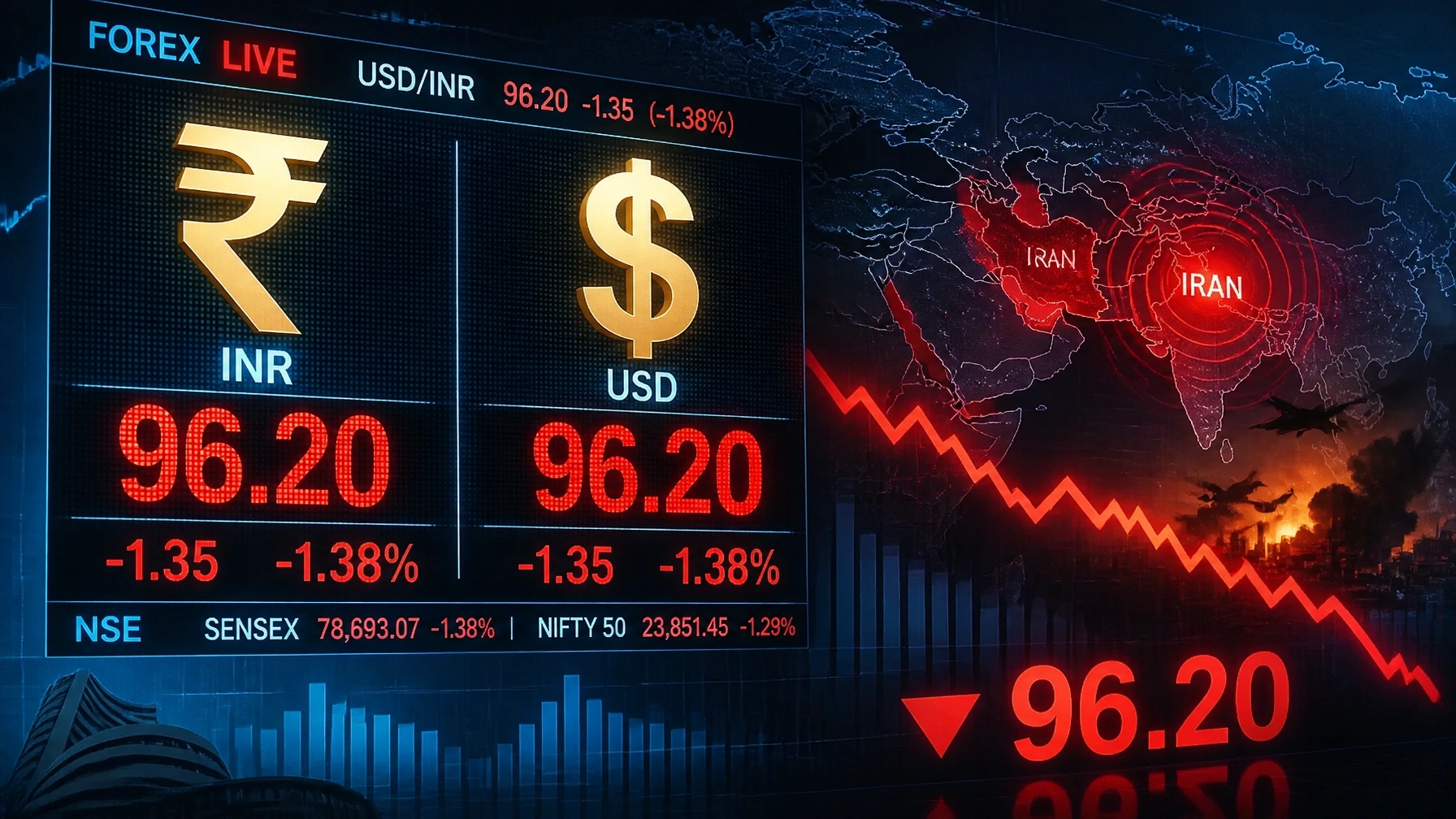

The Indian financial landscape is currently navigating a period of unprecedented volatility as the Indian Rupee (INR) plummeted to a historic low of 96.20 against the US Dollar on Monday. This decline represents a staggering 5.5% depreciation since the onset of the conflict in the Middle East, marking a critical juncture for the economy of India. As geopolitical tensions escalate, the ripple effects are being felt across every sector, from the local petrol pump to the high-rise boardrooms of Mumbai’s financial district.
For market observers and policymakers, the breach of the 96.00 psychological barrier is more than just a numerical milestone; it is a catalyst for change in how India manages its external vulnerabilities. The suddenness of the slide has sent shockwaves through the markets, prompting urgent discussions on fiscal resilience and the long-term sustainability of India's current account deficit.
The Geopolitical Catalyst: Iran War and Global Risk Aversion
The primary driver behind this currency freefall is the intensifying conflict in West Asia. Since the war involving Iran began, global investors have retreated into "safe-haven" assets, primarily the US Dollar and gold. This "risk-off" sentiment has triggered a mass exodus of Foreign Portfolio Investment (FPI) from emerging markets, with India being no exception.
Geopolitical instability in the Strait of Hormuz: a vital artery for global energy trade: has injected a premium of uncertainty into the markets. As a major importer of crude oil, the economy of India is uniquely sensitive to disruptions in this region. The threat of a prolonged conflict has led to a sharp appreciation of the Dollar Index (DXY), which tracks the greenback against a basket of major currencies, leaving the Rupee struggling to find its footing.

Oil Prices and the "Imported Inflation" Trap
The most immediate and visceral impact of the Rupee's decline is seen in the energy sector. With Brent crude hovering near $111 per barrel, India’s oil import bill is ballooning in Rupee terms. Since India imports approximately 85% of its crude requirements, a weaker currency acts as a multiplier for inflation.
When the Rupee depreciates by 5.5% in such a short window, the cost of every liter of fuel, every kilogram of fertilizer, and every ton of plastic resin imported into the country rises. This phenomenon, known as "imported inflation," is a significant threat to the purchasing power of the Indian consumer. According to recent Indian business updates, the logistics and transportation sectors are already bracing for a series of price hikes that could revitalize the dormant inflationary pressures seen in early 2025.
Impact on the Economy of India: A Sectoral Analysis
The depreciation of the Rupee creates a complex landscape of winners and losers across the Indian corporate spectrum.
- Manufacturing and Logistics: Companies in the industrial sector are facing a dual crisis. Not only are their raw material costs (many of which are dollar-denominated) rising, but their energy expenses are also skyrocketing. This squeeze on margins is likely to result in a slowdown in capital expenditure as firms prioritize survival over expansion.
- Information Technology and Pharma: Traditionally, a weaker Rupee is seen as a boon for exporters like IT services and pharmaceutical giants. Since these firms earn in Dollars and spend in Rupees, the 5.5% slide translates directly to improved bottom lines. However, this silver lining is clouded by the global risk-off sentiment, which may lead to reduced discretionary spending by Western clients.
- The Consumer Goods Sector: From electronics to edible oils, the cost of imported components is rising. This is likely to democratize the pain of the currency fall, as brands pass on these costs to the end-consumer, further dampening domestic consumption.

RBI’s Strategic Intervention: Holding the Line
The Reserve Bank of India (RBI) has not been a silent spectator. As the Rupee approached the 96.20 mark, the central bank reportedly intervened in the non-deliverable forward (NDF) and spot markets to curb excessive volatility. By utilizing its substantial foreign exchange reserves, the RBI aims to provide a "cushion" rather than defending a specific level, ensuring that the depreciation remains orderly.
Furthermore, the RBI has tightened rules regarding banks' net open positions to prevent speculative attacks on the currency. According to official data from the Reserve Bank of India, these data-driven insights are crucial for maintaining market confidence during periods of extreme geopolitical stress. The central bank’s mission remains clear: protect the internal value of the Rupee while allowing the external value to adjust to global realities.
Indian Business Updates: Navigating Volatility
For entrepreneurs and business leaders, the current environment demands a sophisticated approach to risk management. Hedging strategies that were once considered optional are now a necessity for any firm with significant import exposure.
The new wave of Indian entrepreneurs is increasingly turning to sophisticated financial instruments to lock in exchange rates. In the current climate, "wait and watch" is no longer a viable strategy. Businesses must actively monitor international news and regional developments to stay ahead of the curve.

The Long-Term Structural Shift
While the current crisis is triggered by war, it highlights a structural vulnerability in the economy of India: our dependence on foreign energy and volatile capital flows. The government’s push for "Atmanirbhar Bharat" (Self-Reliant India) has never been more relevant. Transitioning toward renewable energy and attracting more stable Foreign Direct Investment (FDI) over flighty Portfolio Investment (FPI) are the only long-term solutions to currency stability.
The move toward settling international trade in Rupees: a strategy gaining traction in recent years: is another potential "catalyst for change." If India can successfully transition more of its trade to bilateral currency arrangements, the dominance of the US Dollar over the domestic economy could eventually be diluted.
Conclusion: A Test of Resilience
The fall of the Rupee to 96.20 is a stark reminder of how interconnected the economy of India is with global geopolitical events. While the 5.5% drop since the start of the Iran war is significant, India enters this period of turbulence with stronger foreign exchange reserves and a more robust regulatory framework than in previous decades.
The immediate future will undoubtedly be challenging. Higher inflation, wider trade deficits, and market volatility are the prices of a globalized world in conflict. However, the mission for Indian businesses and policymakers is clear: utilize this period to build more resilient, self-reliant systems that can withstand the exponential growth of global risks.
As we monitor the latest Indian business updates, the focus remains on the "value proposition" of the Indian market: a market that, despite the currency headwinds, remains one of the fastest-growing major economies in the world. Whether this record low is a temporary dip or a new baseline depends entirely on the duration of the conflict and the effectiveness of India’s policy response.

For more in-depth analysis and the latest stories on the Indian markets, stay tuned to Business Tantra’s Economics section.