



























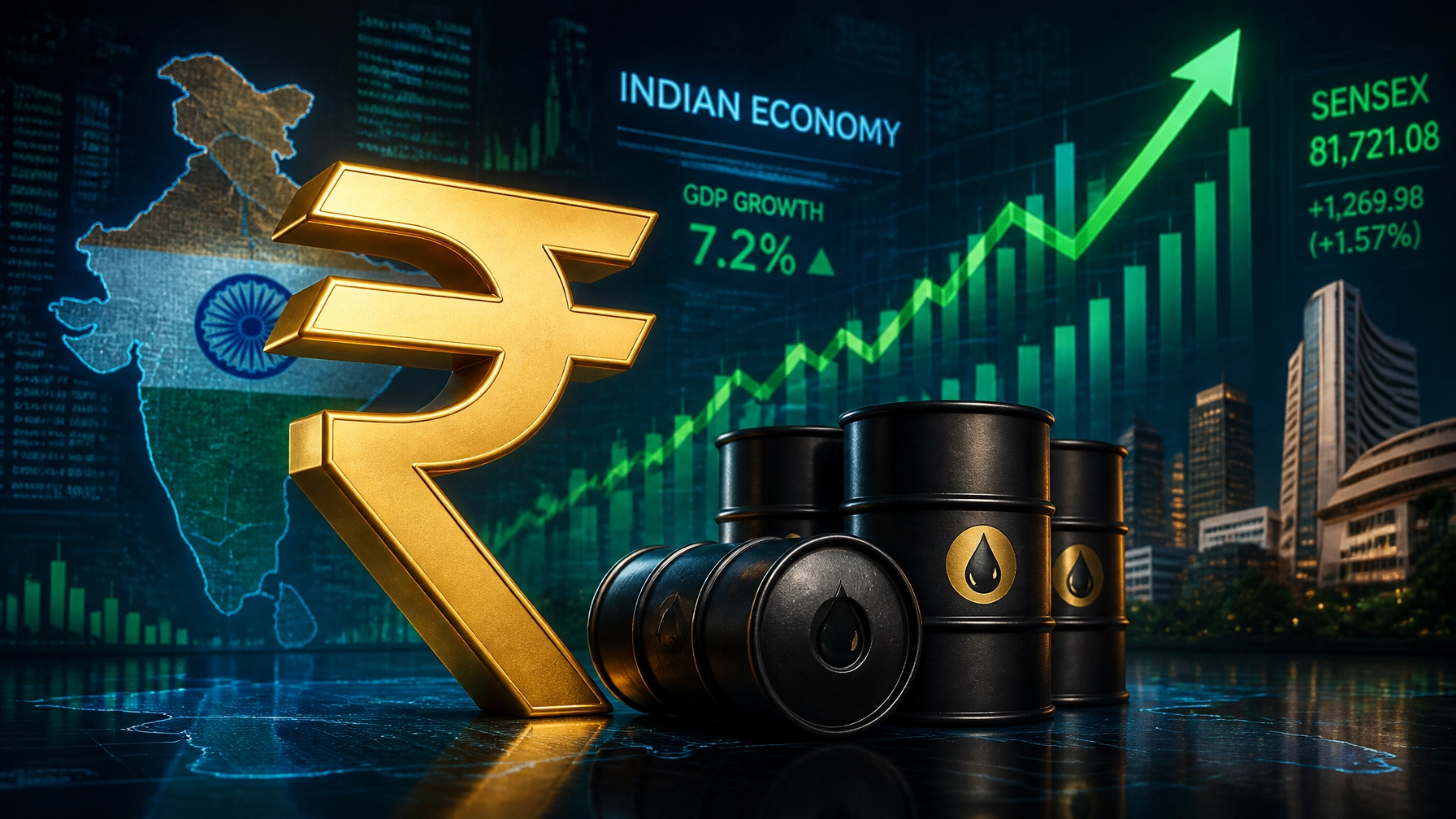

The economy of india demonstrated remarkable resilience on June 25, 2026, as the Indian Rupee (INR) navigated a complex global landscape to conclude the trading session with modest gains. In an environment characterized by a surging US Dollar Index and shifting geopolitical dynamics, the local currency found a firm footing, bolstered by a significant retreat in global crude oil prices and a revitalized influx of foreign capital.
Opening the day on a positive note, the rupee surged by approximately 31 paise in early trade, touching a high of 94.24 against the greenback. While intraday volatility, driven by corporate dollar demand and standard month-end adjustments, tempered some of these gains, the currency ultimately settled within the 94.40–94.65 range. This performance marks a notable recovery from the technical lows witnessed in late May, positioning the rupee as a resilient performer among its emerging market peers.
The Crude Oil Catalyst: A Reprieve for the Trade Deficit
A primary driver behind the rupee’s appreciation today was the dramatic correction in global energy markets. Brent crude, the international benchmark, experienced a sharp decline, plummeting to approximately $72.50 per barrel. This represents a staggering 10% decrease within the current week and a cumulative 21% drop over the last month. For the economy of india, which remains one of the world's largest net importers of crude oil, this downward trajectory acts as a powerful catalyst for change.
Lower energy prices directly alleviate the pressure on India’s import bill, which historically has been a significant drain on foreign exchange reserves. When crude prices soften, the demand for dollars by state-run oil marketing companies (OMCs) diminishes, thereby reducing the structural depreciation pressure on the INR. Furthermore, this decline in input costs provides a disinflationary impulse, allowing the Reserve Bank of India (RBI) more room to maneuver in its pursuit of price stability and sustainable growth.
Analysts at Business Tantra suggest that if Brent crude sustains its current trajectory towards the $60-$70 range predicted by some global research houses, the rupee could see a period of prolonged stability, revitalizing investor confidence across various sectors.

Foreign Inflows and Revitalized Market Sentiment
The movement of the rupee is inextricably linked to the ebb and flow of foreign institutional investment (FII). Despite a challenging global macro backdrop where the US Dollar Index hovered near a 13-month high of 101.5, the Indian markets witnessed a tactical shift in sentiment. While FIIs remained net sellers in the prior session: offloading shares worth ₹1,843.4 crore: the early hours of June 25 saw a pivot towards renewed accumulation.
This influx of capital is not merely a reaction to technical oversold conditions but a reflection of the long-term value proposition offered by the economy of india. Foreign investors are increasingly looking past short-term volatility to capitalize on India’s structural reforms, demographic dividend, and digital transformation. The democratization of credit and the expansion of the electronic communications network have made the Indian financial ecosystem more transparent and accessible to global players.
The current trend suggests that as long as domestic growth remains robust and the central bank maintains its hawkish yet pragmatic stance, India will continue to attract high-quality, long-term capital. This data-driven insight is crucial for understanding why the INR managed to end the day "a tad higher" despite the overwhelming strength of the dollar on the global stage.
Central Bank Vigilance: The RBI’s Strategic Intervention
No analysis of the Indian rupee is complete without acknowledging the role of the Reserve Bank of India. Market participants noted that state-run banks were active on behalf of the central bank during today's session, particularly when the rupee faced selling pressure near the 94.60 level. This strategic intervention is a cornerstone of India's exchange rate management policy, aimed at curbing excessive volatility rather than targeting a specific level.
By utilizing its vast foreign exchange reserves, the RBI ensures that the currency does not experience "exponential growth" in volatility, which could disrupt trade and investment. This "legitimate purpose" of stabilizing the currency fosters a predictable environment for businesses engaged in international trade. The central bank’s actions today serve as a reminder of its commitment to maintaining the INR's credibility as a stable medium of exchange within the global financial architecture.
For those tracking the latest developments in central banking, our Economics section provides deep dives into the RBI’s evolving toolkit in 2026.

Impact on the Stock Market Today: Bulls Regain Control
The positive momentum in the currency market was mirrored in the equity space. The stock market today witnessed a significant rally, with the BSE Sensex climbing 440 points and the NSE Nifty 50 gaining 138 points. The correlation between a stable rupee and a bullish equity market is well-documented; a stronger currency enhances the dollar-denominated returns for foreign investors, making Indian stocks more attractive.
Key sectors, particularly those sensitive to import costs like chemicals, paints, and aviation, were the primary beneficiaries of the "oil slide." The easing of input price pressures is expected to bolster corporate margins in the upcoming quarters, a narrative that resonated strongly with market participants today.
Furthermore, the rise in the stock market today was supported by the broader optimism surrounding India’s macroeconomic indicators. With the manufacturing sector showing signs of expansion and the services sector remaining resilient, the underlying strength of the economy of india continues to provide a safety net for both equity and currency markets.
Navigating the Road Ahead: A Journalistic Perspective
As we look toward the remainder of 2026, the trajectory of the rupee will likely be determined by a trio of factors: the Federal Reserve's interest rate path, the stability of global energy markets, and India's ability to maintain its growth momentum. While the dollar index at 101.5 presents a formidable challenge, India’s improved external sector vulnerabilities: manifested through narrower current account deficits and robust forex reserves: position the INR to weather potential storms.
The transition from abstract global trends to concrete operational tools is evident in how Indian corporations are managing their currency exposure. The use of sophisticated hedging instruments and a focus on data-driven insights have allowed businesses to mitigate the impact of exchange rate fluctuations, ensuring that the economy of india remains on its path to becoming a $7 trillion powerhouse.
Conclusion
In summary, the Indian rupee's performance on June 25, 2026, is a testament to the nation's strengthening economic fundamentals. By ending a tad higher against a backdrop of global dollar dominance, the INR has signaled that domestic factors: specifically the sharp decline in crude oil prices and the resilience of the stock market today: are currently outweighing external pressures.
The RBI's timely intervention and the steady inflow of foreign capital underscore a professional and authoritative approach to market management. As the economy of india continues to evolve, staying informed through timely, high-quality analysis is essential. At Business Tantra, we remain committed to providing our readers with the most accurate and insightful coverage of the stories that move the needle in the Indian corporate landscape.